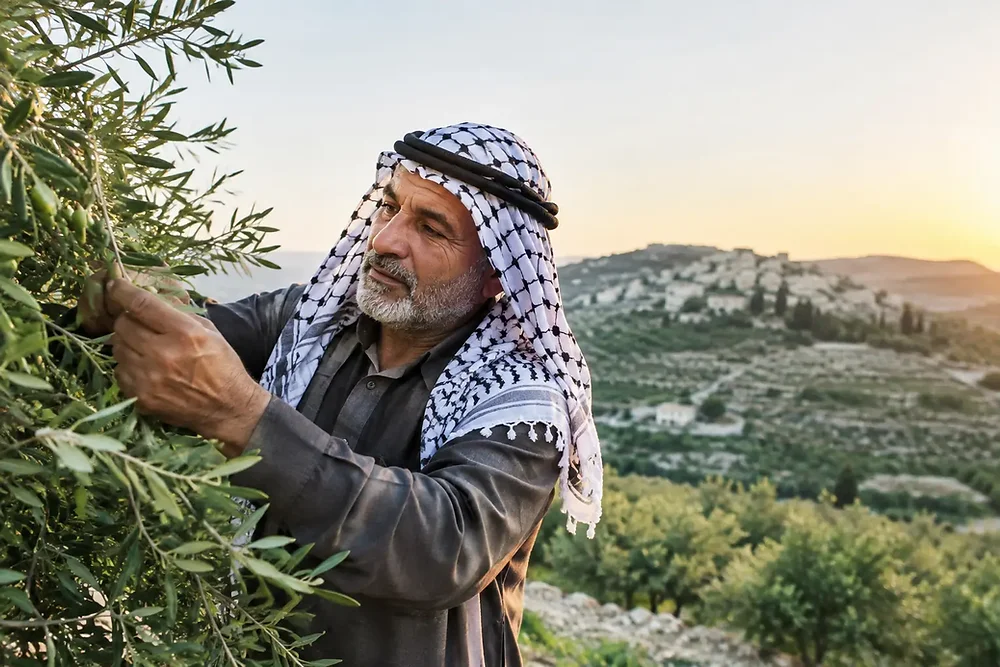
A silver-green olive leaf catching the morning light can look ordinary from a distance. For the family tending the grove, it may represent decades of pruning, watching the weather, protecting the soil, and returning each season to work that cannot be rushed. Palestinian farmer stories begin in moments like this: close to the land, shaped by patience, and carried forward through practical knowledge passed between generations.
For people who care about what they put on their skin, diffuse in their homes, or bring to the table, provenance is more than a label. It is a way to understand quality. A bottle of olive oil, a bundle of za’atar, or a precious drop of Barbary fig seed oil holds a long chain of decisions: when a plant is gathered, how it is dried, whether it is pressed gently, and how carefully its character is preserved.
Palestinian Farmer Stories Are Stories of Attention
Palestinian agriculture is often described through its signature crops, especially olives. Yet the landscape is also home to aromatic herbs, hardy seeds, wildflowers, figs, grapes, almonds, and plants that have long been used in household care. Farmers learn the particular behavior of their plots: which slope dries first, where a plant grows most fragrant, when a late rain may change a harvest, and which old tree needs extra care.
That attention is a form of expertise. It does not sit apart from modern standards of purity and testing. At its best, traditional knowledge gives careful sourcing its starting point. A grower or forager can recognize a plant at its right stage, while responsible processing helps retain the constituents, aroma, and texture that make the finished botanical worth seeking out.
Consider Origanum syriacum, the beloved herb associated with za’atar. Its bright, savory scent is tied to meals, hospitality, and family kitchens, but its quality also depends on the harvest. Leaves must be selected and dried with care so their essential character remains vivid rather than dusty or flat. The same principle applies to aromatic oils: the plant material, timing, and extraction method all influence the result.
What the Harvest Teaches Us About Purity
Natural does not automatically mean consistent. Weather, elevation, soil conditions, and handling can affect every crop. That is why meaningful botanical sourcing requires both respect for the grower and real quality controls. A premium plant oil should be stored and handled in a way that protects its freshness. An essential oil should be thoughtfully extracted and evaluated for identity and purity. Culinary herbs deserve clean, careful preparation as much as skincare ingredients do.
This is where the farmer’s role becomes especially meaningful. Their work is not simply to supply raw material. It is to make countless judgment calls before a product ever reaches a bottle or jar. They know that harvesting too early can sacrifice aroma, while harvesting too late can diminish vitality. They know when rainfall has been sparse, when a tree has given generously, and when the land needs rest.
For the wellness-minded customer, this offers a more useful way to think about efficacy. The story behind a botanical is not a substitute for good formulation, appropriate use, or safety testing. It is one part of the whole. But it is an essential part. The care evident at the beginning of the process can shape the sensory richness and integrity experienced at the end.
Olive Trees and the Long View
Olive cultivation asks for a long view. Trees can live for generations, yet each season brings new variables: heat, rainfall, pests, labor, and the narrow window in which fruit must be gathered. The best extra-virgin olive oil is not only a pantry staple. It is the result of timing and discipline, from the grove to the mill.
Its flavor can be grassy, peppery, soft, or fruit-forward, depending on variety and harvest conditions. Those variations are not defects when the oil is fresh and well made. They are part of what makes a regional food feel alive. In a simple dish, a finishing pour of Palestinian olive oil can bring depth to lentils, roasted vegetables, labneh, or warm bread without asking for much else.
Small Seeds, Exacting Work
زيت بذور التين البربري tells a different agricultural story. The seeds are small, and the yield is naturally limited. Producing a refined oil from them requires significant plant material and meticulous handling. That labor is part of why the oil is treasured in high-performance skincare rituals.
Its light feel makes it especially appealing for dry-looking or depleted skin. Press a few drops into slightly damp skin after cleansing, or blend it with a simple moisturizer to support a more nourished finish. As with any botanical skincare product, individual skin can respond differently. Patch testing first is a sensible ritual, particularly for sensitive or reactive skin.
From Wild Herbs to a Home Ritual
Not every plant is cultivated in neat rows. Some of Palestine’s most evocative botanicals are associated with hillsides, seasonal growth, and skilled wildcrafting. Wild harvesting can honor local ecological rhythms when it is done thoughtfully: gathering only what the landscape can replenish, avoiding vulnerable areas, and respecting plant identification and seasonality.
Helichrysum, pine, and traditional herbs invite a different kind of connection to place. Their aromas are not generic floral or forest notes. They can be dry, resinous, herbaceous, warm, or sharply green. In a diffuser, a carefully chosen essential oil can change the character of a room, creating a quiet pause at the end of a crowded day.
Use essential oils with restraint. Diffuse according to the product directions in a well-ventilated space, and dilute topical blends appropriately in a carrier oil. Avoid applying undiluted essential oils directly to skin, and take extra care around children, pets, pregnancy, and known sensitivities. A beautiful plant deserves knowledgeable use.
The Human Value Behind a Better Purchase
Farmer stories can be romanticized, and that does no one a service. Agricultural work is skilled, physically demanding, and vulnerable to forces beyond a farmer’s control. Seasonal uncertainty, changing markets, water access, transport, and the practical costs of cultivation all shape rural livelihoods. Supporting heritage-based agriculture should mean recognizing that complexity, not reducing it to a picturesque label.
Still, there is real dignity in choosing products whose value begins with growers and makers rather than anonymous commodity supply. When a customer seeks traceable Palestinian botanicals, she is choosing more than a scent profile or an ingredient trend. She is making room for regional knowledge in a marketplace that often rewards sameness.
That choice can be small and personal. It might look like setting out za’atar and olive oil for guests, reaching for black seed oil as part of a simple hair ritual, or giving a botanical gift with a story attached. It can also be discerning: asking how an ingredient was sourced, whether a formula is transparent, and whether the product’s claims match what it can responsibly offer.
At PALINOVA, that connection is central to the idea of wellness. Palestinian botanicals are not treated as interchangeable raw materials. They are gifts of the earth, shaped by distinct terrain, seasoned hands, and traditions that continue because people keep practicing them.
Let the Story Change the Ritual
The most enduring Palestinian farmer stories are not only about resilience. They are about continuity: a family returning to the grove, an herb gathered at the right moment, a seed carefully pressed, a recipe made the way it has been made for years. These details carry meaning because they are useful, lived, and repeated.
The next time you open a fragrant jar of za’atar, smooth a plant oil over your skin, or breathe in a resinous botanical aroma, pause for the work behind it. Let that knowledge make the ritual slower, more intentional, and more connected to the soil from which it came.