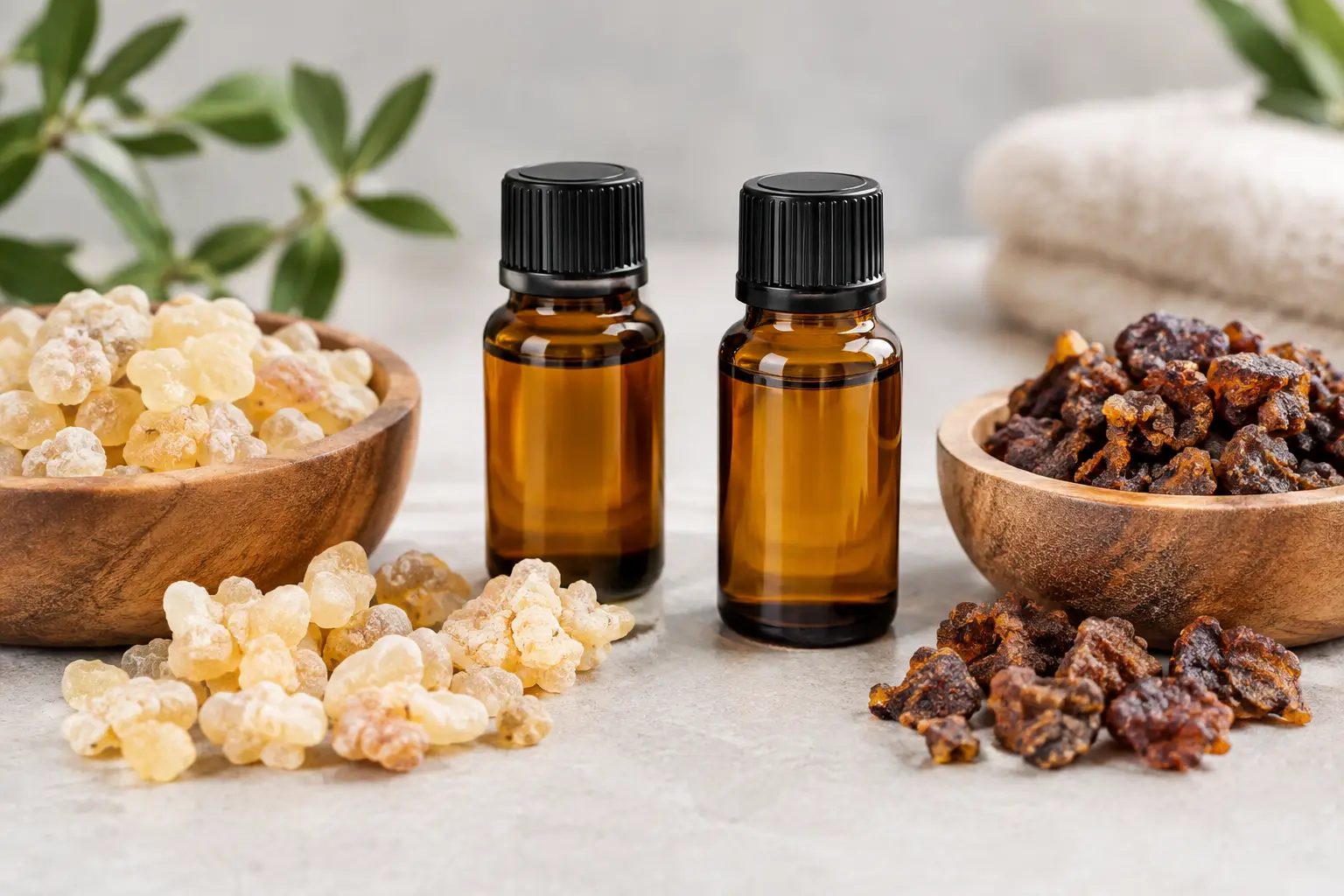
A drop of resin oil can change the character of an evening ritual. Frankincense feels clear, dry, and quietly uplifting; myrrh is darker, warmer, and more balsamic. When choosing frankincense oil versus myrrh oil, the better choice is not about which ancient resin is more celebrated. It is about the experience you want from your diffuser, your skin ritual, and the botanical story you want to bring home.
Els dos olis procedeixen de resines d'arbres aromàtics amb arrels profundes en les cultures i les rutes comercials de l'Orient Mitjà i del nord d'Àfrica. Els seus aromes han format part durant molt de temps de la pregària, de l'hospitalitat, de l'ornament personal i de la cura estacional. Tanmateix, no són intercanviables. Els seus perfils olfactius, textures i millors usos són prou diferents perquè moltes llars es beneficiïn de tenir tots dos a mà.
Oli d'encens contra oli de mirra: la diferència essencial
L'oli essencial d'encens es destil·la a partir de la resina recol·lectada dels arbres del gènere Boswellia. Segons l'espècie i l'origen, pot tenir una olor cítrica, de pi, lleugerament picant o suaument fustada. En aromateràpia, sovint es tria per a moments que demanen espai: respiració lenta, concentració tranquil·la, meditació o un moment de descans després d'un llarg dia.
L'oli essencial de murra procedeix de la resina dels arbres del gènere Commiphora. Té un aroma més ric i envolvent, amb matisos terrosos, fumats, lleugerament herbacis i resinosos. Pot resultar especialment reconfortant en una barreja de nit o en un ritual de cura corporal pensat per alentir el ritme del dia.
La diferència es nota fàcilment a l'aire. L'encens s'eleva. La mirra es posa a terra.
Aquesta distinció també explica per què l'encens sovint és la primera compra més versàtil per a qui vol començar una col·lecció d'olis essencials. El seu caràcter de resina lluminosa es combina fàcilment amb cítrics, fusta de cedre, lavanda o pi palestí. La mirra és més aviat una nota de acabat: preciosa, molt distintiva, i ideal quan es busca calidesa i profunditat més que frescor.
La resina no és el mateix que l'oli essencial
Això és útil saber quan es compren qualsevol de les dues plantes. Les resines senceres d'encens i de mirra són materials aromàtics que es poden cremar com a encens, mentre que els olis essencials són extractes volàtils concentrats, que normalment s'obtenen per destil·lació amb vapor. Ofereixen experiències olfactives diferents i s'han d'utilitzar de manera diferent.
A bottle labeled “frankincense oil” can also mean a resin-infused carrier oil rather than a pure essential oil, depending on the maker. Read the ingredient panel closely. For aromatherapy and diffuser use, choose a clearly labeled, pure essential oil from a brand that can speak to its botanical source and extraction standards. For direct facial application, a properly formulated diluted oil is usually the more appropriate choice.
Choose Frankincense When You Want Clarity and Ease
Frankincense has a refined, meditative presence without being overly sweet or floral. It suits a morning shower, a work-from-home diffuser, or the few quiet minutes between responsibilities. Its scent can make a familiar room feel more intentional, like opening a window onto dry hillsides and sun-warmed wood.
In skincare rituals, frankincense is often appreciated by people seeking a balanced, less cluttered routine. Add it only in low dilution to a carrier oil or unscented body product, never directly from the bottle. A simple facial massage blend can pair one drop of frankincense essential oil with one teaspoon of a nourishing plant oil, such as jojoba or Oli de llavor de figa de moro. The goal is sensory care and a comfortably conditioned feel, not a miracle promise.
Frankincense is also a natural fit for a shared space. Its aroma is generally more approachable than myrrh’s for daytime diffusing, especially when softened with sweet orange, bergamot, or a gentle floral note. Start small. Two or three drops in a water-based diffuser are often enough for a modest room.
Choose Myrrh When You Want Warmth and Depth
Myrrh has a more intimate personality. It can smell almost ancient in the best sense: amber-like, earthy, and quietly bittersweet. If frankincense is the clear opening breath, myrrh is the warm exhale.
It shines in evening rituals, particularly during colder or drier months when skin and senses may both crave extra comfort. Blended into a body oil at a careful dilution, myrrh can lend a luxurious scent to a post-shower massage of elbows, knees, hands, and feet. Its deep profile also works beautifully with vanilla-like botanical notes, sandalwood, cedarwood, or a little frankincense to lift the blend.
Myrrh is less forgiving in a diffuser if you use too much. One or two drops can be plenty, especially in a small bedroom. Its natural heaviness is its beauty, but it may not be what you want before a busy morning or in a room shared with people who prefer lighter fragrances.
For dry-feeling skin, the carrier oil matters most
Both frankincense and myrrh are frequently included in products for mature, dry, or dull-looking skin. But essential oils are not moisturizers on their own. A well-chosen carrier oil does the practical work of reducing moisture loss and improving slip, while the essential oil adds aroma and a sensory dimension to the ritual.
For a face oil, keep dilution especially conservative. One drop of essential oil in two teaspoons of carrier oil is a gentle place to begin. For body use, you may use a slightly stronger dilution, but there is no benefit to making a blend intensely fragrant. Premium botanicals deserve restraint.
Those with easily reactive skin may prefer to enjoy these oils through diffusion or a personal inhalation ritual rather than facial use. Patch test every new blend on a small area of skin and wait 24 hours. Stop using it if redness, itching, or discomfort occurs.
Can You Blend Frankincense and Myrrh Together?
Yes. Together, frankincense and myrrh create a full resin accord: bright enough to breathe in, deep enough to linger. This is the pairing to reach for when you want a ritual that feels rooted rather than merely scented.
For a diffuser, begin with two drops of frankincense and one drop of myrrh. For a body oil, blend one drop of each into two tablespoons of carrier oil. The frankincense keeps the fragrance from becoming too dense, while myrrh brings a warm, enduring base.
This combination is especially meaningful for people drawn to botanicals as more than ingredients. Resin oils carry the memory of patient harvesting, sun, dry air, and skilled hands. In Palestinian homes and across the wider region, fragrance has never been separate from care, welcome, and tradition. It belongs to the atmosphere of daily life.
Purity, Origin, and What to Look For
A beautiful label is not proof of a beautiful oil. Resin oils vary by species, harvest conditions, distillation method, and storage. Look for transparent naming, a complete ingredient declaration, and guidance on proper use. The oil should be stored in dark glass, away from heat and direct sunlight, because aromatic compounds gradually change when exposed to light and air.
Scent alone is not a reliable purity test. Authentic frankincense and myrrh can vary from batch to batch because plants are living materials. Still, an oil should smell dimensional rather than flat, harsh, or perfume-like. If a supplier makes sweeping medical claims or suggests applying undiluted oil everywhere, consider that a warning sign.
PALINOVA approaches botanical care with respect for provenance, purity, and the knowledge carried through generations. That perspective matters: a plant’s story includes the soil, the people who tend and gather it, and the practices used to preserve its character.
Essential Oil Safety for Everyday Rituals
Use both oils externally and aromatically only unless a qualified healthcare professional specifically advises otherwise. Do not ingest essential oils, add them to drinking water, or use them undiluted on skin. Keep them away from eyes, inner ears, and mucous membranes.
If you are pregnant, breastfeeding, managing a medical condition, taking medication, or choosing oils for a child, speak with a qualified clinician before use. Myrrh is traditionally approached with particular caution during pregnancy. People with asthma, fragrance sensitivity, or allergies should diffuse in a well-ventilated space and stop if breathing feels irritated.
Keep bottles securely closed and out of reach of children and pets. A ritual should feel restorative from the first inhale to the last detail of care.
The simplest way to choose is to follow the mood you want to create. Reach for frankincense when you want to clear space, steady your breath, and begin again. Choose myrrh when you want to slow down, soften the edges of the day, and stay close to the earth. Used thoughtfully, either oil can make an ordinary pause feel like a gift of the earth.