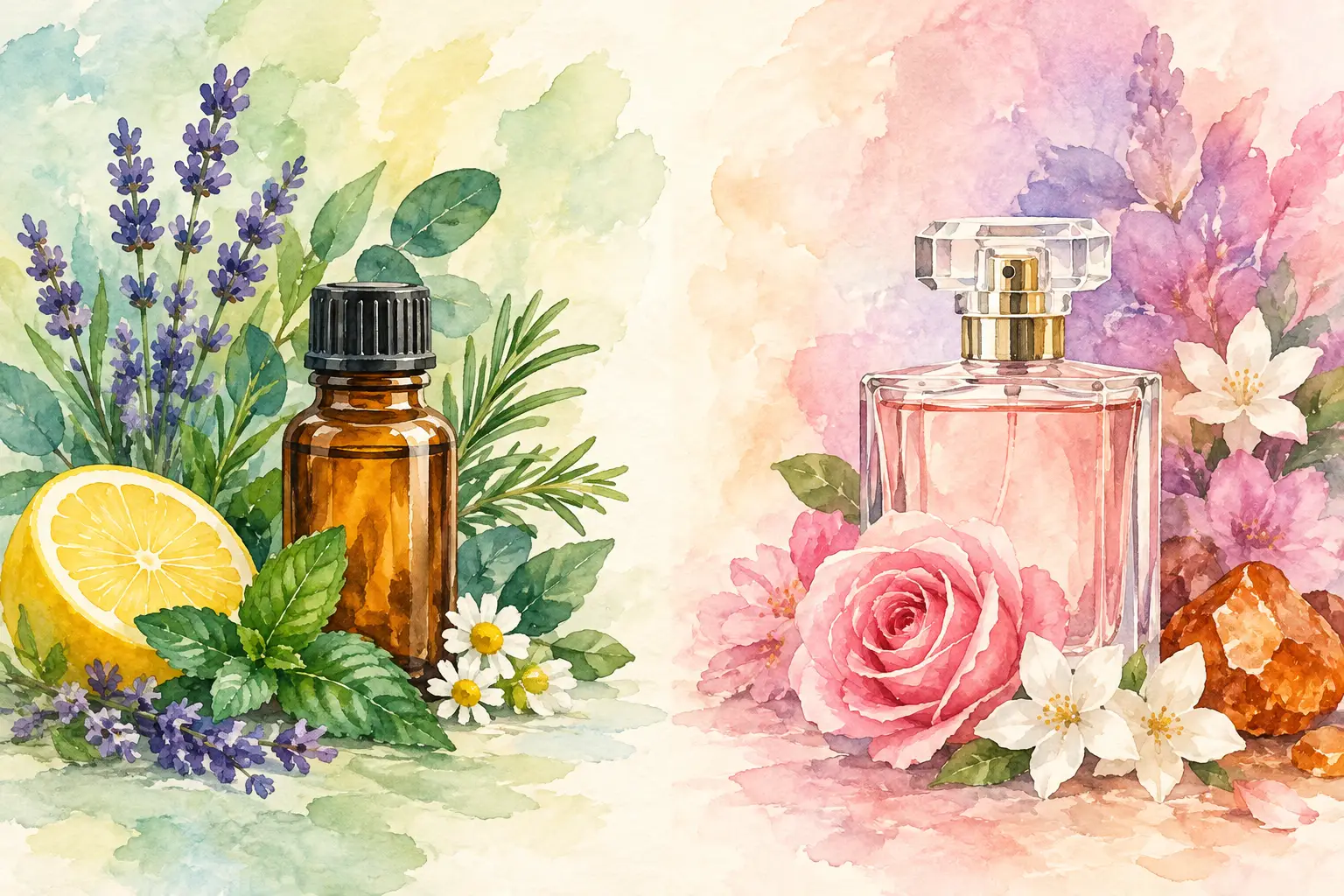
A bottle can smell like a sun-warmed orange grove, fresh-cut cedar, or a bouquet in full bloom. Yet scent alone does not tell you what is inside. When choosing between essential oils versus fragrance oils, the meaningful difference lies in origin, composition, intended use, and how the oil fits into your ritual.
For those drawn to clean beauty, botanical care, and the living character of plants, this distinction matters. A true botanical aroma carries the particular place, season, and plant material from which it came. A fragrance oil is created to deliver a scent experience, often with greater consistency and staying power. Neither belongs in every application. The right choice depends on what you want your scent to do.
Huiles essentielles Versus Fragrance Oils: The Core Difference
Essential oils are concentrated aromatic extracts derived from plant material such as flowers, leaves, bark, resin, peels, seeds, or roots. They may be steam-distilled, cold-pressed, or extracted through methods suited to the specific botanical. Huile essentielle d'encens, for example, comes from the resin of Boswellia trees. Sweet orange oil is commonly pressed from the peel. Each contains naturally occurring aromatic compounds that give a plant its recognizable character.
Fragrance oils are blends formulated primarily for scent. They can contain synthetic aroma molecules, naturally derived aroma materials, essential oils, or a combination of these. Their formulas are often proprietary, which means the precise aromatic ingredients may not be fully disclosed on a label.
That does not make fragrance oils inherently poor quality. A well-formulated fragrance can smell beautiful, perform reliably in a candle, and retain its character in soap or body care. But it is not the same thing as a pure, single-botanical essential oil. If your priority is traceable plant material and the complexity of a natural aromatic profile, essential oils are the clearer fit.
Why Plant Origin Changes the Experience
An essential oil is shaped by more than a plant’s name. Soil, rainfall, elevation, harvest timing, and extraction all influence its aroma and chemical profile. Palestinian frankincense, wildcrafted helichrysum, pine, and Origanum syriacum each express a distinct botanical identity rooted in land and season.
This is part of what makes pure essential oils so compelling. Their aromas are rarely flat or identical from batch to batch. A frankincense oil may open bright and resinous before settling into a warm, meditative depth. Helichrysum may feel honeyed, herbal, and quietly earthy. These variations are not flaws. They are signs of a material connected to nature rather than engineered to smell exactly the same every time.
Fragrance oils are usually designed for predictability. A “sea salt” or “cashmere” scent may be evocative, but it does not correspond to a single plant that can be distilled. Perfumers build these scent stories using aromatic materials selected for effect, stability, and longevity. This makes fragrance oil especially practical when the desired scent does not exist naturally, or when a product needs to smell consistent across many batches.
Choose by Purpose, Not by Marketing
The most useful question is not which oil is universally better. It is what you are making, wearing, or diffusing.
For personal aromatherapy rituals, essential oils are generally the appropriate choice. Their naturally occurring aromatic compounds are the reason people reach for lavender to soften an evening routine, frankincense to create a grounded atmosphere, or citrus oils to brighten a morning space. Aromatherapy should still be approached thoughtfully. Aroma can support a sense of calm, clarity, or comfort, but it is not a substitute for medical care.
For a botanical facial oil, massage blend, or scalp ritual, choose a properly diluted essential oil from a supplier that provides clear botanical information and safe-use guidance. Essential oils are highly concentrated. “Naturel” does not mean gentle enough to apply undiluted. They should be blended into a carrier oil, such as jojoba, olive, or L'huile de pépins de figue de Barbarie, at an appropriate dilution for the area of use.
For candles, wax melts, and strongly scented home products, fragrance oils are often the more functional material. Many are developed specifically to hold their aroma through heat and to scent a room effectively. Essential oils can be lovely in candles, but high heat may alter their delicate notes, and their scent throw may be softer or less predictable.
For soap making, the decision is more nuanced. Essential oils bring beautiful natural aroma, but some fade, shift, or require larger amounts to remain noticeable after curing. Fragrance oils are often favored for reliability, although they should be specifically approved for the product type and used within established safety limits.
Purity Is Not the Same as Safety
It is tempting to place essential oils in the “safe” category and fragrance oils in the “unsafe” one. Real life is more discerning than that. Essential oils can irritate skin, trigger sensitivities, or cause harm when used incorrectly. Certain citrus oils can increase sun sensitivity when left on the skin. Some oils are not suitable during pregnancy, for young children, around pets, or for people with specific health conditions.
Fragrance oils can also cause sensitivities, particularly in leave-on body products. The word “fragrance” on an ingredient list does not reveal every component, which may be a concern for people with known fragrance allergies or those seeking maximum ingredient transparency.
A careful approach begins with the finished product, not the label’s mood. Look for clear usage directions, batch or sourcing information where relevant, and safety documentation from the maker. Patch-test any new skin product on a small area first. Keep aromatic oils away from eyes and mucous membranes, and do not ingest oils unless a qualified health professional has advised it.
How to Read the Bottle With More Confidence
A pure essential oil label should identify the plant clearly. Look for both the common name and, ideally, the Latin botanical name, such as Boswellia carterii ou Helichrysum italicum. It should also state the plant part when useful, the country or region of origin, and the extraction method. A bottle labeled simply “frankincense fragrance oil” is not the same as frankincense essential oil.
Price can offer a clue, though it is not a perfect test. Oils made from large amounts of delicate flower petals or slow-growing resin are naturally more costly than oils pressed from abundant citrus peels. A very low price for a rare oil may warrant questions about dilution, adulteration, or the quality of source material.
For fragrance oils, look for direct language about intended use. A fragrance designed for a candle is not automatically suitable for skin. If you are purchasing a scented body product, seek a maker that provides transparent ingredient information and follows recognized fragrance safety standards.
The Beauty of a More Intentional Scent Ritual
There is room for both essential oils and fragrance oils in a considered home. A fragrance oil may be perfect for the cozy, long-lasting scent of a holiday candle or a linen spray that captures a feeling rather than a plant. Essential oils offer something different: an aromatic relationship with the botanical world itself.
With a pure oil, you are not only choosing a scent. You are choosing resin gathered with care, leaves distilled at their most aromatic, or fruit peel pressed into a bright golden essence. At PALINOVA, that connection is central to the experience of Palestinian botanicals: the spirit of resilience in every drop, shaped by land, cultivation, and inherited knowledge.
Let your purpose lead. Choose fragrance oils when you want a crafted scent that performs beautifully in home goods. Choose pure essential oils when you want traceable plant aroma for a mindful diffuser blend or properly diluted body ritual. The most nourishing choice is the one made with clear eyes, informed care, and respect for what the bottle truly holds.