
Oil Cleansing Method: How to Oil Cleanse by Skin Type
- Palinova

- 2 days ago
- 14 min read

The oil cleansing method (OCM) works for most skin types as a gentle, chemistry-backed way to dissolve sebum, sunscreen, and makeup without stripping the skin barrier. The key is technique: massage, then emulsify. Before your first full-face session, patch test your chosen oil on your jawline or inner arm for 24 hours. Strong starting options include jojoba oil, sunflower oil, rosehip seed oil, castor oil (in small ratios), and Palinova Barbary Fig Seed Oil for a lightweight, antioxidant-rich option.
Quick picks by skin type:
Oily or acne-prone: Jojoba or sunflower oil (high linoleic acid, low comedogenicity)
Dry or mature: Rosehip seed oil, sweet almond oil, or Palinova Barbary Fig Seed Oil
Sensitive: Sunflower oil or sweet almond oil, unfragranced and cold-pressed
Combination: Jojoba as a base, with a small castor oil ratio for oilier zones
All types: Patch test first, always
Table of Contents
What is the oil cleansing method and why does it work?
OCM is a cleansing approach where you massage a plant-based or mineral oil into dry skin to dissolve impurities, then emulsify with water and rinse. No foaming detergent, no harsh surfactants.
The chemistry is simple: sebum, sunscreen filters, and most cosmetic pigments are nonpolar compounds. Water alone cannot dissolve them. Nonpolar botanical oils can, because like dissolves like. When you massage oil into your skin, it binds to the nonpolar debris sitting in your pores and on the surface, lifting it away without disrupting the skin’s natural lipid barrier.
OCM can stand alone as your only cleanse, or it can be the first step in a K-beauty double-cleanse routine. The double-cleanse approach follows oil with a water-based cleanser to catch any remaining residue. For most people wearing light daily moisturizer and SPF, a thorough single oil cleanse is enough. If you wear heavy or waterproof makeup, or your skin tends to run oily, the second cleanse is worth adding.
What are the real benefits of oil cleansing?
The practical case for OCM is solid, though it comes with honest caveats.
What OCM does well:
Removes waterproof sunscreen and long-wear makeup more thoroughly than water-based cleansers. Clinical testing shows oil-based cleansers remove waterproof sunscreen much more effectively than water alone.
Preserves the skin’s lipid barrier instead of stripping it, which matters most for dry, sensitive, or eczema-prone skin. Readers managing barrier issues can find more context in Palinova’s guide to gentle cleansing for eczema-prone skin.
Leaves skin feeling hydrated and soft immediately after rinsing, without the tight, squeaky-clean sensation that signals over-cleansing.
Gentle enough for sensitive skin when the right oil is chosen and technique is correct.
Removes oil-based impurities including excess sebum, pollution particles, and residual SPF.
Statistic to know: Research published via Klarity Health found oil cleansers outperform water alone on waterproof sunscreen removal by roughly 4x.
The honest caveat: large-scale clinical trials standardizing OCM efficacy are limited. Dermatologists generally view it as a customizable supplement to a skincare routine, not a medical treatment. If you have seborrheic dermatitis or severe cystic acne, check with a dermatologist before starting.
How does oil chemistry actually guide oil selection?
The fatty-acid profile of an oil determines how it behaves on your skin, and that profile is the single most useful filter when choosing a base oil.
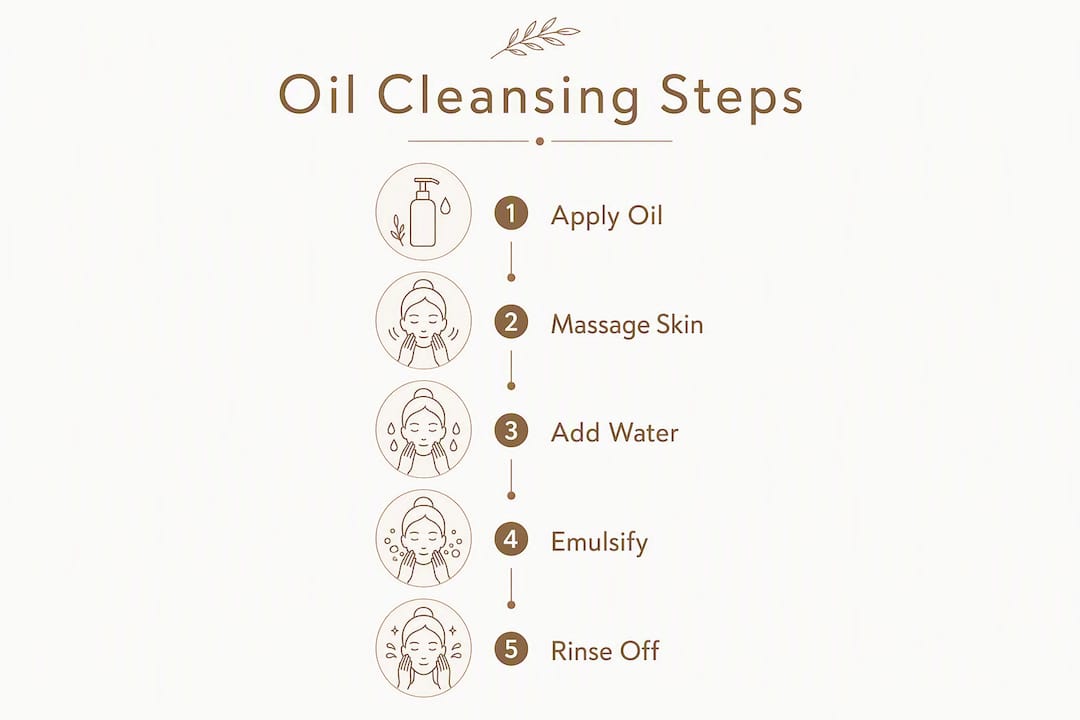
Emulsification is what makes OCM work as a rinse-off method rather than a leave-on treatment. After massaging oil into dry skin, you add a small amount of water and continue massaging. The oil turns milky as it emulsifies, converting from a nonpolar liquid into a water-dispersible form that rinses cleanly without leaving a greasy film. Skip this step and you will likely feel residue.
The linoleic-versus-oleic split is the practical shorthand most practitioners use:
Oil | Linoleic acid (approx.) | Oleic acid (approx.) | Best suited for |
Safflower oil | ~75% | Low | Oily, acne-prone |
Sunflower seed oil | ~68% | Moderate | Oily, combination, sensitive |
Rosehip seed oil | ~45% | ~15% | Combination, dry, aging |
Argan oil | ~34% | ~45% | Dry, mature |
Jojoba oil | Wax ester (sebum-like) | N/A | All skin types |
Sweet almond oil | ~25% | ~65% | Dry, sensitive |
Coconut oil | ~6% | ~6% | Dry only (high comedogenicity) |
Figures for sunflower, safflower, coconut, and argan sourced from fatty-acid analysis via Klarity Health.
The practical rule: higher linoleic acid for oily and acne-prone skin (less pore-clogging, lighter texture), higher oleic acid for dry and mature skin (more occlusive, richer feel). Jojoba is the exception. It is technically a liquid wax ester that mimics the composition of human sebum, which is why it suits nearly every skin type without tipping toward comedogenicity.
Which oils work best for your skin type?
Choosing the right oil is not about finding the most expensive option. It is about matching fatty-acid profile, texture, and comedogenicity to what your skin actually needs.
Oily and acne-prone skin
Jojoba is the go-to base. Its sebum-mimicking structure signals to the skin that it does not need to overproduce oil, and it sits at a comedogenic rating of 2 out of 5. Sunflower oil at ~68% linoleic acid is another strong choice: light, affordable, and widely available cold-pressed. Add a small amount of castor oil (no more than 1 part castor to 5 parts base) for its astringent, drawing effect. Go heavier on castor and you risk feeling stripped.

Dry and mature skin
Rosehip seed oil brings linoleic acid plus natural vitamin A precursors, making it a popular choice for aging or dull skin. Sweet almond oil is richer and more occlusive, good for very dry skin that needs a longer massage window. Palinova Barbary Fig Seed Oil (prickly pear seed oil) is worth noting here: it is exceptionally light for a dry-skin oil, absorbs quickly, and carries a high concentration of tocopherols (vitamin E), making it a strong candidate for a nighttime oil-cleanse blend. More on anti-aging oil options is in Palinova’s guide to best oils for aging skin.

Sensitive skin
Sunflower oil and sweet almond oil are the safest starting points: both are low-irritant, fragrance-free when cold-pressed, and well-tolerated by reactive skin. Avoid fragranced blends, essential-oil-heavy formulas, and anything labeled “kitchen grade.”
Combination skin
Jojoba as a primary base, with a small castor ratio for the T-zone. In summer, lean lighter (sunflower or jojoba alone). In winter, a small addition of sweet almond oil adds the extra richness combination skin often needs in cold, dry weather.
Oils to avoid on the face: Coconut oil (comedogenic rating 4), unrefined wheat germ oil, and any oil that is not cold-pressed or clearly labeled for cosmetic use. Low-quality or heat-processed oils can contain irritating byproducts that undermine the whole point of a gentle cleanse.
Olive oil is a common OCM recommendation you will see widely, but use it cautiously. It is high in oleic acid and suits very dry skin, but its oleic-to-linoleic ratio can aggravate acne-prone or sensitive skin with prolonged use.
Simple DIY blends for common skin types
These ratios are starting points. Mix small batches (1–2 teaspoons total) so you can adjust before committing to a larger bottle. Store all blends in a small, dark glass bottle with a pump or dropper.
According to Mountain Rose Herbs’ oil cleansing guide, a practical starting framework is 1 part astringent oil (castor) to 5 parts base oil for oily skin, and 1 part nourishing oil to 3 parts base oil for drier skin.
Oily / acne-prone blend 1 part castor oil + 5 parts jojoba oil. For a 1-teaspoon batch: ~¼ tsp castor + ¾ tsp jojoba. Light, non-stripping, and easy to emulsify.
Combination blend 1 part castor oil + 4 parts sunflower oil. Adjust castor down if skin feels tight after rinsing.
Dry skin blend 1 part rosehip seed oil + 3 parts sweet almond oil. For extra richness in winter, swap sweet almond for a small addition of Palinova Barbary Fig Seed Oil.
Sensitive skin blend Pure sunflower oil or sweet almond oil, no castor, no essential oils. Keep it simple until you know how your skin responds.
Storage and safety notes:
Use dark glass bottles (amber or cobalt) and store away from heat and direct light.
Label each batch with the date. Seed oils like rosehip and sunflower have shorter shelf lives (roughly 6–12 months unopened; use within 3–4 months once opened).
If you want to add an essential oil, keep it at or below 0.5% for facial use. At that concentration, one drop per 10 ml of blend is already at the upper limit. For guidance on choosing essential oils safely for skin, Palinova’s guide covers dilution rules in detail. When in doubt, skip the essential oil entirely for OCM.
How to oil cleanse: step-by-step routine
This sequence takes about 2–3 minutes total and works for an evening cleanse on dry or makeup-wearing skin.
Start with a dry face. Do not wet your skin first. OCM works on dry skin so the oil can bind directly to sebum and makeup without water interference.
Dispense the oil. Use roughly a dime-to-quarter-sized amount (about ½ to 1 teaspoon) depending on your face size. Less is fine for a light daily cleanse; more for heavy makeup.
Massage for 30–60 seconds minimum. Work in gentle, circular motions across your entire face, including the hairline, jawline, and around the nose. This massage phase is what loosens debris and increases circulation. Do not rush it.
Emulsify. Wet your fingertips with a small amount of lukewarm water and continue massaging. The oil will turn milky and slightly foamy. Keep going for another 20–30 seconds until the milky texture is consistent across your face.
Rinse or remove with a cloth. Splash lukewarm water to rinse, or use a damp muslin cloth or soft washcloth to gently wipe away the emulsified oil. A warm (not hot) cloth helps lift residue more thoroughly and feels good, but it is not mandatory.
Assess and decide on a second cleanse. If you wore waterproof sunscreen or heavy foundation, follow with a gentle water-based cleanser. Dermatologists note that double-cleansing is most useful for oily skin or heavy makeup days; for a light daily cleanse, one thorough oil cleanse is usually sufficient.
Follow up. Apply your usual moisturizer, serum, or SPF (morning). Do not skip moisturizer after OCM, even if your skin feels hydrated. A simple AM/PM skincare routine helps you slot OCM into the right step without disrupting your other products.
Tools you need: A small glass bottle with a pump or dropper for your oil blend, a muslin or soft cotton washcloth, and lukewarm water. That is it.
How often should you oil cleanse, and what results can you expect?
Frequency depends on skin type. Starting too aggressively is one of the most common mistakes.
Skin type | Suggested starting frequency | Notes |
Oily / acne-prone | 3–4 evenings per week | Build up; watch for purging vs. adverse reaction |
Combination | 4–5 evenings per week | Adjust castor ratio seasonally |
Dry / mature | Daily evening cleanse | Can replace all other cleansers |
Sensitive | 2–3 evenings per week | Patch test first; use the simplest blend |
Normal | Daily evening cleanse | Most flexible; adjust by season |
What to expect over time:
Immediately: Skin feels soft and hydrated. Some people notice a slight glow from the massage.
Week 1–2: An adjustment period is normal. Practitioners and anecdotal reports describe transient blemishes or mild purging as the skin adapts, particularly in breakout-prone areas.
Week 4–6: This is the honest evaluation point. If your skin has improved or stabilized, OCM is working for you. If breakouts have worsened or irritation persists, the oil or technique needs adjusting.
Purging vs. adverse reaction: Purging shows up as small, transient blemishes in areas where you already break out, and it typically resolves within 2 weeks. An adverse reaction looks different: spreading rash, increasing cystic acne, persistent redness, or irritation that worsens rather than settles. Purging = wait and monitor. Adverse reaction = stop and reassess.
Hormonal shifts can also affect how your skin responds to OCM. Adjusting oil choice or frequency across your cycle is a practical strategy covered in more depth in this guide on skincare across the menstrual cycle.
Safety steps, patch testing, and when to see a dermatologist
OCM is low-risk for most people, but “natural” does not mean risk-free. Every oil is a complex mixture of fatty acids, antioxidants, and trace compounds that can trigger reactions in sensitive individuals.
Patch test procedure:
Apply a small amount of your chosen oil (or blend) to your inner arm or jawline.
Leave it for 24 hours without washing.
Monitor for redness, itching, swelling, or breakouts.
If no reaction appears, proceed with a small-area face test before a full cleanse.
Red flags that mean stop immediately:
Cystic acne that is increasing in size or spreading to new areas
A rash that is spreading beyond the application site
Signs of infection: warmth, swelling, pus
Severe or worsening irritation after more than 2 weeks
Dermatologist perspective: Medical News Today’s review of dermatological opinion on OCM notes the lack of extensive clinical trials and frames OCM as a gentle, customizable routine supplement rather than a standardized treatment. Dermatologists generally support it for normal-to-dry skin but advise caution for seborrheic dermatitis (where certain oils can feed Malassezia yeast) and active, severe cystic acne.
Pro Tip: If you use prescription topicals like tretinoin or benzoyl peroxide, do your oil cleanse first, rinse thoroughly, and wait a few minutes before applying the active. Residual oil on the skin surface can physically block penetration and reduce efficacy.
This article is general information, not medical advice. Confirm any skincare changes with a dermatologist if you have an active skin condition.
How to store your oils and what shelf life to expect
Oil quality degrades with heat, light, and air exposure. Rancid oil on your face is counterproductive at best and irritating at worst.
Storage basics:
Store all base oils and blends in dark glass bottles (amber or cobalt), away from direct sunlight and heat sources.
Refrigerate delicate seed oils like rosehip seed oil and sunflower oil if you live in a warm climate or buy in bulk.
Keep lids tightly closed; oxygen accelerates oxidation.
Buy small quantities first, especially for specialty seed oils, until you know what works for your skin.
Shelf life by oil category:
Stable base oils (jojoba, sweet almond, argan): 12–24 months unopened; 6–12 months once opened.
High-linoleic seed oils (sunflower, safflower, rosehip): 6–12 months unopened; 3–6 months once opened. These oxidize faster.
Specialty seed oils (Barbary Fig / prickly pear seed oil): similar to high-linoleic seed oils; store refrigerated for maximum longevity.
Signs an oil has gone rancid: a sour, crayon-like, or paint-like smell; a darker or cloudier color than when fresh. If it smells off, discard it.
Cost context: Cold-pressed base oils like sunflower and jojoba are among the most affordable options, typically a few dollars per ounce at natural grocery stores or online. Specialty seed oils like rosehip and Barbary Fig run higher per ounce given the extraction process. Buying a 1–2 oz bottle to trial before committing to a larger size is the practical move.
Why technique and oil quality change your results
Two people can use the same oil and get completely different outcomes. The difference almost always comes down to emulsification and sourcing.
Pro Tip: Emulsification is the step most beginners skip or rush. After your massage, add just a few drops of water and keep working the oil until it turns uniformly milky. That milky state means the oil has become water-dispersible. Rinse it off and your skin is clean. Skip it and you are just redistributing oil.
Cold-pressed plant oils preserve the beneficial lipids and bioactive compounds that make them effective for skin. Heat-processed or low-quality oils can contain irritating byproducts that undermine the cleanse. For OCM, the label matters: look for “cold-pressed,” “unrefined,” and a clear country of origin or sourcing statement.
A few things to keep in mind when using actives alongside OCM:
Complete your oil cleanse and rinse fully before applying retinoids or chemical exfoliants.
Residual oil creates a physical barrier that reduces how well actives absorb.
If you double-cleanse, apply actives after the second cleanse, not after the oil step.
Pair OCM with consistent SPF use in the morning and an appropriate moisturizer to support barrier function long-term.
Key Takeaways
The oil cleansing method works best when you match the oil to your skin type, emulsify fully, and give it at least 4–6 weeks before judging results.
Point | Details |
Match oil to skin type | High-linoleic oils (jojoba, sunflower) for oily skin; oleic-rich oils (sweet almond, rosehip) for dry skin. |
Emulsify every time | Add water after massaging and work until milky; this step makes the oil rinse cleanly without residue. |
Patch test before full use | Apply your chosen oil to your jawline or inner arm for 24 hours before a full-face cleanse. |
Evaluate at 4–6 weeks | Expect a 1–2 week adjustment period; real results show at the 4–6 week mark. |
Palinova Barbary Fig Seed Oil | A lightweight, antioxidant-rich seed oil suited to dry, mature, or combination skin in a nighttime OCM blend. |
What oil cleansing has taught me about trusting the process
Most skincare advice rushes past the part that actually determines whether something works: patience and specificity. The oil cleansing method gets dismissed by people who tried it for a week with the wrong oil, skipped emulsification, and concluded it broke them out. That is not a fair test of OCM. It is a fair test of using coconut oil on acne-prone skin without rinsing properly.
What stands out about OCM, when done correctly, is that it asks you to slow down. Two minutes of massage is longer than most people spend on their entire cleansing routine. That time is not incidental. The massage itself increases circulation, loosens debris, and gives the oil time to do its chemistry. The emulsification step is not optional. These are not arbitrary rituals.
The sourcing question also matters more than most guides admit. A cold-pressed, traceable seed oil behaves differently on skin than a commodity oil of unknown origin. Palinova’s approach to botanical sourcing, rooted in Palestinian agricultural heritage and free from synthetic additives, is exactly the kind of transparency that makes a difference in a routine built on oil quality. Barbary Fig Seed Oil, in particular, is a genuinely underused option for nighttime OCM blends: light enough not to feel heavy, rich enough to support dry or mature skin, and stable enough for regular use.
The honest bottom line: OCM is not magic, and it is not for everyone. But for most people who try it with the right oil and correct technique, it is one of the gentler, more effective cleansing methods available.
Palinova Barbary Fig Seed Oil for your oil cleansing blend
If you have been looking for a single oil that works across skin types without feeling heavy, Palinova’s Barbary Fig Seed Oil is worth trying. Sourced from Palestinian botanicals and cold-pressed without synthetic additives, it brings a high tocopherol (vitamin E) content and a light, fast-absorbing texture that suits dry, mature, and combination skin equally well in an evening OCM blend.
For a nighttime blend, use Barbary Fig Seed Oil as 20–30% of your total mix alongside jojoba or sunflower oil as the base. Store in a dark glass bottle, away from heat, and use within 3–4 months of opening. As with any new oil, patch test on your jawline before a full-face session.
Palinova’s full range of natural Palestinian skincare includes barrier-support creams and soothing treatments that pair well with an OCM routine. If you want to add an essential oil to your blend, keep it at or below 0.5% for facial use and choose carefully. Palinova’s frankincense essential oil is one option sometimes used in anti-aging blends at very low concentrations.
Browse the Barbary Fig Seed Oil product page to check availability and current sizing options.
Useful sources
These are the primary references used to build this guide:
Does Oil Really Clean Your Skin? The Science Behind the Oil Cleansing Method — supports emulsification technique, massage timing, and the 4x waterproof sunscreen removal finding.
How To Use an Oil Cleanser, According to Dermatologists — dermatologist perspective on double-cleansing and active ingredient interaction.
Oil Cleansing Method — covers purging vs. adverse reaction and the 4–6 week evaluation timeline.
Oil Cleansing Method — dermatological caveats and the limited clinical trial landscape.
Deep Oil Cleansing: How it Can Benefit Your Skin — cold-pressed oil quality and bioactive compound preservation.
Palinova Barbary Fig Seed Oil — publisher product page for the recommended in-house OCM option.
FAQ
What is the correct way to oil cleanse?
Apply oil to a dry face, massage for at least 30–60 seconds, then add a small amount of water and continue massaging until the oil turns milky. Rinse with lukewarm water or remove with a damp cloth.
Do you oil cleanse on wet or dry skin?
Always start on dry skin. Water on the face before you apply the oil prevents it from binding properly to sebum and makeup, which reduces how well it cleans.
Do dermatologists recommend oil cleansing?
Many dermatologists support OCM for removing oil-based impurities and for dry or sensitive skin types, but they frame it as a customizable routine supplement rather than a standardized treatment, and advise caution for seborrheic dermatitis or severe cystic acne.
Do you wash your face before or after an oil cleanser?
Oil cleansing comes first, on a dry face. If you double-cleanse, follow the oil step with a gentle water-based cleanser as the second step, not before.
How long before you see results from oil cleansing?
Expect a 1–2 week adjustment period that may include minor transient blemishes. A fair evaluation of whether OCM is working for your skin takes 4–6 weeks of consistent use.
Recommended


Comments