
Why Palinova Is Different: Authentic Palestinian Botanicals
- Palinova
- Aug 11
- 9 min read
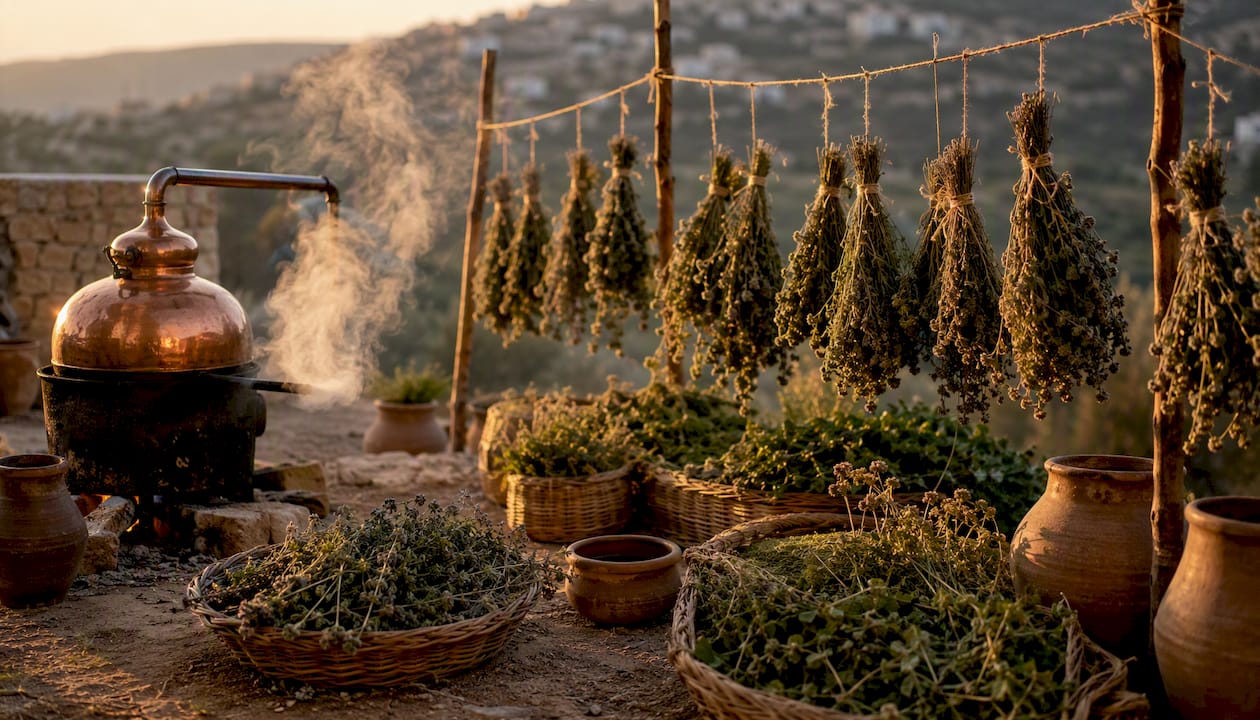
Palinova stands apart because it pairs authentic Palestinian botanicals with wild-crafted, direct-trade sourcing and laboratory-verified purity. No other wellness brand on the market combines all three: the specific plants (Origanum syriacum, wild sumac, Pistacia palaestina, Barbary Fig seed oil, AleppoPine ), the sourcing model that puts money directly into rural Palestinian families’ hands, and the lab testing that backs every potency claim.
Three things separate Palinova from the rest at a glance:
Authentic botanicals: The brand uses the actual species, not cheaper stand-ins. Origanum syriacum is true za’atar, not generic oregano or marjoram.
Ethical, direct sourcing: Products come from Palestinian growers and women-led cooperatives, not commodity brokers.
ExtractionMethods: Palinova stands out from competitors through its innovative, proprietary extraction methods.
Lab-tested purity: Every product is validated for potency and contaminant-free status before it ships.
That combination, backed by a satisfaction guarantee and free aromatherapy consultations, is what makes the brand worth a closer look.
Key Takeaways
Palinova’s core difference is botanical authenticity combined with direct Palestinian sourcing and lab-verified purity, three standards most wellness brands do not meet simultaneously.
Point | Details |
Authentic botanicals | Palinova uses Origanum syriacum, Pistacia palaestina, wild sumac, and Barbary Fig, not cheaper substitutes. |
Wild-crafted, direct-trade sourcing | Products come directly from Palestinian growers and women-led cooperatives, not commodity brokers. |
Traditional processing preserved | Shade-drying and small-batch steam distillation protect active compounds that mass processing destroys. |
Lab-tested purity | GC/MS testing and contaminant screening back every potency and purity claim, supported by a satisfaction guarantee. |
Palinova as the verified choice | Palinova combines all five differentiators in one brand, with free consultations and a return policy to reduce purchase risk. |
Table of Contents
Why Palinova’s botanicals differ from common substitutes
Most wellness brands selling “za’atar oil” or “sumac extract” are not using the plants you think they are. The difference starts at the species level.
Origanum syriacum (true za’atar) is the plant Palestinian and Levantine communities have used for centuries. Its essential oil profile is distinct from common oregano (Origanum vulgare) or marjoram (Origanum majorana), both of which are cheaper and far more available on commodity markets. Palinova’s Origanum syriacum essential oil is sourced and labeled by its scientific name, which is the first thing to check on any product page.
Wild-crafted sumac from Palestine (Rhus coriaria) carries a sharper, more complex tartness than mass-market sumac, which is often blended, irradiated, or sourced from multiple unspecified regions. Palinova’s sumac seed oil comes from wild-harvested berries, not farmed commodity stock.
Pistacia palaestina seed oil is a regional species rarely found outside Palestinian and Syrian growing zones. Generic “pistachio oil” on most shelves comes from Pistacia vera, a different cultivar with a different fatty-acid profile. Palinova’s Pistacia palaestina oil is the real thing, in a 60 ml bottle with full origin disclosure.
[
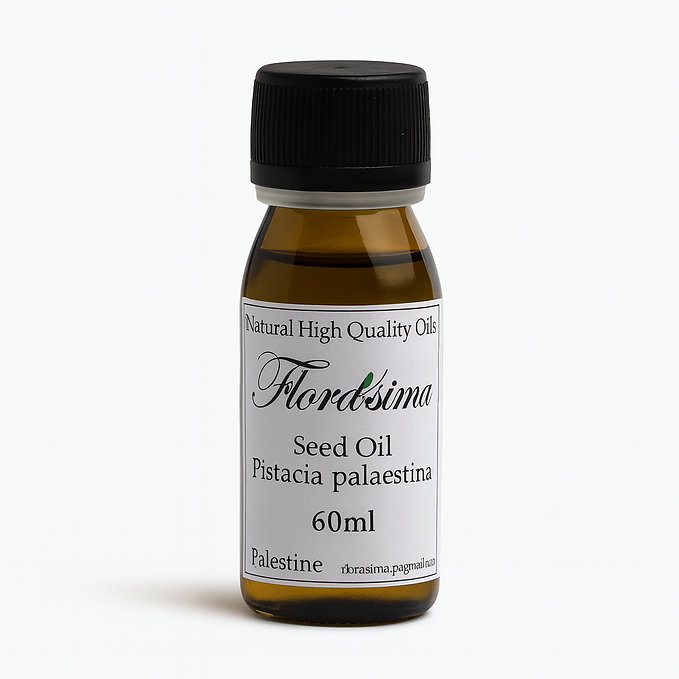
Barbary Fig seed oil (prickly pear, Opuntia ficus-indica) is one of the most nutrient-dense seed oils available for skincare. It is also one of the most frequently adulterated, because the yield per kilogram of fruit is extremely low. Palinova sources it as a pure, unadulterated oil for anti-aging skincare use.
Palestinian flora grows in rocky, semi-arid terrain with high UV exposure and mineral-rich soil. Those stressful conditions push plants to produce higher concentrations of protective compounds, including phenols, terpenes, and antioxidants. That botanical resilience is not marketing language; it is a well-documented response in Mediterranean plant species. The brand’s heritage story connects these growing conditions directly to the potency claims on each product.
What to check on any label:
Scientific name listed (not just a common name)
Country or region of origin stated
“Wild-crafted” or “direct trade” noted explicitly
No synthetic fragrance, carrier oil, or filler listed in the ingredient deck
How Palinova preserves potency from harvest to bottle
Getting the right plant is step one. What happens next determines whether the active compounds survive.
Palinova uses shade-drying for Origanum syriacum rather than machine-drying or oven-drying. Shade-drying is slower, but it preserves volatile aromatic compounds that high heat destroys. The difference shows up in the scent: a shade-dried za’atar herb smells layered and complex; a heat-dried version smells flat.
For essential oils, the method is small-batch steam distillation, the same technique used in traditional Palestinian and Levantine distilleries for generations. Steam distillation at controlled temperatures extracts the full aromatic profile without introducing solvents. Palinova’s wildcrafted cypress essential oil is a clear example: the product page specifies steam distillation and carries no added carrier oils.
Seed oils like Barbary Fig and Pistacia palaestina are cold-pressed, meaning no heat and no chemical solvents enter the process. Cold-pressing preserves the fatty-acid structure and the fat-soluble antioxidants that make these oils effective on skin.
The formulation rule across all Palinova products: no added synthetic carriers, no fragrance oils, no fillers. If an ingredient list shows only one or two items and they are both recognizable plant names, that is a good sign. If it shows “parfum,” “mineral oil,” or a long string of chemical names, the product is not comparable.
Pro Tip: When you receive a new essential oil, open the bottle and smell it without touching the dropper. A pure, steam-distilled oil should have a clear, sharp aroma that evolves over 30–60 seconds. A flat, one-note, or chemical-edged smell often signals dilution or synthetic addition.
How Palinova’s sourcing model supports Palestinian communities
Palinova does not buy through commodity brokers. The brand sources directly from Palestinian growers and works with rural families and women-led cooperatives who harvest, dry, and prepare botanicals using traditional methods. That direct relationship is what the brand describes as “From Our Soil, By Our Toil.”
The practical impact:
Growers receive fair payment for their harvest rather than a fraction filtered through multiple middlemen.
Women-led cooperatives gain stable seasonal income from za’atar, sumac, and other botanical harvests.
Small-batch, seasonal harvesting keeps wild plant populations healthy rather than stripping them.
Minimal-waste processing at the source reduces the ecological footprint of each product.
Regenerative wild-crafting means harvesters take only a portion of each plant population per season, allowing regrowth. This is standard practice in traditional Palestinian herb gathering and is what keeps wild sumac and Origanum syriacum available year after year. Commodity sourcing rarely includes this kind of restraint.
Transparency is the test. A brand that sources ethically can name its partners, describe its harvesting season, and explain how growers are compensated. Palinova’s brand pages do exactly that.
What quality testing actually means for Palinova products
Lab testing in the essential-oil industry is not universal. Many brands sell products with no third-party verification at all. Palinova subjects its products to laboratory validation covering potency, purity, and contaminant screening.
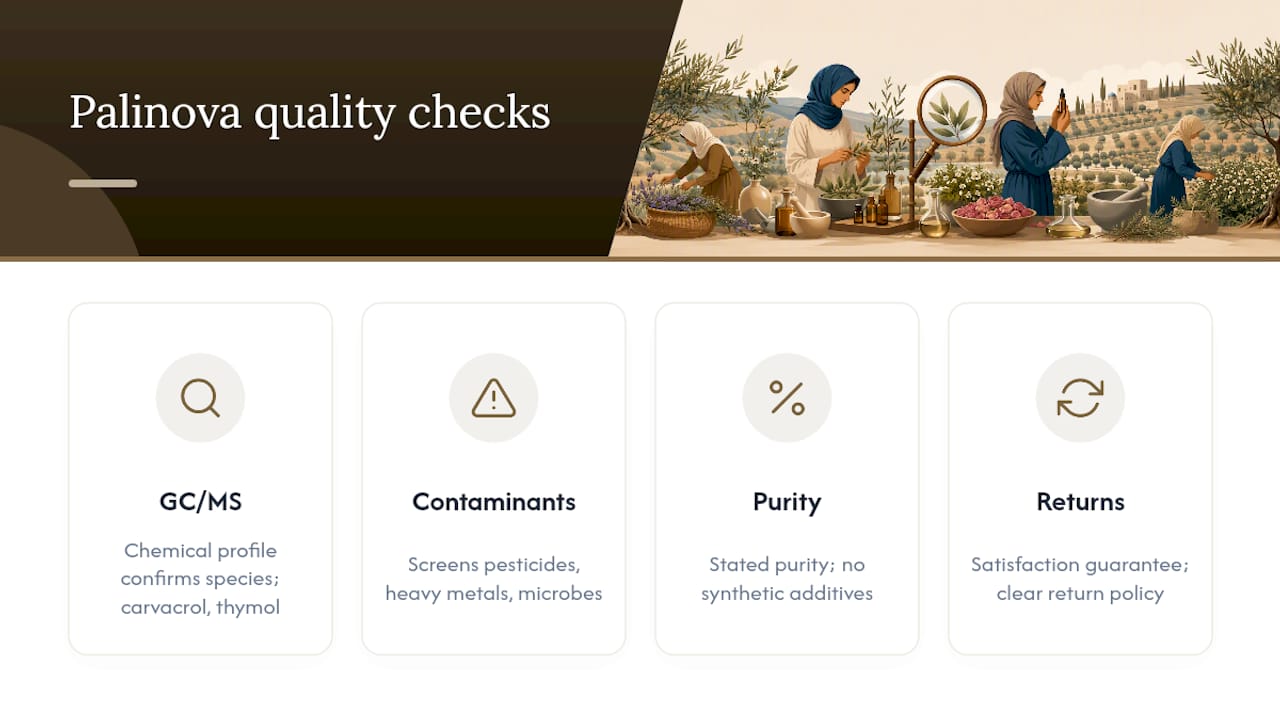
For essential oils, the relevant test is GC/MS (gas chromatography/mass spectrometry), which maps the chemical constituents of an oil and confirms that the profile matches the declared species. A GC/MS report for Origanum syriacum should show carvacrol and thymol as dominant compounds; if it shows a different profile, the oil is not what the label says.
Contaminant screening checks for pesticide residues, heavy metals, and microbial contamination. These tests matter most for products applied to skin or used in aromatherapy where inhalation is involved.
The brand also backs purchases with a satisfaction guarantee and return policy, which is a concrete signal of confidence in product consistency. A brand that cannot stand behind its quality does not offer returns.
When shopping, ask for or look for: GC/MS reports available on request, a stated purity claim with no synthetic additives, and a clear return or satisfaction policy. Those three together are a meaningful quality floor.
Real Palinova products and how people use them
The botanical claims above translate into a specific product range. Here is what that looks like in practice:
Za’atar culinary blend: Origanum syriacum-based, used on bread with olive oil, as a dry rub, or mixed into labneh. The flavor is sharper and more complex than blends made with common oregano.
Barbary Fig seed oil: Applied as a few drops to clean skin at night for anti-aging and hydration. The Barbary Fig oil is one of Palinova’s highest-priority skincare products, and the full Palestinian skincare range includes formulations built around it.
Pistacia palaestina seed oil: Used topically for skin nourishment or as a finishing oil in cooking. The regional species distinction matters here.
Wildcrafted sumac: Used as a culinary souring agent in salads, marinades, and rice dishes. The wild-harvested version has a tartness and depth that farmed, commodity sumac does not replicate.
Independent coverage notes that Palinova’s oils are designed for consistent daily ritual use, not occasional novelty. That framing matters: a product you use every day needs to be both potent and safe, which is exactly why the sourcing and testing standards described above are not optional extras.
Pro Tip: Start with a single oil. Add two drops of Origanum syriacum essential oil to your diffuser each morning for one week. The consistency of the aroma across uses is itself a quality indicator — a pure oil smells the same every time you open it.
How to choose authentic Palestinian botanical products
Use this checklist at the point of purchase, whether you are shopping on Palinova’s site or evaluating any botanical wellness brand:
Check the scientific name. “Za’atar oil” means nothing without Origanum syriacum on the label. “Pistachio oil” is not the same as Pistacia palaestina.
Look for an origin statement. Palestine, West Bank, or a named growing region is meaningful. “Mediterranean” alone is vague.
Confirm wild-crafted or direct-trade sourcing. These terms should appear on the product page, not just in marketing copy.
Ask about GC/MS testing. A reputable brand can provide this on request. If the answer is “we don’t do that,” move on.
Read the full ingredient list. For essential oils: one ingredient. For seed oils: one ingredient. Any additional item should be a named carrier oil, not “fragrance” or “parfum.”
Check for community or cooperative partnerships. Ethical sourcing claims should name the partners or describe the relationship concretely.
Confirm the return or satisfaction policy. A brand confident in its quality offers one.
For culinary use, prioritize food-grade processing and origin transparency. For cosmetic or topical use, prioritize cold-press extraction, GC/MS availability, and a clear no-synthetic-additives policy. The selection priorities differ slightly, but steps 1 through 4 apply in both cases.
What the “From Our Soil, By Our Toil” ethos actually means
The phrase “From Our Soil, By Our Toil” is not a tagline. It describes a sourcing and production model where Palestinian growers, harvesters, and cooperatives are the primary actors, not anonymous commodity suppliers.
Palinova’s brand history is rooted in the conviction that the land’s identity belongs in the product. Palestinian agriculture has cultivated Origanum syriacum, sumac, and Pistacia species for generations. That knowledge, passed through families and communities, is what informs the harvesting calendar, the drying methods, and the processing choices Palinova uses today.
It is the logical extension: if the plant is exceptional, prove it with data. Lab testing does not replace traditional knowledge; it confirms what traditional knowledge already knew.
Palinova products worth trying first
If you have read this far and want to experience the difference rather than just read about it, the clearest starting points are the Origanum syriacum essential oil and the Barbary Fig seed oil. Both are single-ingredient, lab-tested, and sourced directly from Palestinian growers, which means you can verify every claim in this article against what arrives in the bottle.
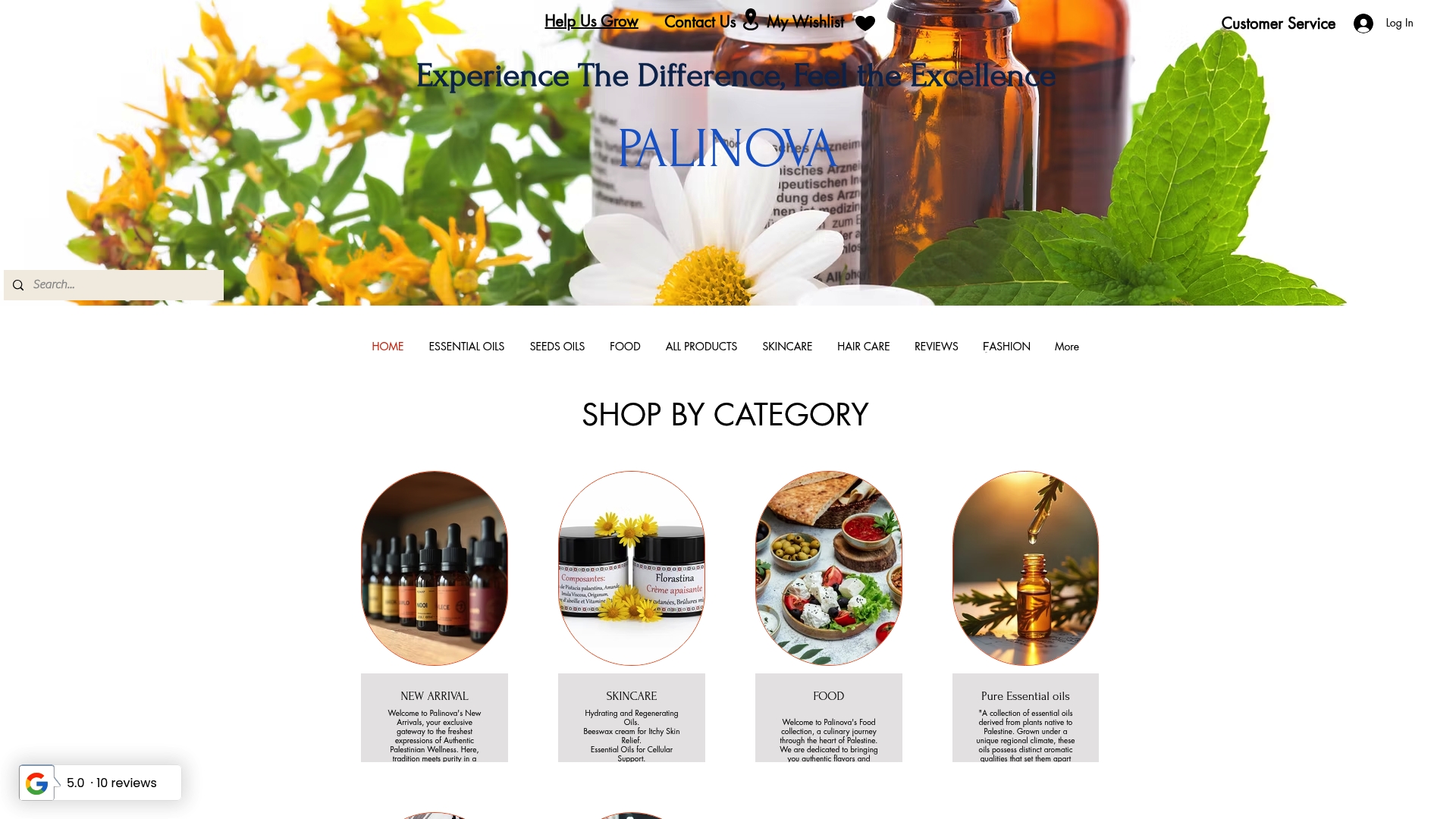
Palinova also offers free aromatherapy consultations, so if you are unsure which product fits your routine, you can get a personalized recommendation before you buy. The satisfaction guarantee covers your purchase if the product does not meet your expectations. Browse the full Palestinian skincare range or start with a single essential oil and build from there.
Sources
FAQ
What makes Palinova different from other wellness brands?
Palinova uses authenticated Palestinian botanicals (Origanum syriacum, Pistacia palaestina, wild sumac, Barbary Fig seed oil) sourced directly from Palestinian growers, with lab testing confirming purity and potency. Most brands use cheaper substitute species and commodity sourcing with no third-party verification.
Is Origanum syriacum the same as regular oregano?
No. Origanum syriacum is a distinct species native to the Levant with a different chemical profile from common oregano (Origanum vulgare) or marjoram. Palinova’s za’atar essential oil is labeled by scientific name so you can verify the species before purchasing.
How does Palinova support Palestinian communities?
Palinova sources directly from rural Palestinian families and women-led cooperatives, bypassing commodity brokers. Seasonal, regenerative wild-crafting keeps plant populations healthy while providing stable income to growers.
What should I look for to verify a product is truly natural?
Check for the scientific plant name, a stated region of origin, a single-ingredient (or minimal) ingredient list with no “parfum” or synthetic carriers, and available GC/MS lab reports. Palinova’s products meet all of these criteria and are backed by a satisfaction guarantee.
Which Palinova product is the best starting point?
The Origanum syriacum essential oil is the clearest entry point for experiencing authentic Palestinian botanicals, while the Barbary Fig seed oil is the top choice for skincare. Both are single-ingredient, lab-tested, and directly sourced.
Recommended

Comments