
Palinova Essential Oils for Stronger, Healthier Nails

Updated: Aug 10
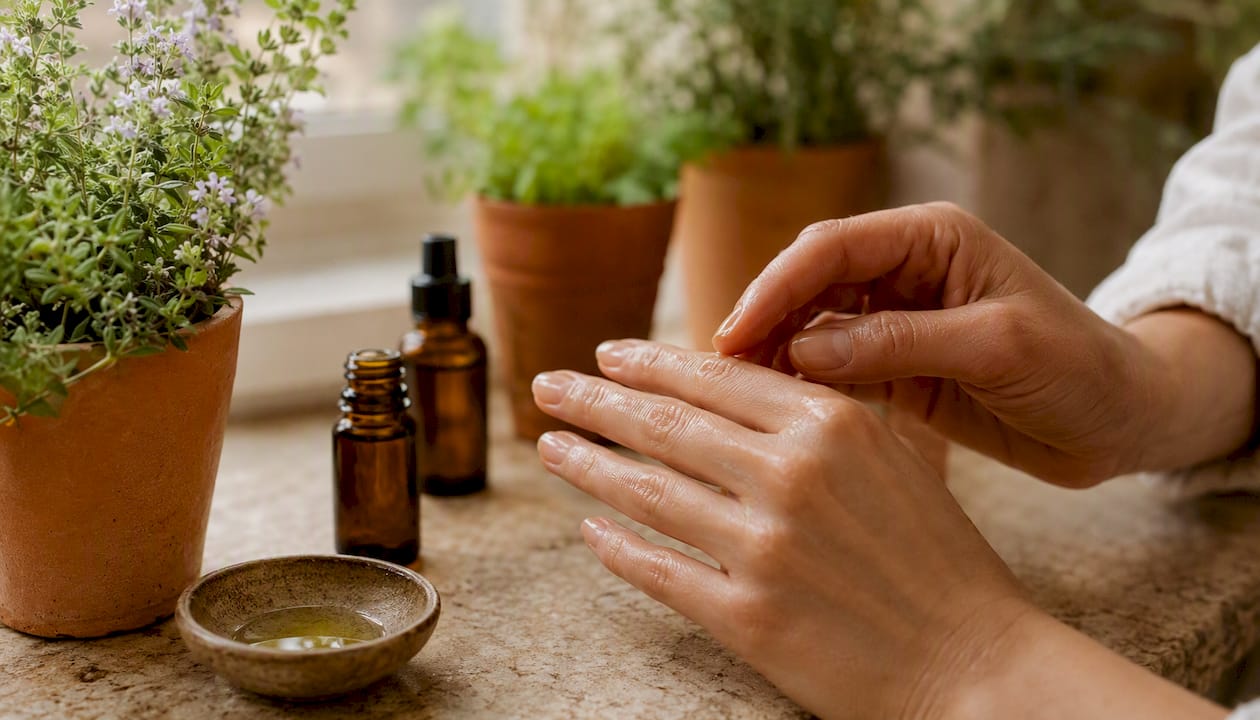
For brittle plates, stubborn discoloration, or inflamed cuticles that never quite heal, Palinova’s core nail-care oils give you a targeted, evidence-aware starting point: Inula viscosa for antifungal defense and collagen stimulation, Helichrysum italicum for tissue regeneration, Boswellia sacra for anti-inflammatory cuticle care, and Origanum syriacum for additional antifungal support. Pair any of these with Barbary Fig seed oil as your primary carrier, diluted to 1–2% for daily use, and you have a functional nail serum you can mix at home in under five minutes.
Quick-start checklist:
Daily strengthening serum (10 ml): 2 drops Helichrysum + 2 drops Boswellia sacra + 1 drop Inula viscosa in Barbary Fig seed oil; apply once daily to clean nails and cuticles.
Antifungal support blend (10 ml): 2 drops Origanum syriacum + 2 drops Inula viscosa + 1 drop tea tree in jojoba or Barbary Fig seed oil; apply twice daily for up to 4 weeks, then reassess or consult a clinician if no improvement.
Patch-test first: apply a small amount of your diluted blend to the inner forearm, wait 24 hours, and check for redness or irritation before using it on nails.
Pro Tip: Before your first full application, browse Palinova’s essential oils and aromatherapy content to understand each oil’s profile and confirm you are choosing the right one for your specific concern.
Key Takeaways
Palinova’s nail-care approach works because it combines antifungal, regenerative, and anti-inflammatory oils in a penetrating seed-oil carrier, addressing the nail problem from multiple mechanisms at once.
Point | Details |
Core oil trio | Inula viscosa, Helichrysum italicum, and Boswellia sacra target antifungal, regenerative, and anti-inflammatory needs respectively. |
Dilution rule | Use 0.5–3% for periungual application; high-phenol oils like Origanum syriacum stay at 0.5–1% maximum. |
Best carrier | Barbary Fig seed oil absorbs quickly, strengthens the moisture barrier, and enhances active-compound delivery. |
Timeline | Expect cuticle improvement in 2–4 weeks; visible nail plate improvements in 6–12 weeks; full nail plate results take 3–6 months of consistent daily use. |
Palinova’s offer | Palinova sells all five recommended oils and offers free aromatherapy consultations for personalized nail-care guidance. |
Table of Contents
Why do essential oils actually improve nail health?
Nails are not impermeable. The nail plate is a layered keratin structure with small gaps between cells that allow low-molecular-weight compounds to pass through, especially when aided by a fatty carrier oil. That penetration pathway is why topical oil blends can reach the nail bed and the periungual skin around it.
The mechanisms that matter most for nail care:
Antifungal and antimicrobial action: Certain essential oils contain compounds such as carvacrol, thymol, and sesquiterpene lactones that disrupt fungal cell membranes. This can reduce the discoloration, thickening, and brittleness associated with mild onychomycosis.
Anti-inflammatory effects: Oils rich in boswellic acids or neryl acetate calm the periungual tissue, reducing redness, swelling, and the chronic low-grade inflammation that slows nail growth.
Collagen stimulation: Some botanical compounds support fibroblast activity in the nail matrix, which influences how strong and flexible the new nail plate grows in.
Improved penetration via carrier oils: Cold-pressed seed oils like Barbary Fig act as more than a diluent. Research on cold-pressed specialty oils confirms they deliver topical benefits of their own and enhance the delivery of active botanical compounds into skin and nail tissue.
Tissue trophism: Fatty acids and tocopherols in seed oils nourish the periungual skin, keeping cuticles supple and reducing the micro-tears that invite infection.
One honest limitation: topical oil blends work best for mild to moderate nail issues. Severe onychomycosis covering more than half the nail plate, or any infection with spreading redness and pain, needs a clinician’s assessment before you try home care.
Which Palinova oils work best for your specific nail concern?
The short answer: Inula viscosa leads for antifungal and collagen support, Helichrysum italicum for regeneration and repair, Boswellia sacra for inflammation and cuticle health, Origanum syriacum for added antifungal strength, and Barbary Fig seed oil as the carrier that ties everything together.
Inula viscosa (False Yellowhead): antifungal defense and collagen stimulation
Inula viscosa is Palinova’s most targeted oil for nails showing early fungal signs. Its sesquiterpene lactone content gives it documented antimicrobial activity, and it also supports collagen synthesis in the nail matrix, meaning new growth comes in stronger. Use it at a low dilution appropriate for topical use in Barbary Fig or jojoba oil. Apply once or twice daily. Expect to see changes in nail texture within 6–12 weeks as the new plate grows in.
Use-case tags: brittle nails, fungal prevention, growth supportIrritation risk: low to moderate; always dilute; patch-test before periungual use.
Helichrysum italicum (Immortelle): cell regeneration and tissue repair
Known as the “Everlasting Flower,” Helichrysum italicum is the regeneration specialist in this lineup. Its neryl acetate and di-ketone content accelerates tissue repair around damage from physical trauma, harsh nail treatments, or chronic inflammation. If your cuticles are cracked, your nail bed is discolored from an old injury, or your nails peel in layers, this is the oil to prioritize. Dilute to a controlled low percentage appropriate for topical use in Barbary Fig seed oil. The regenerative effects of Helichrysum on periungual tissue also make it a strong choice for anyone recovering from gel or acrylic nail damage.
Use-case tags: brittle nails, cuticle repair, post-trauma recoveryIrritation risk: low; well tolerated at standard dilutions.
Boswellia sacra (Sacred Frankincense): anti-inflammatory and cuticle health
Boswellia sacra works on the inflammation side of nail problems. Chronically inflamed cuticles, red periungual skin, and nails that grow slowly due to matrix irritation all respond to its boswellic acid content. It also has mild antimicrobial properties that complement Inula viscosa in a blend. Dilute to a controlled low percentage appropriate for topical use in Barbary Fig or sweet almond oil. Use it daily as part of a cuticle massage routine.
Use-case tags: cuticle health, anti-inflammatory, slow growth from irritationIrritation risk: low; generally well tolerated.
Origanum syriacum (Za’atar): antifungal support
Origanum syriacum is a high-phenol oil with strong antifungal credentials, similar in profile to oregano oil. Its carvacrol content is the active driver. Because phenol-rich oils can irritate skin at higher concentrations, keep this one at a low dilution suitable for periungual use and never apply it undiluted. Pair it with Barbary Fig or jojoba oil. Use it in short cycles of 2–4 weeks for fungal support, then take a break.
Use-case tags: fungal prevention and supportIrritation risk: moderate to high if undiluted; strict dilution required.
Barbary Fig seed oil: the restorative carrier
Barbary Fig seed oil is cold-pressed from prickly pear seeds and is one of the richest plant sources of linoleic acid and tocopherols. It absorbs quickly without a greasy residue, which makes it ideal for nail and cuticle use. It strengthens the nail plate’s moisture barrier, reduces brittleness, and delivers active essential oils efficiently. Use it as the base for every nail serum recipe in this guide, as it is a cold-pressed seed oil known for enhancing skin and nail penetration.
A note on quality: Palinova sources these botanicals from Palestinian growing regions and uses steam distillation for its essential oils. GC-MS testing confirms purity and active-compound profiles, which matters for antifungal blends where carvacrol or sesquiterpene content drives efficacy. Palinova’s sourcing and testing practices are described in detail on their ethical sourcing page.
What carrier oils and dilution ratios are safe for nails?
The general rule for periungual and nail-plate topical use is 0.5–3%, depending on the oil and the goal. Daily maintenance sits at the lower end; short-term antifungal support can go slightly higher for non-sensitizing oils.
Best carrier oils for nails and what each contributes:
Barbary Fig seed oil: high linoleic acid and tocopherols; fast absorption; strengthens moisture barrier; top choice for all nail blends.
Jojoba oil: technically a liquid wax; very stable; mimics sebum; excellent for high-phenol oils like Origanum syriacum because it dilutes evenly.
Sweet almond oil: rich in oleic acid; softens cuticles and periungual skin; good for dry, cracked nail beds.
Olive oil: widely available; recommended by natural nail care professionals for strengthening alongside lemon; heavier texture, better for overnight treatments.
Pro Tip: For periungual patch-testing, apply your diluted blend to the inner forearm skin, not the nail plate itself. Nail keratin rarely reacts; the surrounding skin is where sensitization happens. Wait a full 24 hours before proceeding.
Two DIY nail oil recipes you can mix at home
Both recipes use a 10 ml amber glass roller bottle, which protects the oils from light degradation and makes application precise.
Recipe 1: Daily strengthening serum
Purpose: Strengthen brittle nails, support new growth, and repair periungual tissue with daily use.
Add 2 drops Helichrysum italicum to the roller bottle.
Add 2 drops Boswellia sacra.
Add 1 drop Inula viscosa.
Fill the remaining volume with Barbary Fig seed oil (approximately 9.75 ml).
Cap, roll gently between palms to blend, and label with the date.
Apply to clean, dry nails and cuticles once daily, massaging for 60 seconds per hand.
Total dilution: approximately 1.5%. Shelf life: 6–9 months stored away from heat and light. Refrigeration extends this to 12 months.
Recipe 2: Antifungal support blend
Purpose: Short-term antifungal support for nails showing early discoloration, thickening, or brittleness linked to possible fungal activity.
Add 2 drops Origanum syriacum to the roller bottle.
Add 2 drops Inula viscosa.
Add 1 drop tea tree oil (optional, for additional antifungal coverage consistent with the PMC study formulation).
Fill with jojoba oil to 10 ml.
Cap, blend gently, and label with the date and a 4-week end date.
Apply twice daily to affected nails. Do not apply to broken or severely inflamed skin.
Total dilution: approximately 1.5%. Use for 2–4 weeks, then reassess. If no improvement, consult a clinician before continuing.
Pro Tip: Lightly buff the nail surface with a fine-grit file (180–220 grit) before applying the antifungal blend. This removes the outermost keratin layer and meaningfully improves oil penetration into the nail plate. Do this once a week, not daily.
How to apply nail oils and build a simple weekly routine
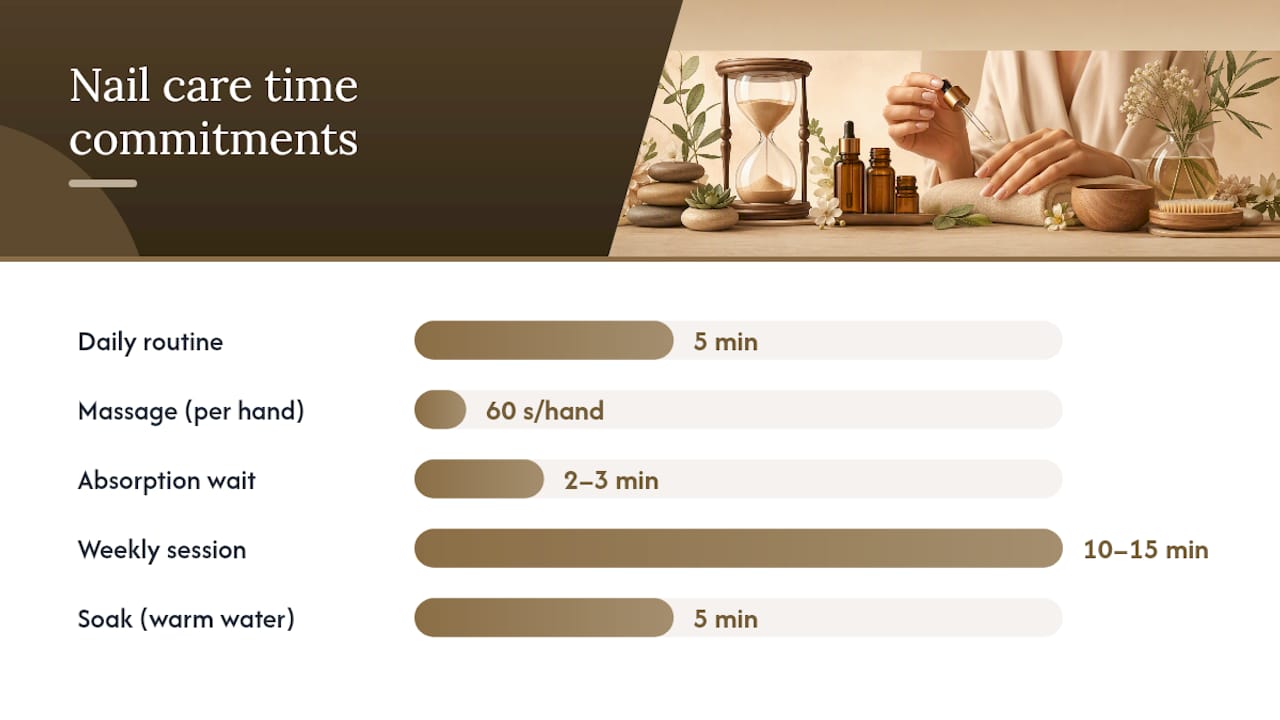
A consistent routine matters more than any single ingredient. Here is a practical daily and weekly schedule:
Daily (morning or evening, 5 minutes):
Wash hands and dry thoroughly, including under the nail tips.
Push cuticles back gently with a wooden stick if needed.
Roll the strengthening serum onto each nail and the surrounding skin.
Massage in small circles for 60 seconds per hand, focusing on the nail base where the matrix sits.
Allow to absorb for 2–3 minutes before putting on gloves or handling products.
Weekly (once, 10–15 minutes):
Soak nails in warm water with a few drops of olive oil for 5 minutes to soften the plate.
Lightly buff with a 180-grit file if using the antifungal blend.
Apply a slightly heavier coat of your serum and leave it on overnight under cotton gloves.
What to expect over time:
2–4 weeks: cuticles soften, periungual redness reduces, nails feel less brittle at the tips.
6–12 weeks: new nail growth comes in with improved texture and reduced peeling; early discoloration begins to grow out.
3–6 months: full nail plate replacement (fingernails grow roughly 3 mm per month), so the complete result of any nail-repair routine takes this long to show across the whole nail.
Consistency is the variable most people underestimate. Missing three days a week cuts your effective exposure roughly in half. Build the routine into an existing habit, such as applying the serum right after washing your face at night, and adherence becomes automatic. For more ideas on integrating oils into a daily ritual, Palinova’s guide on Palestinian essential oils in daily wellness is worth reading.
Safety, allergies, and when to see a clinician
Always dilute. No essential oil in this guide should touch periungual skin undiluted, and that rule applies even to the gentler oils like Helichrysum. The nail plate itself tolerates undiluted oils better than surrounding skin does, but the goal is to treat the whole nail unit, including the matrix and cuticle, so dilution is non-negotiable.
Key safety points:
High-phenol oils (Origanum syriacum): keep at 0.5–1% maximum for periungual use. Phenols are potent sensitizers at higher concentrations. Healthline’s review of essential oils for nail fungus notes that oregano-family oils require careful dilution and clinician consultation for persistent infections.
Pregnancy: avoid Origanum syriacum and high-phenol oils entirely during pregnancy. Helichrysum and Boswellia sacra should be used only after checking with your OB or midwife. Inula viscosa has limited safety data for pregnancy; skip it to be safe.
Children under 10: do not use high-phenol or camphor-containing oils on children. Helichrysum at low dilution (0.5%) is generally considered safer, but confirm with a pediatrician first.
Sensitization: if you develop redness, itching, or a rash after patch-testing, discontinue that oil entirely. Sensitization can worsen with repeated exposure.
Handwashing and sanitizer impact: frequent handwashing strips the nail’s natural moisture barrier. Reapply your serum after every other handwash if your hands are in water frequently. Palinova’s hand care guide covers this in more detail.
Red flags that require medical review before continuing home care:
Discoloration spreading beyond the nail to surrounding skin
Severe pain, swelling, or warmth around the nail
Pus or discharge from under the nail plate
Fever or systemic symptoms alongside nail changes
No improvement after 8 weeks of consistent topical care
Topical essential oil blends are appropriate for mild to moderate nail concerns. Moderate to severe onychomycosis, defined as involvement of more than half the nail plate or proximal subungual infection, typically requires oral antifungal therapy prescribed by a clinician. Topical oils can complement that treatment but should not replace it.
What does the research actually say?
The evidence base for essential-oil topical therapy on nails is promising but still developing. Most strong findings come from in vitro studies and small open trials rather than large randomized controlled trials.
Key findings:
An open clinical study published in PMC found that a topical nail oil combining vitamin E (tocopheryl acetate) with lime, oregano, and tea tree oils was effective and well tolerated in participants with mild to moderate distal subungual onychomycosis. Nail appearance improved from the early weeks of use.
The same study indexed on PubMed confirms the formulation’s efficacy and tolerability in the reported cases, reinforcing that the vehicle (tocopheryl acetate) and the blend together drive results.
Formulation research published in ScienceDirect showed that an optimized essential-oil nail lacquer achieved measurable antifungal activity against Candida species in zone-of-inhibition testing, with one formulation (F4) outperforming a marketed preparation in the laboratory setting. Selecting oils by minimum inhibitory concentration (MIC) data produced more targeted blends.
Study type | Intervention | Main result | Limitation |
Open clinical trial | Vitamin E + lime, oregano, tea tree topical oil | Improved nail appearance; effective and well tolerated in mild–moderate DSO | No control group; small sample |
In vitro formulation study | Essential-oil nail lacquer (various formulations) | F4 formulation exceeded marketed preparation in ZOI against Candida | Lab setting only; no clinical trial |
The honest limitation: nail plate penetration is genuinely difficult. The keratin matrix slows absorption, which is why the carrier and vehicle matter as much as the active oils. Formulation studies confirm that film-forming lacquer vehicles improve residence time on the nail, a principle that also applies to oil-based serums applied consistently over weeks.
Why Palinova formulates nail blends this way
Palinova’s formulation priorities come down to three things: potency from botanicals with documented activity, ethical sourcing from Palestinian growing regions, and targeted synergy across antifungal, regenerative, and anti-inflammatory mechanisms.
Inula viscosa, Helichrysum italicum, and Boswellia sacra were not chosen arbitrarily. Each fills a distinct role in the nail-repair process: Inula viscosa addresses the fungal and structural problem at the source, Helichrysum rebuilds the tissue around it, and Boswellia sacra calms the inflammation that slows recovery. Barbary Fig seed oil ties them together as a carrier that enhances penetration and nourishes the periungual skin simultaneously.
Palestinian botanical sourcing matters here beyond heritage. These plants grow in specific soil and climate conditions that influence their active-compound profiles. Palinova’s steam-distilled production and GC-MS verification mean you know what you are actually applying, not just what the label says.
If you are unsure which blend fits your specific nail concern, Palinova offers free aromatherapy consultations to help you choose the right oils and dilutions for your situation. Details are on the Palinova ethical sourcing and consultation page.
Palinova nail-care oils: where to start
Palinova sells every oil referenced in this guide directly through its online store, so you can build either recipe without sourcing from multiple suppliers.
The five oils to start with, and what each one does for your nails:
Boswellia sacra (Frankincense): the anti-inflammatory anchor for cuticle repair and slow-growing, irritated nails.
Origanum syriacum (Za’atar): high-carvacrol antifungal support for nails showing early discoloration or thickening.
Cypress essential oil: steam-distilled; a complementary option for circulation support around the nail bed.
Palinova skincare range: for readers who want ready-made periungual and hand-care formulations alongside their DIY blends.
Patch-test any new oil before full use, and remember that this guide provides general wellness information, not medical advice. If your nail symptoms are severe or worsening, see a dermatologist or podiatrist before starting home care. Browse the full catalog at Palinova and book a free consultation if you want a personalized recommendation.
What I actually think about essential oils for nail repair
The conventional advice on nail care tends to split into two camps: dermatologists who dismiss topical oils as cosmetically irrelevant, and wellness influencers who overclaim what a single oil can do. Neither position is quite right.
The PMC open study on vitamin E plus essential oils is genuinely encouraging, not because it proves essential oils cure onychomycosis, but because it shows that a well-formulated topical blend in the right vehicle can produce real clinical improvement in mild to moderate cases. The vehicle and the consistency of application matter as much as which oil you choose. That is the insight most guides miss.
What Palinova gets right is the synergy logic. Stacking an antifungal (Inula viscosa, Origanum syriacum), a regenerative (Helichrysum), and an anti-inflammatory (Boswellia sacra) in a penetrating carrier like Barbary Fig seed oil addresses the nail problem from three angles simultaneously. Most single-oil approaches do not do that.
The honest caveat: if your nail is more than halfway involved, or if you have tried a consistent topical routine for 8 weeks without improvement, a clinician’s assessment is the right next step. Essential oils are a strong first line for mild issues and a useful complement to prescription treatment for moderate ones. They are not a substitute for oral antifungals in severe cases.
Sources
The findings in this guide draw on clinical and formulation research. Here is where to read deeper:
An Open Study to Evaluate Effectiveness and Tolerability of a Nail Oil Composed of Vitamin E and Essential Oils in Mild to Moderate Distal Subungual Onychomycosis - PMC
An Open Study to Evaluate Effectiveness and Tolerability of a Nail Oil Composed of Vitamin E and Essential Oils in Mild to Moderate Distal Subungual Onychomycosis
Formulation and evaluation of herbal essential oil based nail lacquer for management of onychomycosis - ScienceDirect
Natural nail care tips for healthy nails - Cortiva Institute
Cold-pressed oils — a green source of specialty oils - Frontiers
A note on interpreting the evidence: clinical trials test real patients under controlled conditions and carry more weight than in vitro studies, which test oils against fungal cultures in a lab. Both matter, but an in vitro result does not automatically translate to the same effect on a living nail. Use clinical findings to set realistic expectations and in vitro data to understand which oils have the strongest antifungal activity worth testing.
FAQ
What is the best essential oil for fingernails?
Helichrysum italicum is the strongest choice for general nail repair and regeneration, while Inula viscosa leads for antifungal defense and collagen support. For a complete nail-care blend, Palinova combines both with Boswellia sacra in a Barbary Fig seed oil carrier.
What oil penetrates the nail bed most effectively?
Low-molecular-weight carrier oils like jojoba and Barbary Fig seed oil penetrate the nail plate best, especially when applied to a lightly buffed nail surface. The PMC clinical study on topical nail oil found that tocopheryl acetate (vitamin E oil) is also an effective delivery vehicle for essential-oil blends.
What essential oil kills nail fungus?
No topical essential oil “kills” nail fungus with the certainty of a prescription antifungal, but oregano-family oils (including Origanum syriacum) and tea tree oil have the strongest documented antifungal activity. An open clinical study found a blend of vitamin E, lime, oregano, and tea tree oils effective and well tolerated for mild to moderate onychomycosis. For moderate to severe cases, see a clinician.
How long does it take for nail oils to show results?
Cuticle softening and reduced periungual inflammation typically appear within 2–4 weeks of daily use. Visible improvement in the nail plate itself takes 6–12 weeks, and full results across the entire nail require 3–6 months, since fingernails grow roughly 3 mm per month.
Recommended

Comments