
10 Questions to Verify GC/MS, SDS & Origin for Essential Oils

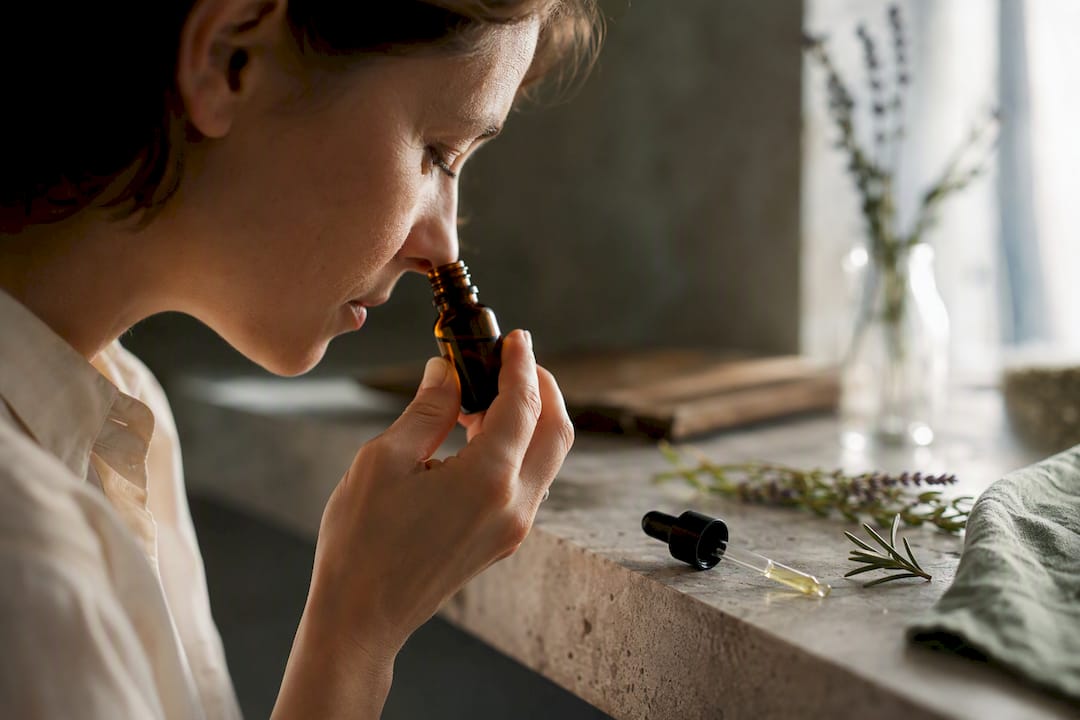
Ask these 10 questions before you hand over your money for any essential oil. Quality and safety in this category aren’t federally regulated in the United States, so the burden falls on you to verify what’s in the bottle. Sellers who can answer clearly, backed by batch-specific documentation and Safety Data Sheets, are the ones worth your business. Some sellers offer free consultations to help you talk it through with someone before buying.
TL;DR:
Ask for batch-specific GC/MS reports to verify the purity of essential oils, as generic or old reports offer little value.
Confirm the Latin botanical name and extraction method, since mislabeling or incomplete details indicate low-quality or adulterated products.
Check that suppliers provide detailed origin, storage, and safety information upfront, especially for expensive oils like rose or frankincense.
Ensure essential oils are stored in dark glass bottles and are fresh, especially citrus oils, which oxidize quickly once opened.
Prioritize vendors willing to answer all questions transparently, including safety data, sourcing claims, and handling procedures, to avoid misleading or unverified products.
Table of Contents
The 10 Questions to Ask Before Buying Essential Oils
Print this list. Email it to a supplier. Copy and paste it into a chat window. However you use it, these are the questions that separate a legitimate essential oil seller from someone repackaging cheap synthetic fragrance and hoping you won’t ask too many questions.
What’s the botanical (Latin) name, and does it match the common name on the label? “Lavender” could mean Lavandula angustifolia or a cheaper hybrid like Lavandula x intermedia, and the two behave differently on skin and in aromatherapy blends. A real supplier states the Latin name without hesitating.
Which plant part did you use, and how was it extracted? Steam distillation, cold expression, and CO2 extraction all pull different compounds from the same plant, and the answer should match the oil’s intended use. If a seller can’t tell you whether your citrus oil was expressed or distilled, they likely don’t know either.
Where did this oil come from, and how was it grown? Country or region of origin affects chemical composition, since soil, climate, and altitude all shape a plant’s oil profile. Ask whether it’s organic, wild-harvested, or conventionally farmed. A supplier proud of its sourcing will tell you exactly where the harvest happened.
Can I see a batch-specific GC/MS report for this exact lot? Gas chromatography-mass spectrometry testing is the closest thing to a gold standard for verifying purity, and it should be tied to the specific lot number on your bottle, not a generic report from a different harvest. If they hand you a report from three years ago with no lot number, that’s not batch-specific. That’s decoration.
Do you have a Safety Data Sheet, and can you tell me the dilution rate? An SDS covers handling, storage, and hazard information, and a seller who stocks one for every oil is treating essential oils like the concentrated chemical compounds they actually are.
Is this a single-note essential oil or a blend? Some products marketed as “pure” are actually infused carrier oils or proprietary blends. There’s nothing wrong with a blend, but you need to know what you’re buying before you dilute it for skin use or diffuse it around pets.
What’s the lot number, production date, and how was it stored before it reached me? Heat and light degrade essential oils fast, and a supplier who can’t answer basic storage questions may have left your lavender baking in a warehouse for months.
Why does this price look the way it does? A liter of rose otto costs vastly more to produce than a liter of tea tree oil, because yield per pound of plant material varies enormously between species. If every oil on a site is priced identically, or one bottle is suspiciously cheaper than everyone else’s, ask why.
How do you handle questions, returns, or a bad batch? Send a real question before you buy and see how long it takes to get a real answer. A supplier who ghosts you before the sale will ghost you after it too.
Can you back up any sustainability or certification claims? “Ethically sourced” and “organic” mean nothing without a certifying body or a specific, verifiable sourcing relationship behind them. Ask who grows the plants and how that relationship works.
Pro Tip: Save the seller’s answers to these 10 questions in one document. If you ever have a reaction, need to reorder a specific batch, or want to compare it against a new supplier, you’ll have a paper trail instead of a foggy memory of “the lavender I liked.”
How to verify what the seller told you
Getting answers is step one. Confirming they’re true is step two, and it takes less time than you’d think.
Match the lot number on the GC/MS report to the lot number on your bottle. If they don’t line up, the report is worthless to you.
Read the actual Safety Data Sheet, not just a summary. It should list handling precautions, storage temperature, and first-aid steps, not marketing language.
Check the bottle itself: dark amber or cobalt glass, a single-ingredient label with the Latin name, extraction method, and country of origin all visible without digging.
Compare price against known yield. Oils like helichrysum or rose are always expensive because the plant material required is enormous; a $6 bottle claiming to be either is not real.
A supplier who can’t produce a document or a sample when asked directly is telling you something, even if they never say it outright. Scent alone won’t tell you if an oil is pure, which is exactly why documentation carries more weight than a seller’s description of how something smells.
Safety rules every responsible seller should explain upfront
A good supplier volunteers safety information before you ask for it. If a website only pushes you toward “buy now” with no mention of dilution or contraindications, that’s a gap worth noticing.
Adults typically dilute essential oils at 1 to 2 percent for topical use, roughly 6 to 12 drops per ounce of carrier oil, and a patch test 24 to 48 hours before wider use catches most sensitivities early.
Citrus and other expressed oils can cause phototoxic reactions if applied before sun exposure, and the risk depends partly on how the oil was extracted.
Pregnancy, infants, serious medical conditions, and pets, especially cats, all carry specific cautions that a knowledgeable seller should flag rather than leave you to discover the hard way.
Store oils in dark glass, away from heat and light, and note the date you opened each bottle since oils lose potency over time after opening.
Pro Tip: Citrus oils are some of the fastest to oxidize once opened. If yours smells sharper or more sour than it did on day one, it’s past its useful window even if the bottle isn’t empty.
Why Palinova builds this checklist into how we sell
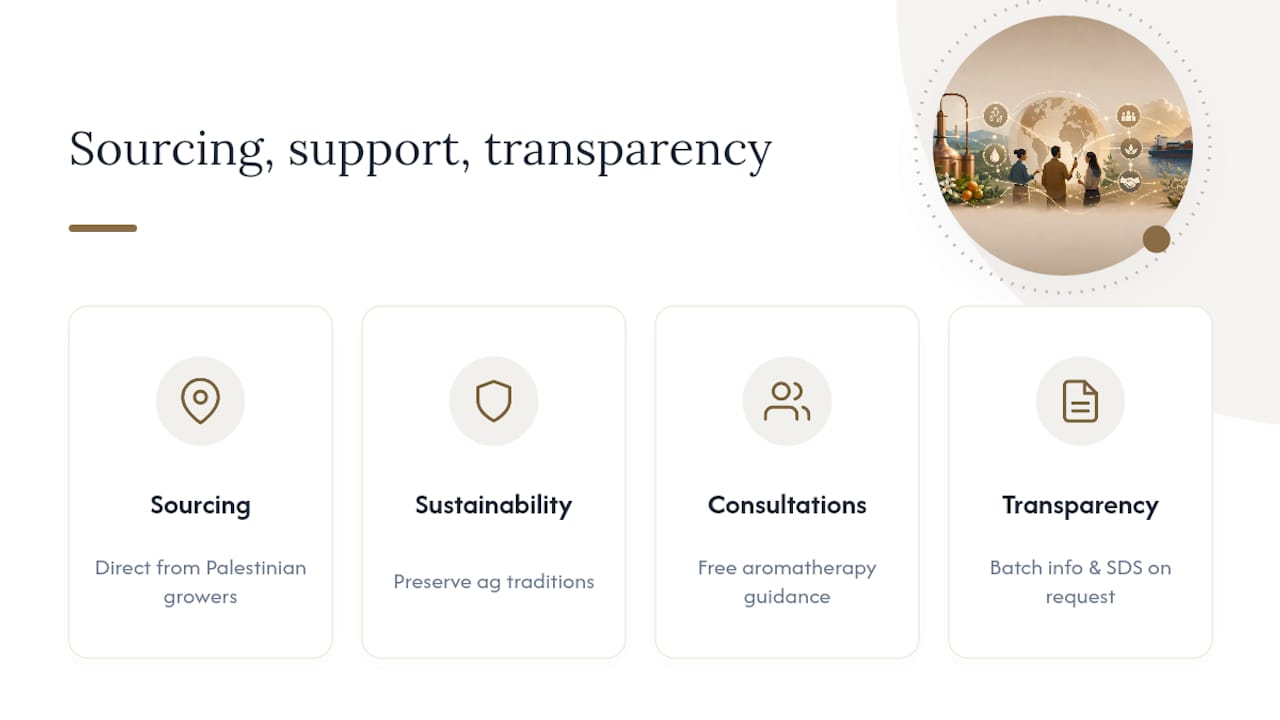
Palinova sources every oil from authentic Palestinian botanicals, working directly with growers who maintain the agricultural traditions behind each plant. That relationship is the foundation of our sustainable sourcing approach, and it means we can answer the questions above without hesitating, because we asked them of ourselves first.
We offer free aromatherapy consultations specifically so you can walk through dilution, safety, and use-case questions with someone before you commit to a bottle. If you want batch information or an SDS for a specific Palinova product, ask. Transparency isn’t a marketing line here. It’s the baseline.
If you’d rather skip the guesswork, here’s where to look
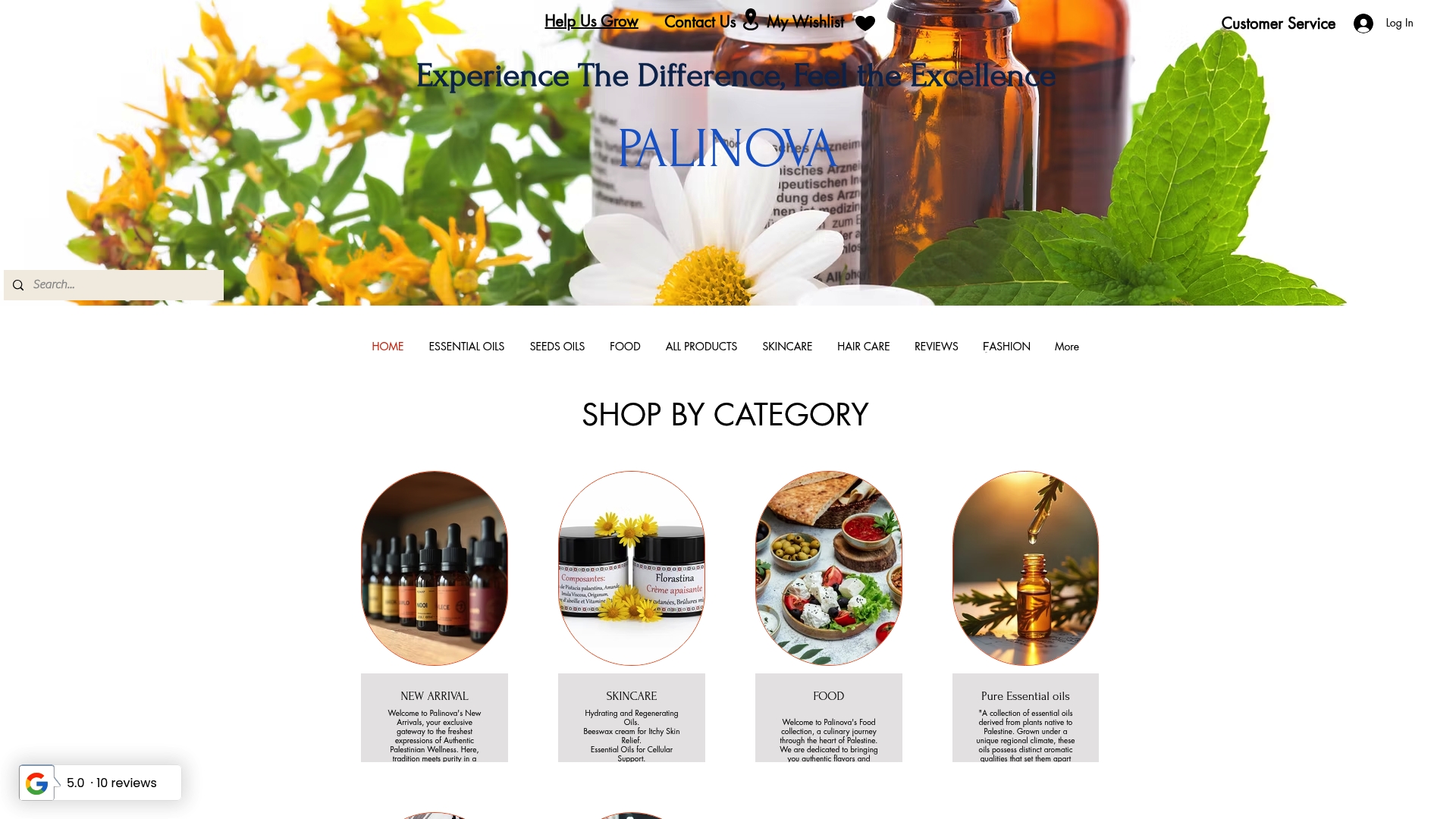
Every question on this checklist points to one thing: buy from a seller who shows their work. Palinova’s shop lists botanical names, origin, and product details on every listing, including oils like Achillea fragrantissima and Origanum syriacum, so you can see exactly what you’re evaluating before you ask a single follow-up question.
If you have a specific skin concern, a pregnancy question, or you’re just not sure which oil fits your situation, request a free aromatherapy consultation and one of our specialists will walk through it with you directly. It costs nothing and takes the guesswork out of a category that’s full of vague claims. Whichever supplier you ultimately choose, run them through the same 10 questions. That consistency is what protects you, not brand loyalty.
Where to verify these claims yourself
For deeper reading on lab testing, sourcing red flags, and safety standards, check the Tisserand Institute, the University of Minnesota’s Taking Charge of Your Wellbeing program, and Greatist’s buying guide.
What buyers get wrong most often
The biggest misconception about essential oil shopping is that “purity” is something you can sense. It isn’t. Adulteration with synthetic isolates or diluted carrier oils often smells fine, sometimes even smells more pleasant than the real thing, because manufacturers optimize fragrance long before they optimize chemistry. That’s the uncomfortable truth the industry doesn’t advertise: your nose is a poor lie detector here.
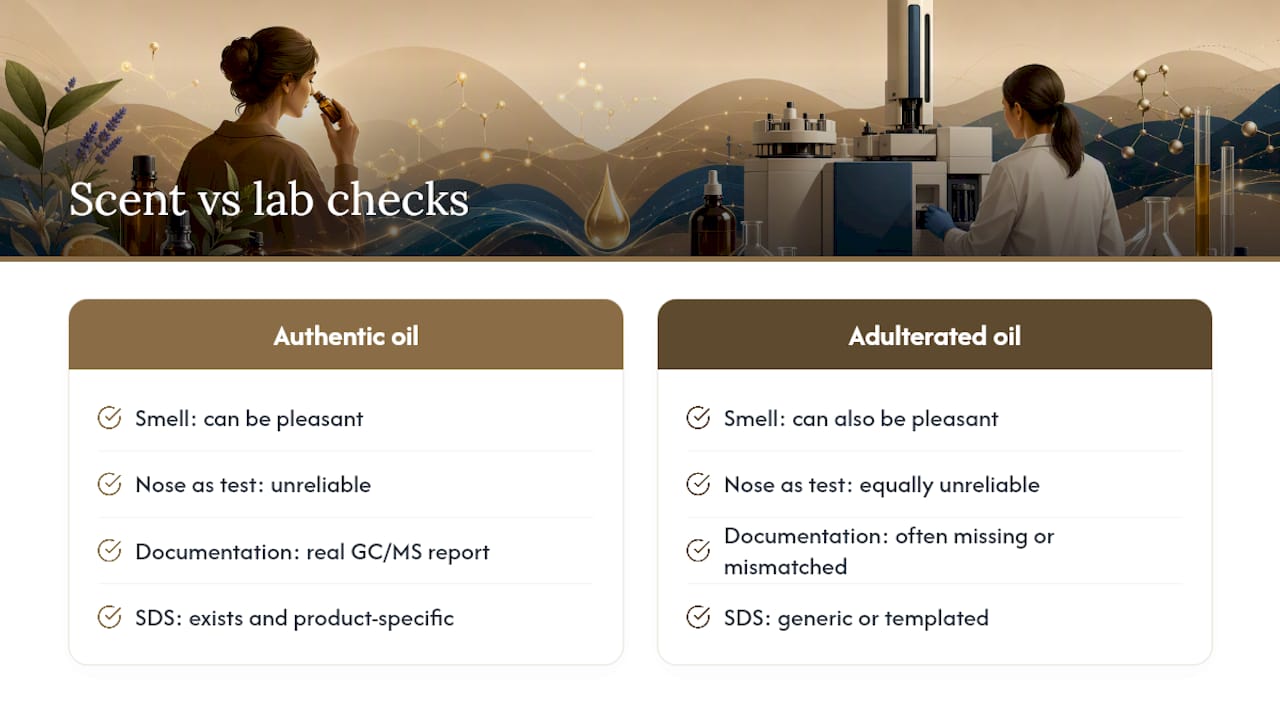
The second mistake is treating “therapeutic grade” as a certification. It isn’t one. No governing body defines or audits that term, so any seller can print it on a label regardless of what’s actually in the bottle. The only claims worth trusting are the ones you can independently check: a lot number that matches a real GC/MS report, a Latin name that matches the species claimed, an SDS that exists and reads like it was written for a real product rather than copied from a template.
What surprises most first-time buyers is how few suppliers actually welcome these questions. A seller with nothing to hide answers fast and specifically. A seller stalling, deflecting to generic marketing copy, or getting defensive about a simple documentation request has already told you what you need to know, whether or not they meant to.
— abdelmuhsen
Sources
FAQ
Do essential oil sellers have to provide a GC/MS report?
No. There’s no federal requirement in the United States, so it’s up to you to ask, and up to the seller to decide whether they’ll provide one tied to your specific batch.
What does “therapeutic grade” actually mean?
Nothing official. No regulatory body defines or certifies that term, so it functions as marketing language rather than a verifiable standard.
How much should I dilute essential oils for skin use?
Most adults use a 1 to 2 percent dilution for general topical application, roughly 6 to 12 drops per ounce of carrier oil, with a patch test beforehand to check for sensitivity.
Does Palinova provide safety data sheets for its oils?
Yes, buyers can request batch information and Safety Data Sheets for Palinova products directly as part of the brand’s transparency practice.
How much do Palinova’s essential oils cost?
Pricing varies by product and current availability, so check the Palinova shop for up-to-date listings on each oil.
Recommended

Comments