
Black Seed Oil for Hair Growth: Evidence and How to Use It
- Palinova
- 15 hours ago
- 9 min read
TL;DR:
Black seed oil can support scalp health and reduce inflammation-related shedding but is not a cure for genetic hair loss.
Consistent use of high-quality, cold-pressed oil over 8 to 12 weeks, with proper patch testing and documentation, yields the best results.
Black seed oil (Nigella sativa) can support scalp health and reduce inflammatory shedding, but it is not a cure for genetic hair loss. If you’re dealing with telogen effluvium, scalp inflammation, or dandruff-driven thinning, the evidence is genuinely encouraging. For advanced androgenetic alopecia, it’s a supportive tool at best.
Three steps to take right now:
Patch test first. Apply a diluted drop to your inner arm and wait 48 hours before any scalp use.
Choose a cold-pressed product. Look for single-ingredient Nigella sativa oil with no added fillers. Palinova Nigella Sativa (Black Seed) Oil is cold-pressed, traceable, and free from synthetic additives.
Run a documented 8–12 week trial. Track shedding counts and photograph your hairline every two weeks so you can actually measure progress.
Table of Contents
What does the clinical evidence say about black seed oil and hair loss?
The research base is real but modest. A controlled instrumental assessment published in the SOFW Journal applied a 5% scalp lotion containing standardized black seed oil (3% thymoquinone) to 22 volunteers daily for 28 days. Shedding decreased by 35% and hair density increased by approximately 7% over that period. Short trial, small group, but instrumented measurements rather than self-report.
Separate clinical reviews on PMC document small randomized trials showing improvements in hair density and thickness in telogen effluvium patients using topical Nigella sativa formulations. The 2014 trial that anchors much of this literature used a placebo-controlled design and reported significant improvements in select populations.
Study type | Population | Duration | Key outcome | Limitation |
Instrumental assessment (SOFW) | 22 volunteers | 28 days | 35% less shedding, ~7% density gain | No placebo arm; standardized lotion, not raw oil |
Small RCTs (PMC review) | Telogen effluvium patients | Several weeks | Improved density and thickness vs. placebo | Small samples, short follow-up |
Plant-oil RCT (rosemary blend) | General hair-loss participants | 90 days | Improved growth rate, thickness, and density vs. coconut oil | Rosemary-based, not BSO alone |
The broader picture from systematic reviews is that many studies combine black seed oil with other ingredients, making it hard to isolate its contribution. Thymoquinone concentration also varies widely between consumer products and clinical formulations, which partly explains inconsistent results across studies.
How black seed oil may act on your scalp and follicles
The most studied active compound in Nigella sativa is thymoquinone (TQ). Mechanistic and preclinical research shows TQ has measurable antioxidant and anti-inflammatory effects, including inhibition of COX-2 and prostaglandin D2 (PGD2) pathways. PGD2 is particularly relevant because elevated scalp PGD2 is associated with follicle miniaturization in androgenetic alopecia, though TQ’s effect on that specific pathway in humans remains under-studied.
Beyond TQ, black seed oil is rich in linoleic acid and oleic acid, both of which support the scalp’s lipid barrier and help retain moisture around the follicle. Vitamin E adds antioxidant coverage at the skin surface. Trichologists describe this combination as creating better “soil” for hair: a less inflamed, better-hydrated scalp environment where follicles can function closer to their potential.

The antimicrobial properties of Nigella sativa are also worth noting for anyone dealing with dandruff or seborrheic dermatitis. Fungal and bacterial overgrowth on the scalp drives chronic inflammation that accelerates shedding. Reducing that microbial load can meaningfully cut inflammation-driven hair loss, which is a different mechanism from directly stimulating follicle growth.
One honest caveat: mechanistic plausibility is not the same as proven clinical regrowth. The pathways are credible; the human trial data is still limited in scale.
How to use black seed oil for your hair and scalp
The method matters as much as the product. Follow these steps in order.
Patch test (48 hours before first use). Mix one drop of black seed oil with three drops of a neutral carrier oil such as jojoba or sweet almond. Apply to your inner forearm. Cover loosely and leave for 48 hours. Redness, swelling, or itching means stop and consult a dermatologist before any scalp application.
Dilute before applying to the scalp. A ratio of roughly 10–20% black seed oil to 80–90% carrier oil is the standard starting point. Undiluted application increases irritation risk, particularly on a sensitive or inflamed scalp.
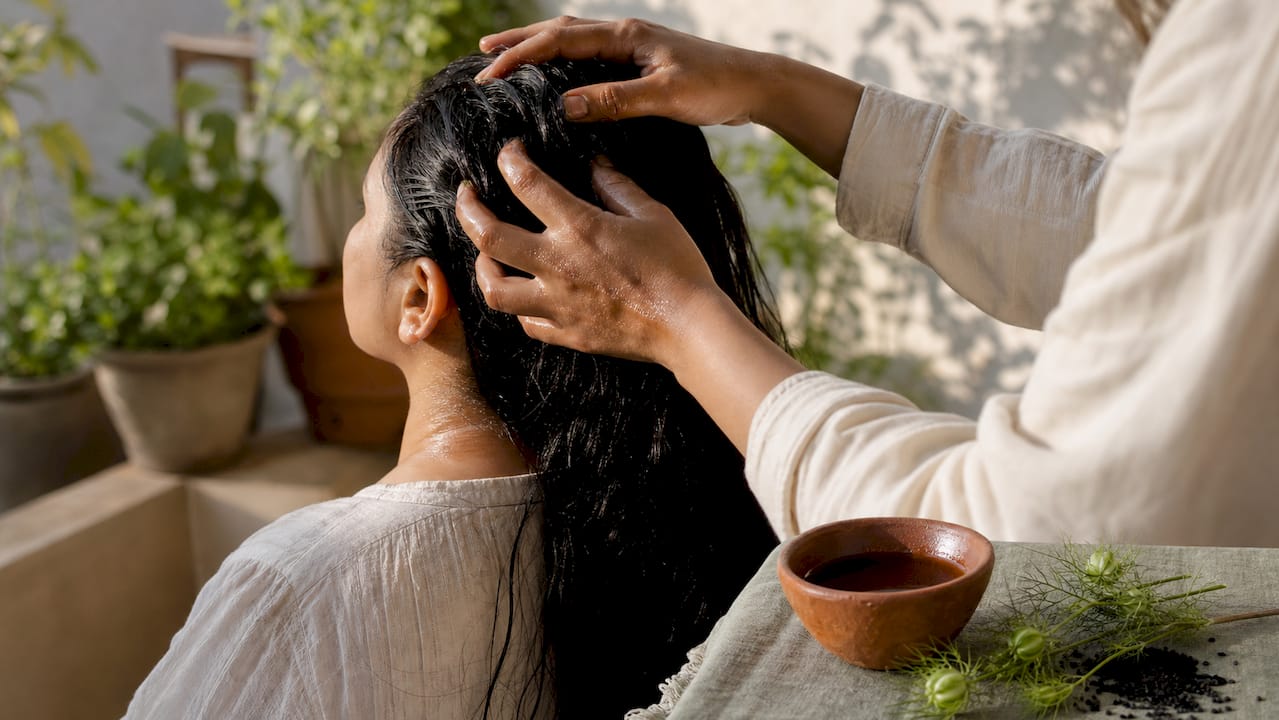
Pre-wash scalp mask (most common method). Warm a few drops of your diluted blend between your palms, section the hair, and apply directly to the scalp. Massage gently for 3–5 minutes to encourage absorption. Leave on for 30 minutes to overnight, then shampoo out. Frequency: 2–3 times per week.
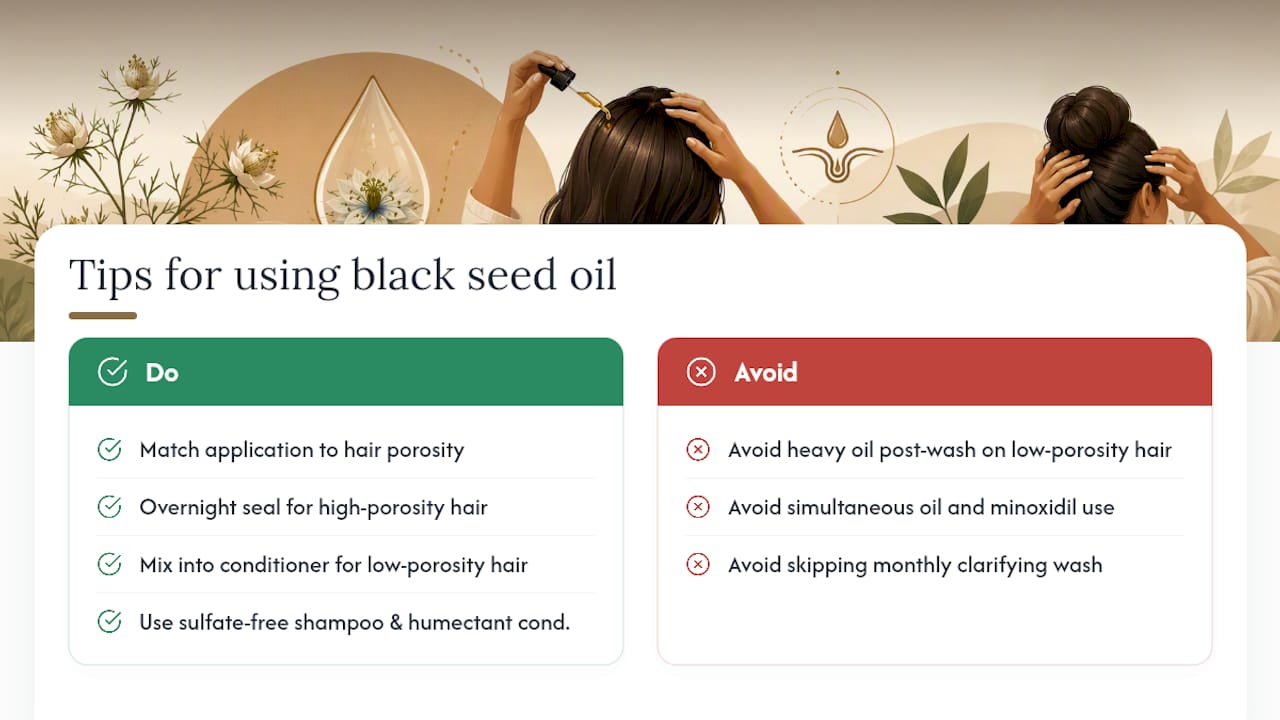
Overnight sealant for dry or high-porosity hair. Apply a slightly richer amount to the scalp and lengths after washing. Cover with a satin cap. This works well for coily and Afro-textured hair, where moisture retention is a priority.
Add to conditioner or shampoo. For low-porosity hair, which resists oil penetration, mix 3–5 drops into your conditioner before applying. This delivers the oil’s benefits without the risk of buildup on the scalp.
Track your results. Take a photo of your hairline and parting under consistent lighting every two weeks. Count shed hairs in the shower drain over a week and log it. Trichologists and hair-care specialists recommend expecting measurable change at 8–12 weeks, with some metrics (scalp comfort, reduced itch) improving earlier.
Pro Tip: For Afro-textured or coily hair, use black seed oil as a pre-poo treatment: apply to dry hair 30–60 minutes before washing to protect strands from hygral fatigue during cleansing, rather than applying post-wash when low-porosity strands may reject the oil.
Who should be cautious, and what are the side effects?
Most people tolerate topical black seed oil well when it’s diluted. That said, a few groups need extra care.
Common side effects include mild scalp irritation, contact dermatitis in sensitive individuals, and increased oiliness or folliculitis if too much product is applied too frequently. If you notice persistent itching, a rash, or small pimples along the hairline, reduce frequency or concentration and give the scalp a week to recover.
Pregnancy and breastfeeding. Safety data for topical Nigella sativa during pregnancy is limited. Oral black seed oil has uterine-stimulant effects documented in animal studies. Topical exposure is lower than oral, but the data gap is real. Consult your OB or midwife before use.
Drug interactions. If you’re using topical minoxidil or any prescription scalp treatment, check with your prescribing clinician before adding black seed oil to the same area. Layering products can affect absorption and irritation profiles.
Stop use and see a clinician if you develop a spreading rash, facial swelling, or any sign of systemic reaction. These are rare but warrant immediate attention.
Pro Tip: Run the 48-hour patch test even if you’ve used black seed oil on your skin before. Formulations vary, and a new batch or brand can have a different sensitization profile.
When can you realistically expect to see results?
Scalp-level changes tend to come first. Most people notice reduced itching, less flakiness, and improved moisture within weeks 2–6 of consistent use. These are signs the oil is doing its anti-inflammatory and barrier-support work.
Hair density and reduced shedding take longer. The SOFW instrumental assessment showed measurable changes at 28 days with daily application of a standardized lotion. In the broader clinical literature, most trials run 8–12 weeks before measuring density outcomes. Patience is not optional here — the hair cycle itself means any follicle-level change takes time to show up as visible growth.
When to see a clinician:
Rapid, diffuse shedding that started suddenly (could indicate thyroid, iron deficiency, or another systemic cause)
Patterned recession at the temples or crown (androgenetic alopecia needs a different treatment approach)
Scalp scarring, persistent pain, or unusual texture changes (possible scarring alopecia, which requires prompt evaluation)
Black seed oil is not a substitute for a diagnosis. If you’re unsure what’s driving your hair loss, a dermatologist or trichologist visit before starting any regimen is the smarter move.
Practitioner tips for better results with black seed oil
Three non-obvious points that make a real difference in practice.
Pro Tip: Match your application method to your hair’s porosity. High-porosity hair benefits from overnight sealing treatments; low-porosity hair does better with oil mixed into conditioner or brief pre-wash applications. Applying a heavy oil to low-porosity hair post-wash just sits on the strand and creates buildup without penetrating.
Trichologists consistently note that black seed oil works best as part of a moisture-forward routine, not as a standalone product. Pairing it with a gentle, sulfate-free shampoo and a humectant-rich conditioner gives the scalp the full environment it needs.
On product buildup: if you’re using black seed oil 2–3 times per week and notice your scalp feeling congested or your hair looking dull, do a clarifying wash once a month. Buildup blocks the follicle opening and counteracts the oil’s benefits.
If you’re combining black seed oil with minoxidil or another prescription treatment, apply them at different times of day and let each absorb fully before applying the next. Mixing them in the same application window can alter absorption. Always confirm this with your prescribing clinician.
For personalized guidance on how to work Palinova’s black seed oil into your specific routine, Palinova offers free aromatherapy consultations. The Palinova hair care approach is built around matching the right botanical oil to the individual’s scalp condition, not a one-size-fits-all protocol.
Key Takeaways
Black seed oil supports scalp health and can reduce inflammatory shedding, but cold-pressed quality, consistent application, and an 8–12 week documented trial are what separate real results from wishful thinking.
Point | Details |
Evidence is real but limited | Small RCTs and a 28-day instrumental assessment show reduced shedding and modest density gains; large-scale trials are still needed. |
Mechanism is credible | Thymoquinone’s anti-inflammatory and antioxidant actions address scalp conditions that drive shedding, not genetic follicle loss. |
Protocol matters | Use cold-pressed oil, dilute to 10–20%, apply 2–3 times per week, and track results over 8–12 weeks before judging effectiveness. |
See a clinician for patterned loss | Rapid or patterned hair loss needs a diagnosis; black seed oil is supportive, not a medical treatment. |
Palinova recommendation | Palinova’s cold-pressed Nigella Sativa Oil matches the quality criteria the clinical literature points to for consistent outcomes. |
The case for realistic expectations
There’s a version of the black seed oil conversation that I find frustrating: the one where it’s either dismissed as folk medicine with no evidence, or hyped as a miracle regrowth serum. Neither is accurate, and both leave people worse off.
The honest picture is that black seed oil has a plausible mechanism, a small but real body of clinical evidence, and a strong safety profile when used correctly. What it doesn’t have is a large randomized controlled trial proving it regrows hair in androgenetic alopecia. That gap matters. Recommending it as a primary treatment for genetic hair loss would be misleading. Dismissing it entirely for inflammatory shedding, scalp health, and moisture retention would be equally wrong.
Palinova’s approach is to be straight about what the evidence supports and what it doesn’t. The free aromatherapy consultations exist precisely because hair loss is not a single condition, and the right botanical protocol depends on what’s actually driving the problem.
Palinova Nigella Sativa Oil: a practical starting point
If you’ve read this far and want to try a documented protocol, the starting point is a product that actually matches the quality criteria the research points to.

Palinova’s Nigella Sativa (Black Seed) Oil is cold-pressed from single-origin Palestinian seeds, free from synthetic additives, and packaged to protect the oil’s active compounds from light degradation. It fits the buying checklist in this article: single ingredient, cold-pressed, traceable sourcing. Use it as a pre-wash scalp mask (diluted 1:4 with jojoba), an overnight sealant for dry or coily hair, or mixed into your conditioner for low-porosity strands, 2–3 times per week over an 8–12 week trial.
Palinova also carries a hair growth oil blend for those who want a ready-formulated option, and the Barbary Fig Seed Oil for complementary skin-barrier support. Not sure which product fits your scalp condition? Book a free aromatherapy consultation directly through the Palinova store and get a personalized recommendation before you buy.
Useful sources and further reading
This article draws on the following primary sources. Evidence strength for black seed oil and hair growth is promising but not yet definitive; large-scale human trials are still needed. For persistent or patterned hair loss, consult a board-certified dermatologist or trichologist.
This article is general information, not medical advice. Confirm current treatment options with a qualified dermatologist or trichologist, especially for persistent or patterned hair loss.
FAQ
What are the best natural oils for hair regrowth?
Rosemary oil has the strongest clinical trial evidence for hair growth, with a 90-day RCT showing improved growth rate, thickness, and density versus coconut oil. Black seed oil is a strong supporting option for inflammatory shedding and scalp health.
How often should you put black seed oil in your hair?
Two to three times per week is the standard recommendation from trichologists and hair-care specialists, applied as a diluted pre-wash mask or scalp treatment and left on for 30 minutes to overnight.
What should you not mix with black seed oil?
Avoid combining black seed oil with other potent actives like undiluted essential oils or prescription scalp treatments in the same application. If you use topical minoxidil, apply them at separate times of day and confirm the combination with your clinician.
How long does black seed oil take to show results for hair?
Scalp comfort and reduced flakiness can improve within 2–6 weeks. Measurable changes in shedding and hair density typically appear at 8–12 weeks of consistent use, based on the clinical trial data reviewed here.
Recommended