
Taste Palestinian Olive Oil in 10 Minutes: Olive Oil Tasting at Home


Olive oil tasting is a sensory check for freshness and quality, not a wine-style ranking of “good” versus “bad.” Three hallmarks tell you an oil is alive: fruitiness on the nose, a clean bitterness on the sides of the tongue, and a peppery bite at the back of the throat. If instead you get flat, musty, metallic, or crayon-like notes, walk away from that bottle.
TL;DR:
High-quality olive oil should exhibit fruity, bitter, and peppery notes, with each contributing to the oil’s freshness and antioxidant level.
Tasting involves warming the oil, swirling, smelling, and slurping with air, while judging pungency often builds after swallowing.
Defects like rancid, musty, metallic, or vinegary aromas indicate poor quality or spoilage, and should be rejected.
Comparing multiple oils side-by-side ensures accurate evaluation of flavor differences, with blind coding preventing bias.
Freshness relies more on recent harvest and proper storage than on brand or packaging; oils pressed within 12 to 18 months are generally brighter and healthier.
Table of Contents
What You Need to Set Up an Olive Oil Tasting Session
You don’t need a lab to taste like the professionals who write the International Olive Council’s standards. You need a small glass, a quiet room, and about ten minutes when your palate isn’t fighting off coffee breath or a heavy lunch.
Professional panels pour a small amount into a covered, cobalt-blue tasting glass so color can’t bias the taster’s judgment, since darker or greener oils get rated as “better” purely on looks even when the chemistry says otherwise. At home, any small clear glass or coffee cup works fine, with about two tablespoons of oil.
Warm the glass in your cupped hands for 30 to 60 seconds. This isn’t cosmetic. Heat releases the volatile aromatic compounds that carry fruitiness and defect notes alike.
Taste in a room free of cooking smells, candles, or strong coffee.
Morning works best, before your palate gets fatigued by other foods, following the IOC’s protocol for target tasting temperature around 28°C.
If you’re comparing several oils, code them (A, B, C) or have a friend pour without telling you the brand, so labels don’t sway your judgment.
Cap your session at four or five oils. Your palate saturates fast.
How Do You Actually Taste Olive Oil Step by Step?
Once your oil is warmed and poured, the actual tasting follows a short, repeatable sequence borrowed from the IOC’s official tasting methodology, scaled down for a kitchen counter instead of a certified panel room.
Swirl and smell. Cup the glass, swirl gently to coat the sides, and bring it to your nose. Sniff briefly, not exceeding about half a minute. Note what comes up first: grass, green apple, tomato leaf, ripe fruit, or nothing at all.
Take a small sip. A small mouthful, enough to coat your tongue, is enough. Don’t swallow yet.
Slurp with air. Pull air across the oil while it’s still in your mouth, the way you’d slurp hot soup. This aerates the oil and pushes aroma up into your nasal passages from the inside, called retro-nasal olfaction. It’s where most of the flavor complexity actually registers.
Spread it across your mouth. Move the oil over your tongue and the roof of your mouth. Bitterness shows up most strongly on the sides and back of the tongue.
Swallow or spit, then wait. If you swallow, pay attention to your throat. A cough or a sharp catch a few seconds later is pungency, the peppery kick from oleocanthal, a compound tied to the oil’s fresh polyphenol content.
Pro Tip: Don’t judge pungency the moment oil hits your throat. It often builds for five to ten seconds after you swallow. Rushing to a verdict too early is the most common mistake first-time tasters make.
Limit yourself to a few samples per session; more than that and your palate can’t reliably distinguish anything. Cleanse between oils with a slice of green apple and a sip of water, and if you’re running a longer comparison, take a suitable break between sessions to reset your senses, a practice recommended by olive oil educators who run home tasting sessions.
What Do Positive Notes and Defects Actually Taste Like?
A high-quality extra-virgin oil announces itself through three attributes working together, and their intensity actually tells you something concrete about the oil’s chemistry.
Fruitiness ranges from green (grass, artichoke, green apple, tomato leaf) to ripe (banana, tropical fruit, mellow olive). Bitterness should feel clean and quick, not lingering or harsh, and it shows up mainly on the tongue’s sides. Pungency is that peppery catch in the throat. Together, bitterness and pungency track directly with polyphenol content, the antioxidant compounds tied to olive oil’s health reputation. An oil with zero bite in the throat isn’t necessarily “mild.” It’s often just old, over-refined, or from olives pressed well past their prime.
Defects tell the opposite story, and each one points to a specific failure in growing, milling, or storage:
Rancid smells like old walnuts or crayons, the result of oxidation from age, heat, or light exposure.
Musty or fusty smells fermented, like wet basement or old hay, usually from olives piled too long before pressing.
Metallic tastes tinny or coppery, often from prolonged contact with metal equipment or containers during processing.
Vinegary carries a sharp, sour bite, a sign of uncontrolled fermentation in the fruit before milling.
Home tasters can reliably catch these defects with nothing more than a warmed glass and a structured routine, according to University of California extension research on DIY tasting. If an oil tastes flat with zero fruit, zero bitterness, and zero pepper, that’s not a “mild” oil. That’s a tired one.
Building a Vocabulary for Tasting Notes
Wine tasters borrowed a whole vocabulary from botany and baking to describe what’s in the glass. Olive oil tasting deserves the same precision, and it’s easier to learn than it looks.
Common aroma and flavor descriptors include green apple, tomato leaf, artichoke, freshly cut grass, almond, walnut skin, and ripe stone fruit. Intensity gets rated simply: mild, medium, or robust, based on how strongly fruitiness, bitterness, and pungency come through. Balance matters too. An oil can be robust in fruit but mild in pepper, or the reverse, and neither is automatically better. It depends on what you’re pairing it with.
A simple template turns a vague impression into something you can actually compare across bottles later:
Fruitiness: mild / medium / robust, with descriptor (e.g., green apple, ripe olive) Bitterness: mild / medium / robust Pungency: mild / medium / robust Overall balance: notes on how the three interact Best for: raw drizzling, roasting, dipping bread, finishing soups
Professional panels use median scores across multiple tasters to classify oils under IOC standards. You don’t need a panel. Even a solo taster who jots down three or four words after each sample builds a reference library fast, and within a few sessions you’ll start predicting what you’ll like before the oil even hits your tongue.
Buying and Storing Oil So It Still Tastes Fresh
The tasting notes on a bottle mean nothing if the oil was already stale before it reached your kitchen, and storage after opening matters just as much as what you bought.
Look for a harvest date, not just a “best by” date. Oil pressed within the last 12 to 18 months tastes noticeably brighter than oil sitting on a shelf for two or three years. Terms like “early harvest” or “first cold-pressed” usually signal olives picked young, which means more bitterness and pepper. Dark glass or tin containers protect against light degradation, and small-batch producers who publish actual tasting notes on their product pages are usually more transparent about quality than mass-market brands that print none at all.
Check for a harvest year printed on the label, not just a shelf-life date.
Favor dark glass, tin, or opaque bottles over clear glass.
Store opened oil in a dark cupboard away from the stove, not on a countertop rack.
Use opened oil within two to three months for the best flavor.
Don’t rely on a fridge test alone. Cloudiness at cold temperatures is normal for real olive oil and doesn’t reliably indicate quality one way or the other. Your palate remains the most dependable tool you have.
Why Palinova Cares About Tasting
Palinova’s roots run through Palestinian olive groves where families have pressed oil the same way for generations, detailed in our piece on Palestinian olive oil from grove to table. Tasting isn’t a novelty exercise for us. It’s how we and our customers judge whether a batch honors that heritage.
The same sensory literacy that tells you an oil is fresh in the kitchen also informs how olive-derived oils perform on skin, since oxidized oils lose the compounds that make them useful topically just as surely as they lose flavor. A bottle worth cooking with is usually a bottle worth trusting on your face, too.
What Kind of Olive Makes the Biggest Flavor Difference?
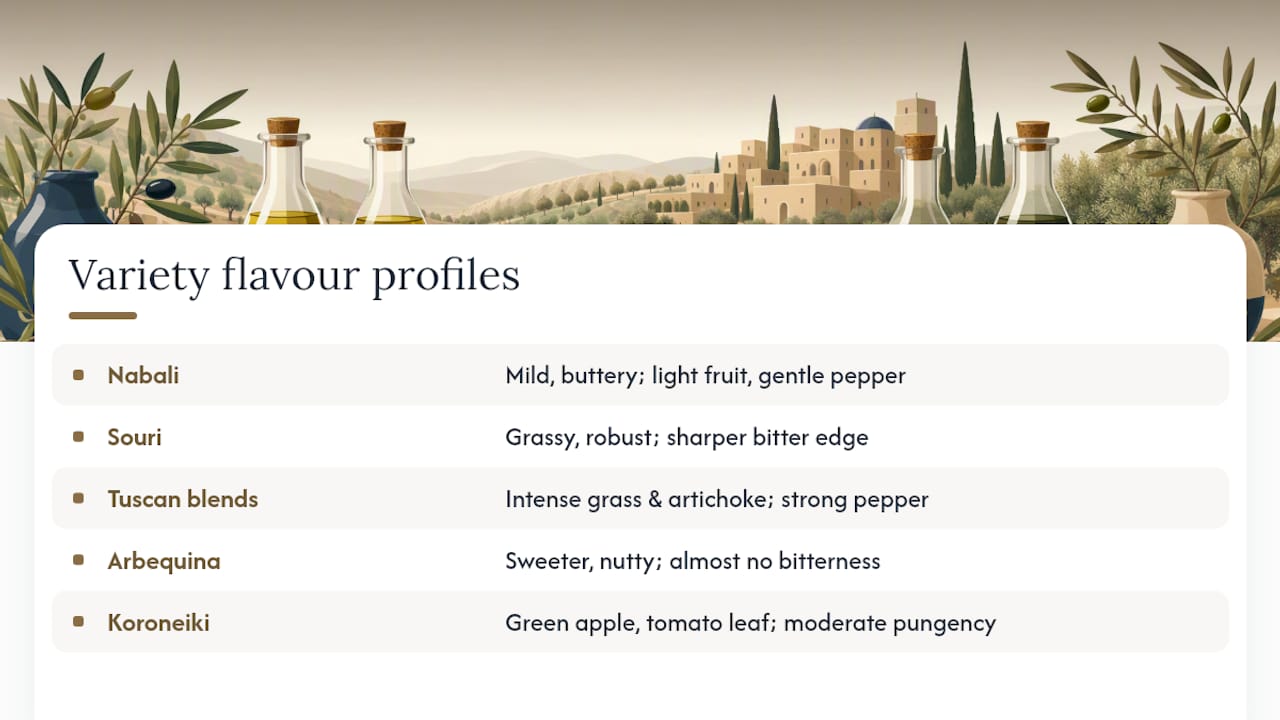
Olive variety shapes an oil’s personality more than almost any other factor, including region. Nabali, a variety native to Palestine, tends toward a milder, buttery profile with light fruitiness and gentle pepper, which is one reason it’s prized for everyday cooking rather than aggressive raw drizzling. Souri, another Levantine variety, leans grassier and more robust, with a sharper bitter edge that holds up in dishes with bold competing flavors.
Outside the region, Tuscan blends built from Frantoio and Moraiolo olives typically deliver intense grass and artichoke notes with a strong peppery finish, the kind that makes you cough on the first sip if it’s genuinely fresh. Arbequina, common in Spain, runs sweeter and nuttier with almost no bitterness, which makes it approachable for people who find robust oils harsh. Koroneiki, Greece’s dominant variety, sits somewhere in the middle: green apple and tomato leaf notes with moderate pungency.
None of these is objectively “best.” A Souri-heavy oil might overwhelm a delicate fish dish where a milder Nabali would let the fish shine, while that same Nabali would get lost drizzled over a peppery arugula salad that wants something with more bite. Learning to match variety to dish is really the entire point of building a tasting vocabulary in the first place. Once you know what Nabali tastes like versus Koroneiki, you stop buying oil by brand alone and start buying it by flavor profile, which is a genuinely different and better way to shop.
How Do You Compare Multiple Olive Oils at Once?
Side-by-side comparison is where tasting notes actually pay off, because memory alone won’t tell you reliably whether Tuesday’s bottle was more bitter than last month’s.
Line up three or four oils, coded with letters instead of visible labels, so brand recognition doesn’t color your judgment before your palate even gets involved. Taste them in the same session, using the identical swirl, sniff, slurp, and swallow sequence for each one, and cleanse with apple and water between every single sample without exception. Score each oil on your fruitiness, bitterness, and pungency template right after tasting it, while the impression is still sharp, not at the end of the session when your memory of the first oil has already faded.
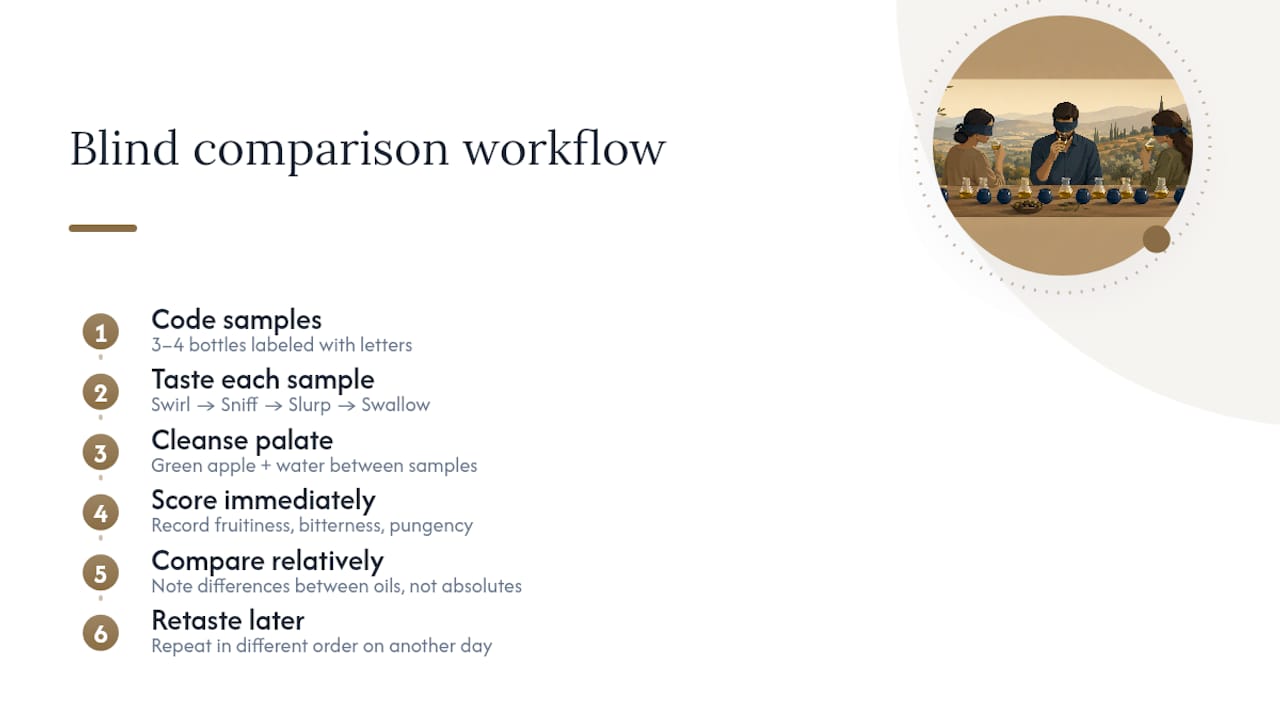
Pay attention to relative differences rather than absolute judgments. If Oil A has noticeably more throat pungency than Oil B, that’s useful information regardless of whether you’d call either one “robust” in isolation. Retaste in a different order on a second day if you’re on the fence. Palate fatigue and the order you taste in can both skew a single-session verdict, which is exactly why professional panels use multiple tasters and multiple sessions rather than trusting one person’s single pass.
Are There Any Safety Concerns With Olive Oil Tasting?
Tasting oil straight, without bread or other food to buffer it, is more intense than most people expect, and a few precautions keep the experience pleasant rather than uncomfortable.
Pure olive oil, particularly a robust, high-polyphenol batch, can cause a genuine coughing fit the first time you swallow it and feel the throat pungency hit. That’s a normal reaction to oleocanthal, not a sign anything is wrong, but pace yourself, especially if you have a sensitive throat or asthma that reacts to strong sensory triggers. If you’re allergic to olives themselves, which is rare but documented, or to any tree nut given cross-contamination risks in some processing facilities, check a producer’s allergen statement before tasting an unfamiliar oil.
Tasting on an empty stomach can also amplify the sensory hit and, for some people, cause mild stomach discomfort, so a light snack beforehand is reasonable if you’re planning to work through several samples. Never taste an oil you suspect is spoiled just to “confirm” it. Rancid or fermented oil won’t poison you in a small sip, but there’s no reason to swallow something your nose has already told you to reject. Trust the reflex.
The Real Value of Learning to Taste Olive Oil Properly
Most guides treat olive oil tasting like a party trick, something you do once at a tasting event and then forget. That undersells what’s actually useful here. The real payoff is learning to shop differently. Once you’ve tasted the difference between a peppery, fresh Souri and a flat, over-the-hill supermarket blend, you stop trusting shelf marketing and start trusting your own palate.
The conventional advice oversells equipment: fancy tasting kits, cobalt glasses, thermometers. None of that matters nearly as much as consistency, tasting the same way every time so your comparisons mean something. What the research actually supports is simpler than most articles admit: warm the oil, slurp with air, wait for the throat pungency, and write down three words. Do that consistently and you’ll outpace most casual buyers within a handful of sessions.
If there’s one thing to prioritize first, it’s this: stop treating bitterness and pepper as flaws. That single mental shift, from “harsh” to “fresh,” changes how you shop for oil permanently.
— abdelmuhsen
Bring That Tasting Skill Home With Palinova
Once you know what fresh fruitiness and real throat pungency taste like, a lot of supermarket oil stops passing the test. Palinova sources its olive oil directly from small Palestinian groves, with harvest information listed on the product page so you’re not guessing at freshness the way you would with an unlabeled bottle.
Our extra-virgin olive oil is pressed in small batches, which is exactly the kind of freshness cue this guide just taught you to look for: recent harvest, minimal processing, no long shelf life eating away at the polyphenols that give you that peppery finish. If you’re also exploring how these oils perform outside the kitchen, our guide to choosing Palestinian essential oils for skincare and this partner breakdown of moisturizer ingredients are worth a look. Ready to taste the difference for yourself? Browse our newest arrivals and see what a genuinely fresh, small-batch oil brings to your kitchen.
FAQ
How Many Olive Oils Should You Taste in One Session?
Stick to four or five oils per session. Beyond that, palate fatigue makes it hard to reliably tell one sample from the next.
What Does a Peppery Throat Sensation Mean?
A sharp catch in the throat after swallowing signals oleocanthal, a polyphenol compound linked to freshness, not a flaw or defect.
Why Does My Olive Oil Taste Bitter?
Clean bitterness on the sides of your tongue is a positive sign of polyphenol content and freshness, not evidence of a bad oil.
How Do I Know if Olive Oil Has Gone Rancid?
Rancid oil smells like old walnuts or crayons instead of grass or fruit. If you catch that smell, skip tasting further and don’t cook with it.
Does the Harvest Date Matter More Than the Brand?
Yes. An oil with a recent harvest date, like one from a small-batch producer such as Palinova, typically tastes fresher than an older oil regardless of brand reputation.
Recommended


Comments