
2% Default and 12 Drops: Safe Essential Oil Dilution

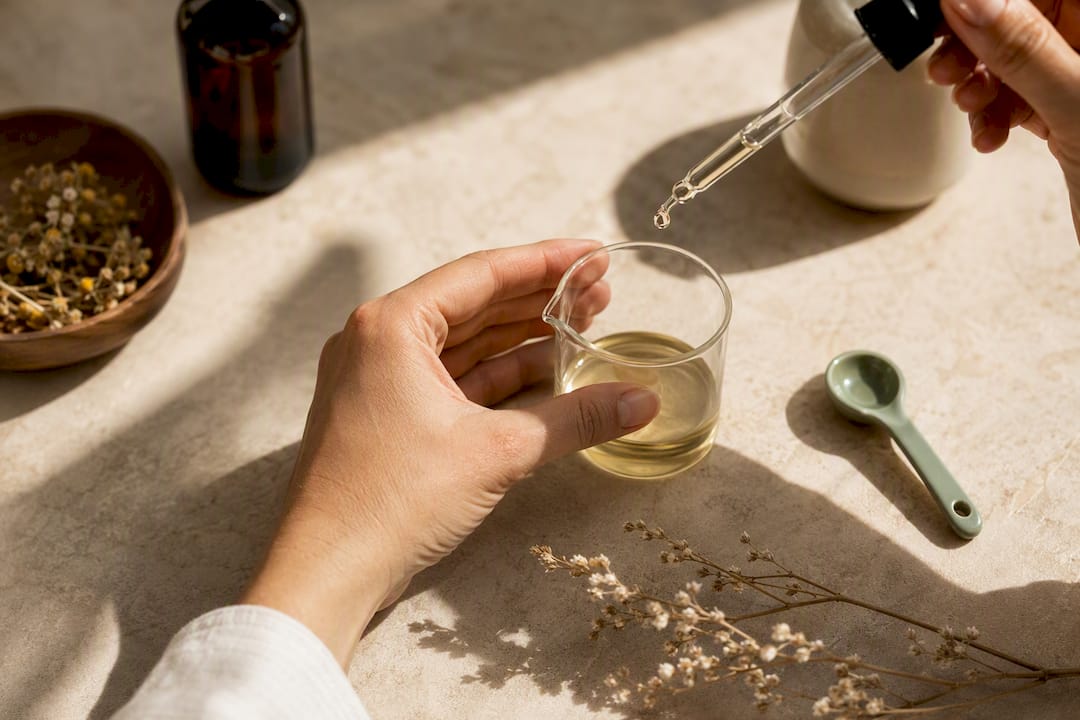
The correct way to dilute essential oils is percentage-based math, not guesswork, and 2% is the working default for most adults using a topical blend daily. Never apply undiluted oil to skin. Patch test first, and cross-check any oil you’re unsure about against Tisserand Institute or NAHA guidance, or through a Palinova aromatherapy consultation, before you mix anything new.
TL;DR:
A 2% dilution in topical blends typically requires about 12 drops of essential oil per 30 mL of carrier oil, but actual drop size varies with oil viscosity.
For sensitive skin or facial use, essential oils should be diluted between 0.2% and 1%, with 2% being standard for general body applications, to minimize irritation.
Use precise tools like graduated syringes or calibrated droppers to measure drops, especially in small bottles, to avoid over- or under-dilution.
Always patch test diluted blends first and consider lower dilutions for children, pregnant women, or those with sensitive skin, to prevent adverse reactions.
Source oils from reputable suppliers like Palinova to ensure product purity and accurate dilution calculations based on authentic, unsweetened botanicals.
Table of Contents
Essential Oil Dilution Chart: Drops Per Bottle Size
Forget the “one drop per teaspoon” folk math you’ve probably seen passed around. Percentages scale correctly across any bottle size, while drop-based rules of thumb fall apart the moment you switch containers. A 1% dilution in a 10 mL roller and a 1% dilution in a 60 mL bottle require completely different drop counts, and treating them the same is how people end up over-diluted in one bottle and under-diluted in another.
Here’s the quick-reference math, based on the standard assumption of roughly 20 drops per mL, which NAHA’s application guidelines use as the working baseline for drops-per-ounce conversions.
A 2% dilution works out to about 12 drops of essential oil per 30 mL of carrier oil — the single number worth memorizing if you only remember one from this entire chart.
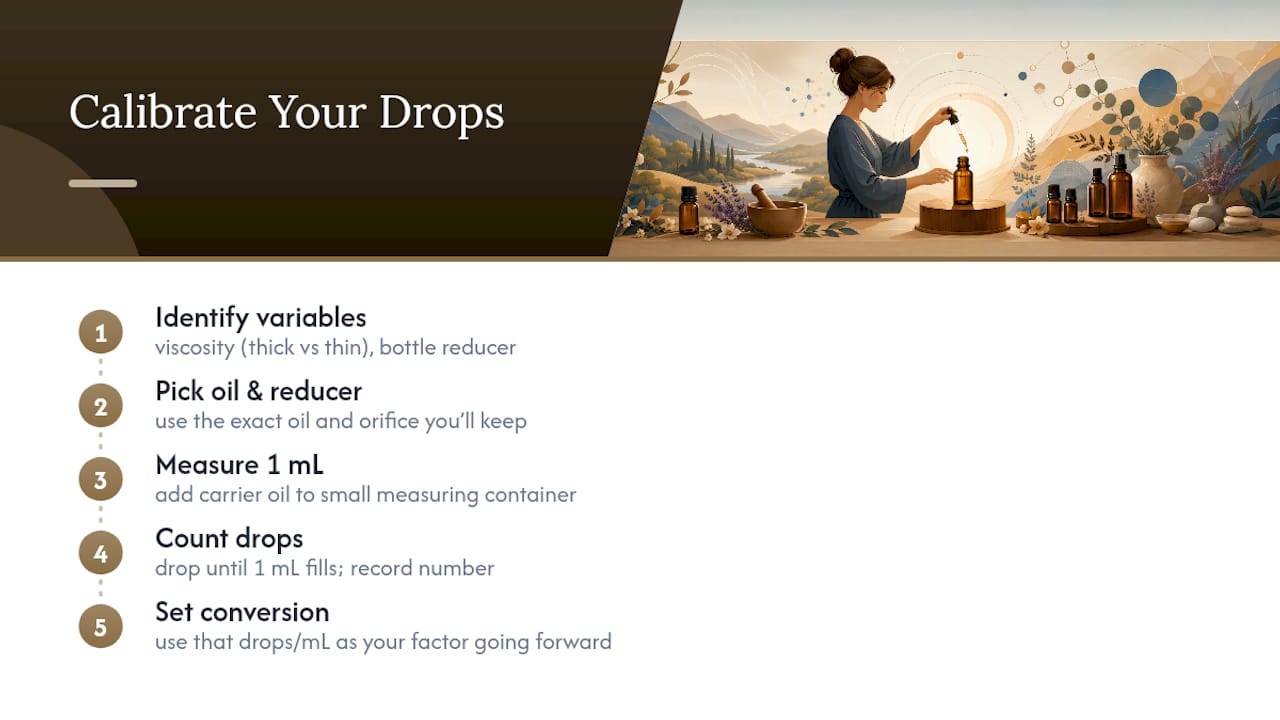
That said, treat every drop count as an estimate, not a lab measurement. Drop size shifts with an oil’s viscosity (thick oils like vetiver or myrrh throw bigger drops than thin ones like citrus) and with the orifice reducer on your bottle. If you’re formulating something you plan to use for months, calibrate your own bottle: drop essential oil into 1 mL of carrier oil in a small measuring container and count how many drops it actually takes to fill it. That number becomes your personal conversion factor going forward.
How Do You Calculate an Essential Oil Dilution Percentage?
Percent dilution means parts of essential oil per 100 total parts of finished blend. A 1% dilution is 1 mL of essential oil in 99 mL of carrier oil, for 100 mL total. This is where a lot of home blenders trip up: misreading a ratio like 1:4 as “1%” is a common and consequential mistake, when 1:4 actually works out to a 20% concentration, ten times stronger than intended.
Here’s the fail-safe method for any bottle size:
Decide your target percent based on the use case (see the ranges below).
Calculate total volume you want to make, in milliliters.
Multiply volume by percent (as a decimal) to get milliliters of essential oil needed. For a 30 mL bottle at 2%, that’s 30 x 0.02 = 0.6 mL of essential oil.
Convert that milliliter figure to drops using your bottle’s actual drops-per-mL count, or the 20-drops-per-mL estimate if you haven’t calibrated yet. 0.6 mL comes out to roughly 12 drops.
Fill the rest with carrier oil to reach your total volume.
For a 10 mL roller at 1%, the math is 10 x 0.01 = 0.1 mL, or about 2 drops. Small bottles leave very little room for rounding error, which is exactly why precise tools matter more as volume shrinks: a glass pipette, a graduated syringe, or a calibrated dropper insert will serve you far better than eyeballing drops into a tiny opening.
Pro Tip: Measure your carrier oil into the bottle first, then add essential oil drops one at a time while counting out loud or logging them on your phone. Adding oil to an already-full bottle is how spills and overshoots happen, and you lose track of your count the moment liquid hits the rim.
What Dilution Percentage Should You Use for Each Application?
Dilution isn’t one-size-fits-all, and the right percent depends heavily on where the blend goes and who’s wearing it. Tisserand’s dilution guidance breaks ranges down by use case, and the pattern holds across most professional aromatherapy references:
Face and sensitive areas: 0.2% to 1%. On a 30 mL facial serum, that’s roughly 2 to 6 drops total. Skin here is thinner and more reactive, so lower is genuinely better, not just cautious.
Daily body use: 1% to 2%, with 2% as the practical default for healthy adults, working out to about 12 drops per 30 mL.
Massage, full body: 2% to 3%. Short-term, targeted massage work (a sore shoulder, a tense lower back) can go up to 3% to 5% for a limited period, not as a standing daily blend.
Spot or acute therapeutic use: Up to 10% in specific cases, always for a short duration and always with caution, per NAHA’s professional application standards. This isn’t a range for casual use.
Bath and wash-off products: 2% to 4%, but only once the oil is pre-mixed into a dispersant. Neat oil floating on bathwater sits in concentrated patches against skin, which defeats the entire point of diluting.
Children, infants, pregnancy, and seniors: Stay conservative, often at half the adult rate or lower (0.5% to 1%), and skip certain oils entirely for these groups, including most high-phenol and strongly stimulating oils. When in doubt, a quick Palinova consultation beats guessing.
More benefit does not come with higher percentages past a certain point. That’s the therapeutic plateau: effectiveness levels off while irritation and sensitization risk keeps climbing.
Choosing the Right Carrier Oil for Your Dilution
Carrier oil isn’t filler. It affects how the blend absorbs, how long it lasts on the shelf, and whether it clogs pores on facial skin.
Fractionated coconut oil: Odorless, thin, absorbs fast, and barely ever goes rancid. A safe default for massage and body blends where you want the essential oil’s scent to lead.
Jojoba oil: Technically a liquid wax, closely matches skin’s natural sebum, and works well for facial dilutions without feeling heavy.
Sweet almond oil: Slightly richer, good moisture retention, solid all-purpose choice for body oils, though it’s a tree-nut derivative worth flagging for anyone with allergies.
Grapeseed oil: Light and fast-absorbing, low comedogenic rating, a good facial-blend option for oilier skin types.
Argan oil: Nutrient-dense and slightly heavier, popular in anti-aging facial blends, and pairs well with the kind of Palinova skincare formulations built around Barbary Fig Seed Oil.
Olive oil: Thick, strongly scented on its own, and better suited to body blends than facial ones since the scent competes with the essential oil.
Viscosity and comedogenic rating matter most for facial use. Thicker oils sit longer on skin, which helps dry skin but can clog pores on acne-prone skin. Store carrier oils away from heat and light, and check scent before you commit a batch: an oil that’s turned even slightly rancid will undercut your entire blend.
Essential Oil Safety Rules You Shouldn’t Skip
Before any new blend touches your skin for real, run it through this checklist:
Patch test first. Apply a diluted drop to your inner forearm, cover loosely, and wait 24 to 48 hours before using the blend anywhere else. No redness, itching, or swelling means you’re likely clear.
Watch for sensitization, not just irritation. Repeated use of high concentrations can sensitize skin over weeks or months, meaning a blend that felt fine at first starts triggering reactions later. Clinical research on topical concentrations backs the general rule: start low, and increase only if the lower percent genuinely isn’t doing the job.
Know your phototoxic oils. Cold-pressed citrus oils (bergamot, lime, grapefruit especially) can cause skin burns or dark patches when exposed to UV light within 12 to 18 hours of application. Use steam-distilled versions or keep phototoxic blends off sun-exposed skin.
Flag pregnancy, asthma, epilepsy, and medication interactions. Certain oils are contraindicated during pregnancy, some trigger asthma symptoms via strong inhalation, and a few carry documented interactions with blood thinners and other medications. If any of these apply to you, check with a doctor before starting a new blend, not after.
Know the emergency steps. If skin reacts, wash the area with plain carrier oil (not water, which can spread the oil) followed by mild soap and water. For breathing difficulty or a spreading rash, stop use and seek medical attention.
Formulators building products for sale face a stricter bar. IFRA’s safe-use standards set evidence-based maximums for specific constituents and phototoxicity limits that go beyond home-use guidance, worth reviewing if you’re ever selling what you make.
Essential Oil Dilution Recipes You Can Make Today
These recipes apply the math above to bottle sizes you can actually buy.
10 mL roller, 1% calm blend: 2 drops lavender, 2 drops chamomile, fill remainder with jojoba oil.
10 mL roller, 2% focus blend: 4 drops rosemary, 2 drops peppermint, fill with fractionated coconut oil.
30 mL massage oil, 1%: 6 drops total (try 4 drops sweet marjoram, 2 drops cypress) in sweet almond oil, suited to daily, gentle use.
30 mL massage oil, 3%: 18 drops total for short-term, targeted soreness, in fractionated coconut oil.
Bath dispersant: Mix 4 to 6 drops of essential oil into 1 tablespoon of carrier oil or a dispersant like solubol before adding to running bathwater. Never pour neat oil straight into the tub.
Room and linen spray: 20 drops essential oil, 2 tablespoons witch hazel or solubol, fill a 100 mL spray bottle with water and shake before each use.
Diffusion works differently from all of the above. Ultrasonic diffusers use water and roughly 3 to 5 drops per 100 mL, while nebulizing diffusers typically run neat oil with no water or carrier at all. Skip the carrier oil in either case; it clogs the mechanism rather than diluting anything meaningful, a distinction worth understanding if you’re using a diffuser rather than a topical blend.
Palinova’s Dilution Resources and Personalized Support
Palinova sources its essential oils and skincare ingredients from Palestinian botanicals grown within a long agricultural tradition, and every product ships free of synthetic additives. That heritage matters for dilution, too: the purer and more concentrated the source oil, the more precision your math needs.
Browse detailed guidance on dilution for skincare rituals for facial-specific ratios and application methods.
See the math applied to a specific oil in the Aleppo Pine Needle dilution guide.
Get ready-made cream recipes if premixed formulations suit your routine better than building blends from scratch.
Book a free personalized aromatherapy consultation through Palinova for dilution guidance tailored to your skin, oils on hand, and specific goals.
What the Dilution Debate Gets Wrong
Most dilution content treats percentages like a compliance checkbox. Hit the number, move on. That misses the actual lesson buried in the Tisserand research: concentration and benefit aren’t linked in a straight line. Past a certain point, more essential oil just means more risk with zero added effect, and plenty of home blenders never learn that plateau exists because nobody explains the “why,” only the “what.”
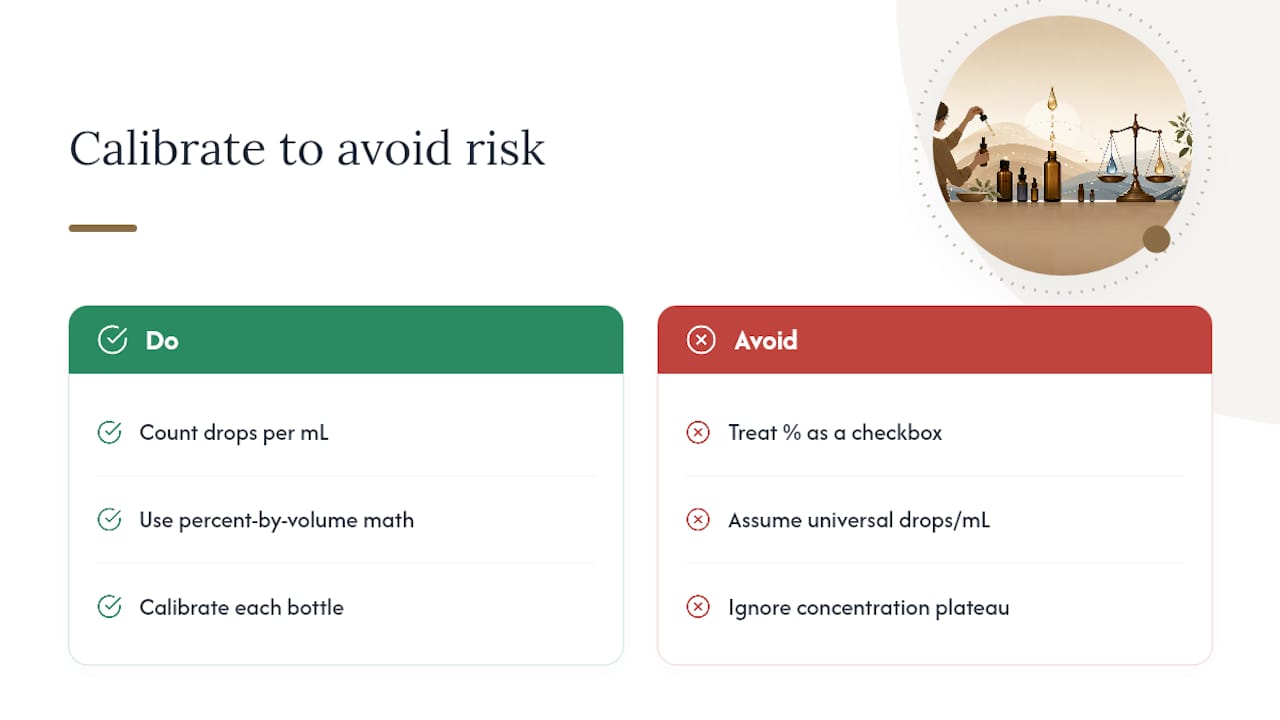
The other gap is math literacy. Once you internalize percent-by-volume math, dilution stops being guesswork and becomes a five-minute calculation you can run on any bottle, for any purpose.
If you take one thing from this guide, make it the calibration habit: count your own bottle’s drops-per-mL instead of trusting a universal assumption. That single step does more for consistent, safe results than any dilution chart, including this one.
— abdelmuhsen
Where to Find Ethically Sourced Oils for Your Dilutions
Once you know your target percent, the oil you start with matters just as much as the math. Palinova sources essential oils and seed oils directly from Palestinian agricultural traditions, free of synthetic additives, so what you’re diluting is the real thing rather than a cut or reconstituted version. That matters for dilution accuracy: a diluted or adulterated starting oil throws off every percentage you calculate from it.
For daily body blends, the Wildcrafted Cypress Essential Oil works well at the 2% default covered above, steam distilled and single origin. If you’re working on facial or anti-aging formulations, Palinova’s skincare line built around Barbary Fig Seed Oil pairs naturally with the low-percent facial ranges in this guide. And if you’re still unsure which oil, carrier, or percentage fits your skin and goals, book a free aromatherapy consultation directly through Palinova. Browse the full collection of new arrivals to see what’s currently in stock, and get a personalized dilution recommendation before you buy.
Sources
FAQ
How should I dilute essential oils?
Use percentage-based math: multiply your total blend volume by the target percent to get the milliliters of essential oil needed, then convert to drops using roughly 20 drops per mL.
What is the 30/50/20 rule for essential oils?
There’s no established or standardized “30/50/20 rule” recognized by aromatherapy safety authorities like Tisserand or NAHA. Stick to percentage-based dilution ranges by use case instead, since those are the guidelines backed by actual safety research.
What three essential oils go well together?
Pairings depend on your goal, but lavender, chamomile, and cedarwood combine well for calming blends, while rosemary, peppermint, and lemon work for a focus-oriented blend. Always dilute the finished combination to your target percent rather than treating individual oils as pre-diluted.
What essential oils should not be mixed together?
There’s no fixed universal “never combine” list, but caution applies to mixing multiple high-phenol oils (like oregano and clove) or several phototoxic citrus oils in the same blend, since that stacks irritation and sun-sensitivity risk rather than adding benefit. When combining strong oils, dilute more conservatively than you would for a single-oil blend.
Can I use essential oils without diluting them at all?
No. Applying undiluted essential oil directly to skin significantly raises the risk of irritation, sensitization, and in some cases chemical burns, regardless of how “gentle” the oil is reputed to be. Even oils sometimes described as skin-safe neat, like lavender, carry meaningfully lower risk when diluted first.
Recommended


Comments