
Harvest Season and Hour Shape Oil Chemistry: 5 Step Plan for Growers

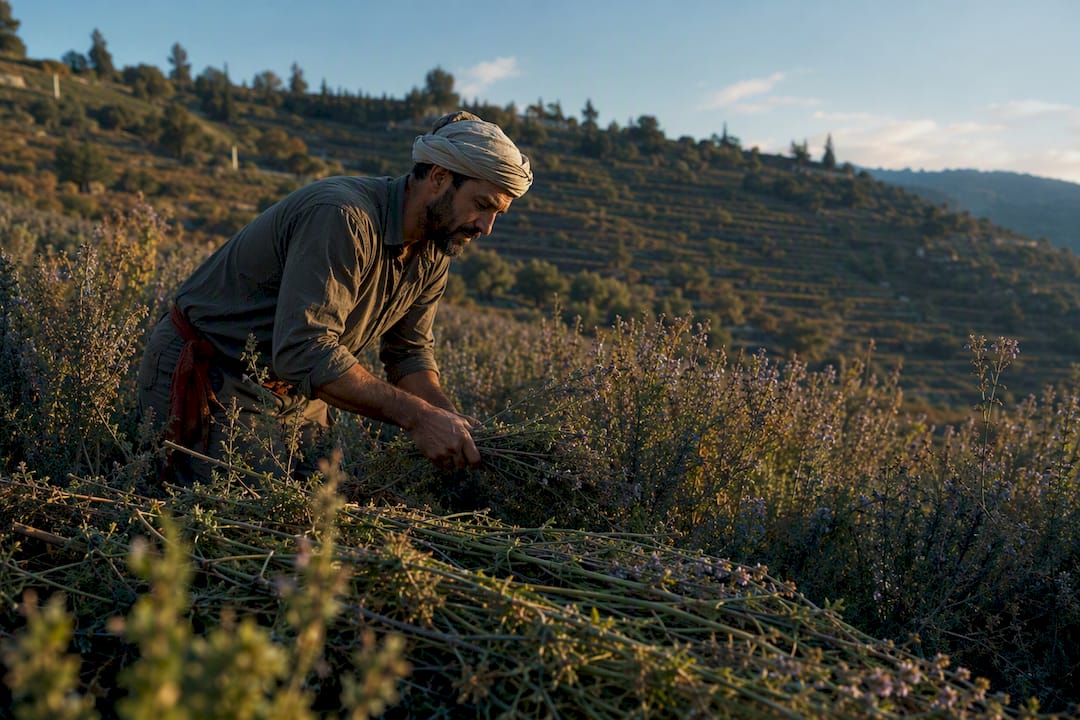
Harvest timing, meaning the hour of day, the plant’s growth stage, and the season, is one of the strongest controllable factors behind both essential oil yield and chemical profile. A sage trial published in Horticulturae found yield swings tied directly to time of day, and rain-soaked harvests raise hydrolysis risk during distillation. Artisan sourcing treats these variables as production decisions, not footnotes.
TL;DR:
Harvesting later in the day, especially between 4 and 6 p.m., can significantly increase essential oil yield and alter its chemical profile compared to early morning cuts.
Mid-flowering or peak bloom stages generally produce oils with higher ester content, which is desirable for fragrance and therapeutic qualities, but timing must be species-specific.
Rain or high moisture during harvest accelerates ester hydrolysis and washes off glandular trichomes, reducing oil quality and concentration.
Regional climate, soil, and plant genetics influence the optimal season and time for harvesting, making local testing and observation essential for best results.
Tracking harvest date, time, weather, and storage conditions creates a valuable dataset to improve quality consistency over multiple seasons.
Table of Contents
Why Harvest Season Changes Essential Oil Quality: The Chemistry Behind It
How Growth Stage Shapes an Essential Oil’s Chemical Signature
How Seasonal Climate Shifts Change Oil Composition and Yield
What the Research Says About Lavender, Sage, Rosemary, and Other Species
Your Harvest and Postharvest Checklist for Better Oil Quality
Why Harvest Season Changes Essential Oil Quality: The Chemistry Behind It
Every essential oil is a mixture of volatile compounds, and each chemical family behaves differently once it leaves the plant. Understanding those families is the fastest way to grasp why a lavender field cut at dawn smells different from the same field cut at 2 p.m.
Monoterpenes are the lightest, most volatile molecules in the mix. Compounds like limonene, camphor, and 1,8-cineole evaporate quickly and give an oil its sharp, immediate top notes. They’re also the first thing to disappear if a crop sits too long after cutting, or if heat pushes them off the plant before distillation even starts.
Sesquiterpenes are heavier and more stable. They anchor the base of a fragrance and tend to survive processing better than their lighter cousins. Chamomile’s characteristic depth, for instance, owes more to sesquiterpenes than to anything volatile at the top.
Esters, such as linalyl acetate, are what give lavender its sweet, rounded character. Esters are chemically fragile: they hydrolyze in water, breaking down into an alcohol and an acid when moisture is present during steam distillation. That single reaction explains a lot of what follows in this article.
Alcohols like linalool and geraniol sit in the middle of the volatility spectrum. They’re prized for both fragrance and reported skin benefits, and they’re often the byproduct when an ester breaks down, which is why a rain-soaked harvest can sometimes show artificially high alcohol readings alongside lower ester counts.
Phenylpropanoids, including eugenol and citral, are structurally different from terpenes altogether and tend to carry sharper, spicier, or more medicinal aromas. Clove and lemongrass both lean heavily on this class.
A few practical distinctions matter most for anyone evaluating oil quality:
Monoterpenes: highly volatile, define top notes, degrade fastest under heat or delay.
Sesquiterpenes: low volatility, stabilize the base note, resist oxidation better.
Esters: fragile under moisture, responsible for sweet or fruity character, break down into alcohols and acids.
Alcohols: moderate volatility, valued for aroma and skin applications, often rise as esters fall.
Phenylpropanoids: distinct aromatic profile, used as chemical markers for authenticity testing.
Laboratories track these ratios with gas chromatography, producing what’s called a GC fingerprint. A pure, well-timed lavender oil typically shows linalyl acetate in the 25% to 45% range alongside linalool, and a batch that falls well outside that band usually signals either the wrong species, poor timing, or a diluted product. Formulators working with active thresholds, where a compound needs to hit a minimum percentage to be functionally useful, live and die by these numbers, which is part of why harvest timing carries so much downstream weight.
How Growth Stage Shapes an Essential Oil’s Chemical Signature
Terpenes and esters don’t distribute evenly across a plant. Most aromatic species concentrate their oils in specialized structures called glandular trichomes, tiny hair-like glands usually clustered on flowers, leaf surfaces, or stems. In many species, flowers carry several times the oil concentration of leaves, which means harvesting even a modest amount of stem or foliage alongside the flower head can dilute the final batch far more than growers expect.
Plant development itself reshapes the chemical mix. Young, pre-flowering growth tends to invest energy in defensive monoterpenes, the sharp, protective compounds that deter pests and browsing animals. As the plant shifts into flowering, biosynthesis pivots toward the sweeter esters and alcohols that attract pollinators. That’s a real physiological trade, not a marketing distinction, and it’s why “harvested at peak bloom” is more than a label.
A review of lavender essential oil quality found that ontogeny, meaning the plant’s developmental stage, and diurnal rhythm together drive most of the variation in linalool and linalyl acetate content. Mid- to late-flowering harvests consistently favored the ester-rich profile distillers want, while earlier or later cuts skewed toward different ratios.
Genotype and plant age layer on top of all this. Two lavender cultivars grown in identical soil and climate can hit their compositional peak on different days, and older, more established plants often hold their peak window longer than young stock. Growth stage sets a general rule; genetics decides how flexible that rule is for a given field.
Trichome density: concentrated on flowers and glandular leaf surfaces, not uniform across the plant.
Pre-flowering stage: dominated by defensive monoterpenes.
Peak flowering: shift toward esters and pollinator-attracting alcohols.
Senescence (late-season decline): overall oil content typically drops as the plant redirects resources.
Genotype and age: shift the timing of the peak window by days or weeks even under identical conditions.
Does the Hour You Harvest Actually Matter?
Yes, and the effect is large enough to show up clearly in controlled field data. Terpene synthase enzymes, the machinery that builds volatile compounds inside the plant, operate on a circadian rhythm. Production ramps up and down across the day independent of temperature alone, which means two harvests from the same field, cut only hours apart, can yield meaningfully different oil.
A diurnal harvest trial on sage recorded the highest essential oil yield between 4 and 6 p.m., with the lowest yield occurring between 4 and 6 a.m. Composition shifted hour by hour alongside yield, not just the total volume of oil recovered. Separate work on lemongrass, palmarosa, and tulsi found that 3 p.m. sampling generally produced higher yields, though the specific compound that mattered most, citral for lemongrass, the primary alcohols for palmarosa and tulsi, peaked at different hours depending on the species.
The general patterns that show up across multiple crops:
Early morning harvests tend to preserve delicate top-note monoterpenes before rising heat volatilizes them off the plant.
Midday heat frequently causes a measurable drop in total yield as light monoterpenes evaporate faster than the plant can replace them.
Late afternoon often brings a rebound, sometimes even a peak, particularly for heavier compounds and in species where circadian biosynthesis ramps back up ahead of evening.
Species-specific timing overrides any universal rule. Lemongrass, palmarosa, and sage don’t share the same optimal hour, so a schedule built for one crop won’t transfer cleanly to another.
Pro Tip: If you’re managing more than one botanical on the same property, don’t assume a single harvest schedule works for all of them. Run a quick side-by-side cutting at two or three different hours on a small test row before committing an entire field to one time slot.
How Seasonal Climate Shifts Change Oil Composition and Yield
Season sets the biochemical stage that hour-of-day and growth stage then play out on. Temperature, rainfall pattern, and photoperiod (day length) all regulate how much energy a plant puts into terpene production versus growth and reproduction, and the effect is large enough to change which compound dominates a batch entirely.
A study of Laurus nobilis (bay laurel) tracked essential oil composition and antioxidant activity across seasons and found 1,8-cineole content peaked in summer, while antioxidant activity in the same oil peaked in autumn. This is a genuinely useful finding for producers: the season that maximizes one desirable trait isn’t automatically the season that maximizes another. A distiller chasing a specific 1,8-cineole target for a respiratory blend and a distiller chasing antioxidant potency for a skincare formulation would harvest the same species at different times of year.
Rosemary shows a related pattern, with warmer, drier stretches generally favoring monoterpene accumulation, since water stress tends to concentrate volatile oils rather than dilute them through rapid vegetative growth. Lavender, by contrast, often reaches its ester-rich sweet spot during a narrower window tied to bloom timing rather than raw temperature, which is part of why lavender harvest calendars are built around flowering stage first and calendar date second.
Seasonal decision-making comes down to a straightforward trade-off:
Maximizing total yield usually means harvesting during the plant’s most vigorous growth period, often earlier in the season before heat stress sets in.
Maximizing a specific target compound (1,8-cineole, camphor, a particular ester) may require waiting for a narrower seasonal window, even if that window produces less total biomass.
Photoperiod effects matter most in regions with sharp seasonal daylight swings, where longer days can accelerate flowering and shift the entire harvest calendar earlier.
Local climate deviation from a published study’s climate means published “best season” windows should be treated as a starting hypothesis, not a fixed calendar date.
There is no universal “best season.” There’s only a best season for the specific compound and yield target a grower or formulator has decided matters most.
What Happens When You Harvest After Rain
Wet plant material is one of the fastest ways to compromise an otherwise perfect harvest, and the damage happens on two separate fronts.
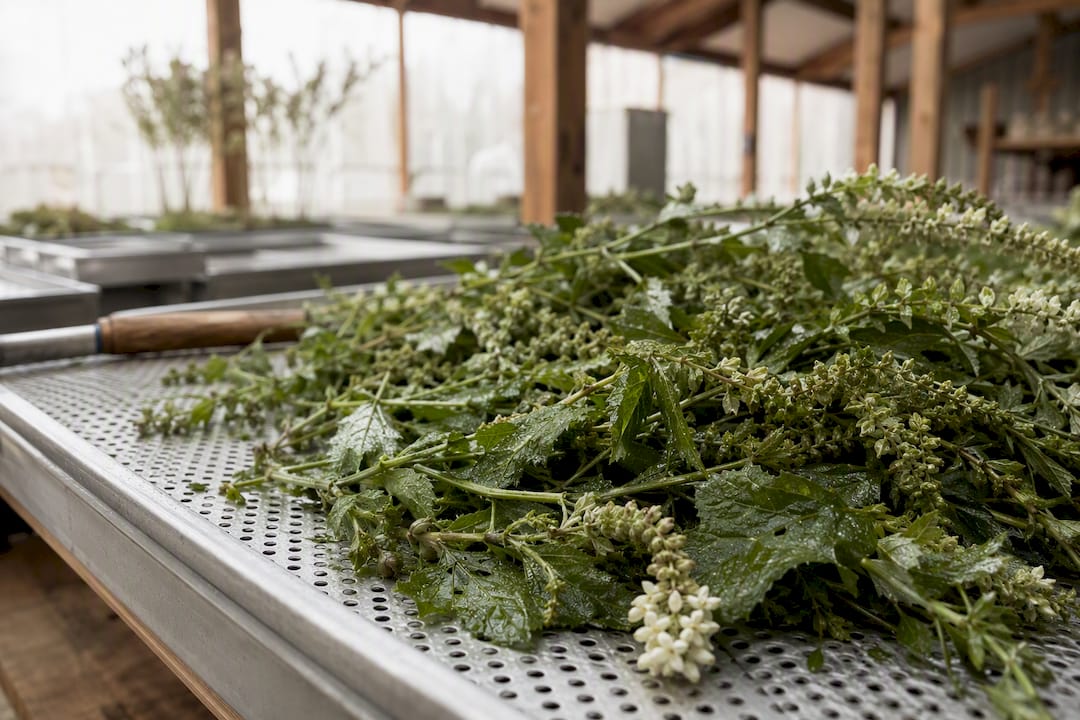
The first is chemical. During steam distillation, excess water on the plant surface or trapped in fresh tissue can drive hydrolysis, the reaction that splits esters into their component alcohol and acid. A mechanistic review of moisture-driven processing risks confirms this pathway degrades exactly the compounds most prized in a fine oil: esters and the lighter top-note monoterpenes that oxidize more readily in humid conditions. An oil that should carry a bright, sweet ester profile can come out flatter and heavier simply because the plant material was wet when it went into the still.
The second is physical. Heavy rain can wash oil directly off glandular trichomes before harvest even happens, and a sudden pass of rain can knock loose material that was ready to be collected, diluting the effective concentration of oil per kilogram of plant matter brought to the still.
Producers dealing with recent rainfall have a short list of real options:
Delay harvest by a day or two if the crop’s growth stage allows it, giving surface moisture time to evaporate naturally.
Move cut material to drying or distillation as fast as logistics allow rather than letting it sit in a truck bed or storage pile.
Avoid direct sun exposure on wet, freshly cut material, since heat plus residual moisture accelerates oxidation faster than either factor alone.
Track weather in the week leading up to a planned harvest, not just the day of, since soil moisture and humidity carry over even after rain stops falling.
Pro Tip: A simple squeeze test on a handful of cut plant material tells you more than a weather app. If water beads visibly on the leaf surface or the material feels damp rather than just cool, give it more drying time before it reaches the still.
What the Research Says About Lavender, Sage, Rosemary, and Other Species
Species-level data is where the general principles above turn into something a grower can actually schedule around. A few crops now have enough published trial data to draw specific conclusions.
Sage (Salvia officinalis) shows one of the clearest diurnal patterns on record. The Horticulturae field trial measured yield across multiple timepoints in a single day and found the 4 to 6 p.m. window consistently outperformed early morning cuts, with composition shifting alongside yield rather than staying static. The practical takeaway for sage growers: an afternoon harvest window isn’t just convenient, it measurably outperforms a pre-dawn one.
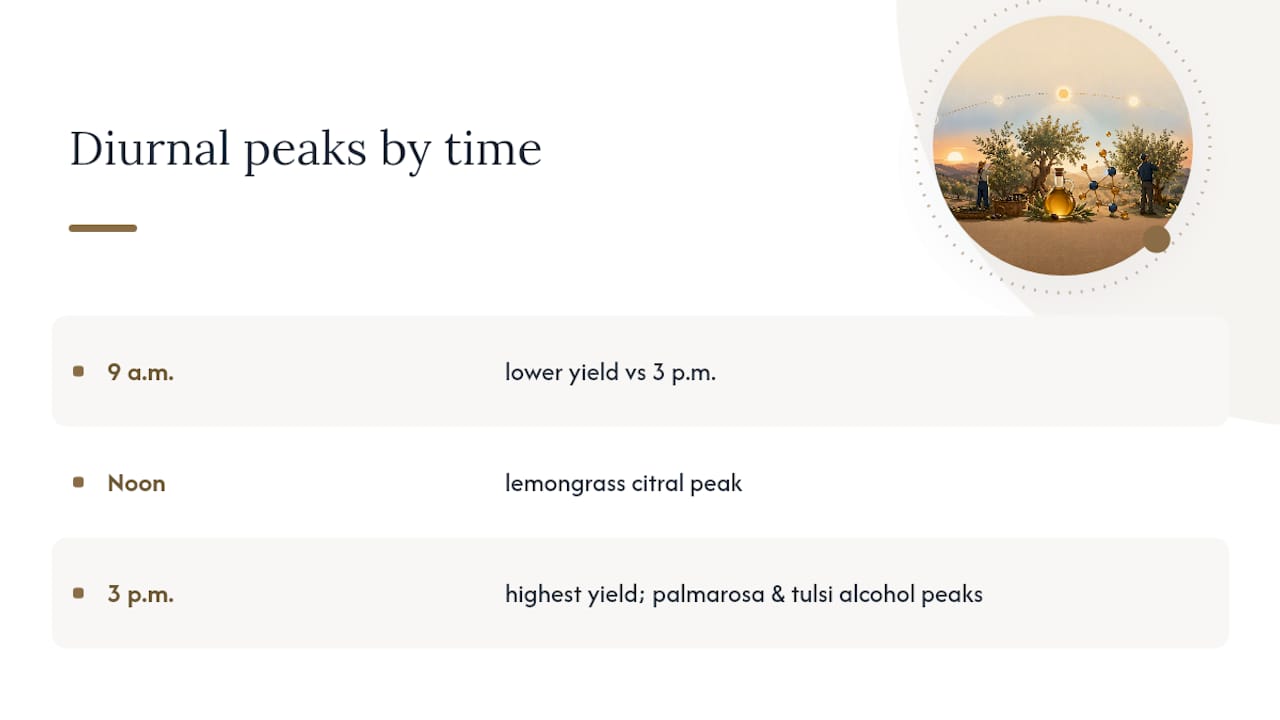
Lemongrass, palmarosa, and tulsi (Ocimum sanctum) were tested together in a diurnal trial comparing 9 a.m., noon, and 3 p.m. harvests. Yield generally favored the 3 p.m. cut across all three species, but the specific compound each crop is grown for peaked differently. Lemongrass hit its citral peak closer to midday, while palmarosa and tulsi favored the 3 p.m. window for their primary alcohol content. This is the clearest documented case of species-specific timing overriding a “one schedule fits all” assumption.
Bay laurel (Laurus nobilis) demonstrated the seasonal split described above, with 1,8-cineole peaking in summer and antioxidant activity peaking in autumn. That divergence is a useful caution against assuming yield and quality always move in the same direction across a season.
Lavender research points strongly toward flowering stage as the dominant variable, with diurnal timing acting as a secondary lever on top of it. The Cosmetics review found mid- to late-flowering harvests, combined with afternoon cutting in many trials, produced the highest linalyl acetate content, the compound most associated with lavender’s signature sweetness.
Rosemary trends toward monoterpene concentration during drier, warmer stretches, consistent with the broader pattern of water stress concentrating volatile oils rather than diluting them.
A few contradictions do show up across this literature, and they’re worth naming rather than glossing over. Some trials report morning peaks for total yield in species where others report afternoon peaks. The most likely explanation isn’t that the plants behave differently in some fundamental way, it’s that latitude, local temperature swings, and even the specific extraction method used in the lab can shift where a peak lands by a few hours or a few weeks. That variability is exactly why the next section covers how to read these studies critically.
Your Harvest and Postharvest Checklist for Better Oil Quality
Turning the research above into a workable schedule comes down to five sequential decisions, followed by two habits that protect the oil after it’s cut.
Set your target compound first. Decide whether you’re optimizing for total oil yield, a specific active like 1,8-cineole, or a fragrance profile driven by esters. This single decision determines every choice that follows.
Select the growth-stage window. For flower-dominant species, that generally means mid- to peak-flowering. For leaf-dominant crops, target the plant’s most vigorous vegetative growth before it shifts energy toward reproduction.
Choose the hour of day based on your species, not a generic rule. Sage favors late afternoon. Lemongrass favors closer to midday for citral. When in doubt, and no published trial covers your exact crop, run your own comparison (see step 4).
Monitor weather for the week leading into harvest, not just the forecast for harvest day itself. Delay if rain has fallen in the prior 24 to 48 hours and the crop’s stage allows flexibility.
Minimize the gap between cutting and distillation. Fresh material degrades fast; every hour of delay is an hour for volatile monoterpenes to evaporate and for esters to begin hydrolyzing if any moisture is present.
Running your own timing trial doesn’t require a laboratory contract. A basic on-farm comparison, cutting small samples from the same plot at staggered hours across one day, then sending them to an external lab for a quick GC run or scoring them side-by-side by smell and color, gives usable, locally validated data within a single harvest season. Record yield alongside your organoleptic notes every time, since a batch that smells right but weighs light is telling you something too.
Storage matters just as much as timing once the oil is actually extracted. Keep finished oil in amber or cobalt glass with minimal headspace, since excess air in the container accelerates oxidation the same way sun exposure does on wet plant material. Store away from heat and direct light, and label every batch with harvest date and time, not just species. That single habit turns a shelf of bottles into a dataset you can actually learn from season over season. Palinova’s own approach to 1 to 10 year storage planning covers container choice and shelf-life expectations in more depth for anyone building out a home or small-batch storage system.
Pro Tip: Keep a simple harvest log, even a spreadsheet with date, time, weather, and a one-line smell description. Two seasons of that data will teach you more about your specific field’s optimal window than any published study can, because it accounts for your exact soil, microclimate, and genetics.
Why Published Harvest Studies Don’t Always Agree
Reading two studies on the same species and getting two different “optimal” harvest times isn’t a sign that the research is unreliable, it’s a sign that a long list of variables sits between the plant and the final GC readout. Genotype, soil composition, altitude, and regional climate all shift where a compositional peak lands, and even the extraction method used in the lab, steam distillation versus other techniques, can change which compounds show up prominently in the final analysis. Fresh-versus-dried material at the time of processing adds another layer of variation on top of that.
Sample size and the specific hours or dates chosen for sampling also matter more than most readers assume. A trial that samples three timepoints across one day tells you something different than one that samples hourly across a full week, and a small sample size can produce a “peak” that’s really just noise.
The practical filter worth applying to any published harvest study: does it match your climate, your genotype, and your extraction method closely enough that the finding is likely to transfer? If not, treat the published result as a hypothesis to test locally rather than a rule to follow blindly. A simple staggered-sampling trial on your own plot, run against your own GC or organoleptic scoring, will usually tell you more than a study conducted three climate zones away.
Genotype and cultivar differences can shift a peak window by days or weeks.
Soil, altitude, and microclimate change biosynthesis independent of the calendar date.
Extraction method (steam distillation vs. other techniques) affects which compounds the analysis captures.
Fresh vs. dried material at processing time changes the moisture and hydrolysis picture entirely.
Small sample sizes or narrow sampling windows can produce peaks that don’t replicate.
How Palinova Applies Harvest Timing in Practice
Palinova’s Palestinian sourcing network works from the same principles this article lays out, translated into working practice. Harvesters track growth stage and time of day for each botanical, and batches carry harvest date and time as part of their identity, the same discipline described in why essential oils vary so much from brand to brand.
That level of tracking matters most when a formulator needs a specific compound threshold, whether that’s an ester ratio for a fragrance blend or an active percentage for a skincare application like Barbary Fig Seed Oil. Timing data lets Palinova match a batch to the use it’s actually suited for, rather than treating every harvest as interchangeable.
Species-specific timing questions don’t have one universal answer, which is exactly why free aromatherapy consultations can be offered for anyone sorting out which botanical, and which harvest characteristics, fit their specific health or formulation goal. You can browse current wildcrafted Cypress oil and other timing-sensitive, steam-distilled products directly at Palinova.
Sources
FAQ
How can you tell if an essential oil is 100% pure?
Check for a GC/MS report showing the expected compound ratios for that species, a Latin botanical name on the label, and a price consistent with the crop’s real extraction yield. An oil priced far below market for its species, with no batch testing available, is a red flag.
What is the 20/30/50 rule for essential oils?
There’s no scientifically standardized rule about specific dilution or blending ratios recognized in peer-reviewed essential oil literature. If you’ve seen such numbers referenced, treat them as informal guidelines rather than established industry standards, and verify dilution percentages against a specific use case instead.
Which brand of essential oils are the purest?
Purity comes down to sourcing transparency and batch testing rather than brand reputation alone. Look for producers who disclose harvest region, extraction method, and GC testing results rather than relying on marketing claims of purity.
Which essential oil brands should I avoid?
Avoid brands that won’t disclose sourcing region, harvest practices, or testing data, and be cautious of any oil priced well below the typical yield-based cost for that species. A lavender oil harvested outside its ester-rich flowering window, for instance, can still be sold as “lavender” while smelling noticeably flatter than a properly timed batch.
Why Timing Gets Overlooked in Most Essential Oil Marketing
Most essential oil marketing talks about species and extraction method, and almost never mentions when in the day or year a crop was actually cut. That’s a real gap, because the sage and lemongrass trials cited throughout this piece show hour-of-day shifts that rival, and sometimes exceed, the differences marketers love to highlight between “wild” and “farmed” sourcing.
The uncomfortable truth for the industry is that harvest timing is harder to market than origin or extraction method. “Cut at 4 p.m.” doesn’t sound as compelling on a label as “wildcrafted” or “steam distilled,” even though the timing decision may have shifted the compound profile more than either of those factors. Consumers have been trained to ask where an oil comes from and how it’s extracted, but rarely when it was cut, and that’s exactly the question the research says matters most.
The producers worth paying attention to are the ones tracking harvest date and hour as carefully as they track species and region. That kind of record keeping doesn’t show up on a pretty label, but it shows up in a consistent GC fingerprint from batch to batch, which is the only real proof that timing discipline is actually happening behind the scenes.
— abdelmuhsen
Recommended

Comments