
Buyers: Verify Wildcrafted Oils With Lab Reports and 10–20% Harvest Limits
- Palinova
- 1 day ago
- 7 min read
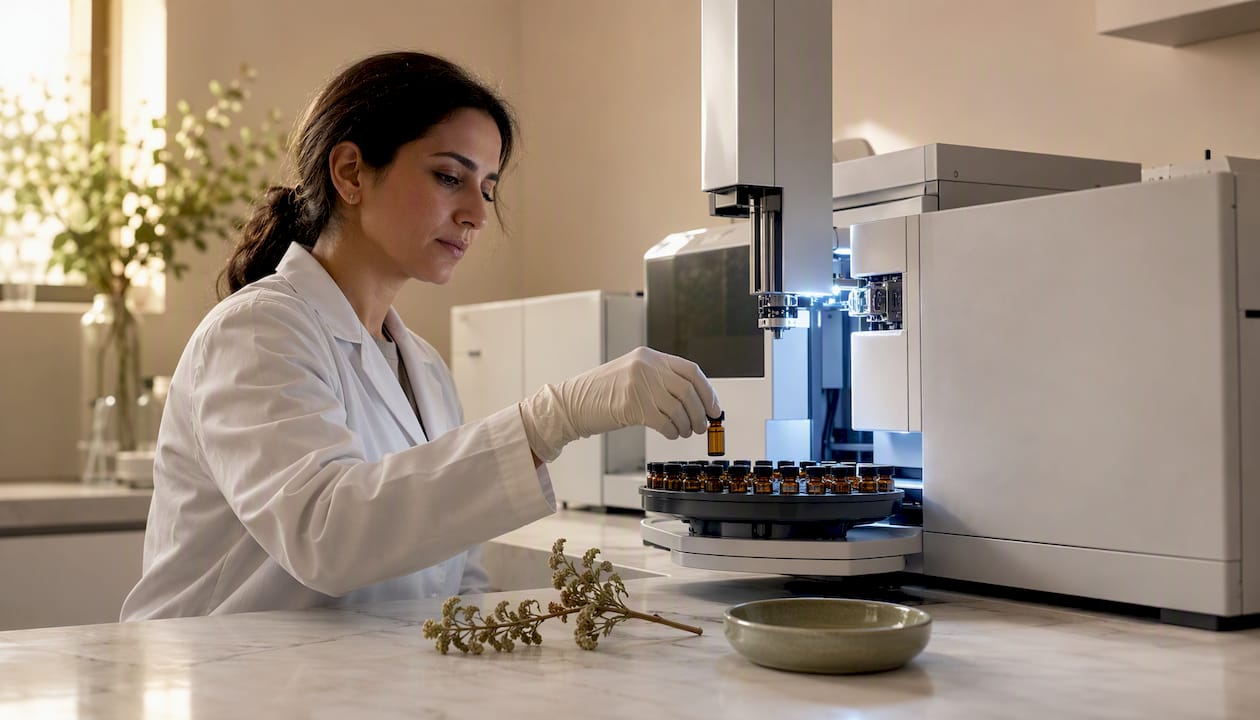
Wildcrafted essential oils come from plants foraged in their native habitat, not grown in rows on a farm. That single sourcing choice changes everything downstream: exposure to real weather and soil stress pushes plants to produce denser concentrations of terpenes and phenolics, the compounds that carry an oil’s aroma and much of its therapeutic punch. The trade-off is variability, sustainability risk, and a harder path to certification. The rest of this guide walks through the chemistry, the ethics, and how to buy smart.
TL;DR:
Wildcrafted oils tend to have higher concentrations of terpenes and phenolics, making them more potent for aromatic and therapeutic purposes, but they vary seasonally and location.
Due to their natural stress factors, wildcrafted oils can display broader chemical profiles, confirmed through batch-specific GC-MS testing, unlike the more consistent cultivated organic oils.
Sustainable wildcrafting depends heavily on responsible harvesting practices, such as limiting extraction to 10-20 percent of a stand and ensuring ongoing species monitoring.
Buyers should check for detailed label information, request specific batch COAs, and be cautious of suspiciously low prices, which may indicate unsustainable or adulterated products.
Sourcing from regions with long-standing land heritage, like Palestinian terrain in Palinova’s case, emphasizes potency rooted in natural environment rather than certification labels alone.
Table of Contents
What Does ‘Wildcrafted’ Actually Mean?
Wildcrafted means the plant grew where nature put it, with no irrigation, no fertilizer, no rows, and no replanting schedule. A harvester locates a wild stand, usually the same one season after season, and gathers material by hand rather than machine.
Real wildcrafting follows a few consistent practices:
Hand-foraging in the plant’s native range, often on rocky slopes or unmanaged terrain where farming isn’t practical anyway
Harvesting only during the plant’s peak chemical window, sometimes a two-to-three-week season
Selective picking that leaves enough of the population intact to regenerate the following year
Formal organic certification is rare in this category, and that’s not a red flag. The USDA’s wild crop harvesting guidance lays out recordkeeping and land-history requirements that most independent foragers simply can’t produce for land they don’t own or control. Absence of a certification seal here tells you less than it would on a bottle of olive oil.
How Is Wildcrafted Different From Organic or Cultivated Oil?
Organic certification verifies a growing process. Wildcrafting describes a sourcing location. Those are two different questions, and confusing them is where most buyers go wrong.
An organic farm controls variables on purpose. Wild stands don’t get that control, and that’s the point.
Consistency: cultivated organic oils smell and test nearly the same batch after batch; wildcrafted oils shift with the season and the specific patch of ground
Supply: farms can scale to meet demand; wild populations cap how much can be responsibly harvested in a given year
Certification assurance: organic labeling gives a paper trail; wildcrafting relies on supplier honesty and lab reports instead
Neither approach is strictly superior. Ananda Aromatherapy’s comparison makes the case that the right choice depends on what you’re after: predictable dosing for daily skincare favors cultivated organic, while a stronger aromatic and therapeutic profile for occasional, targeted use often points toward wildcrafted. For a deeper side-by-side, see how wildcrafted and organic oils compare in practice.
Why Are Wildcrafted Oils Often More Potent?
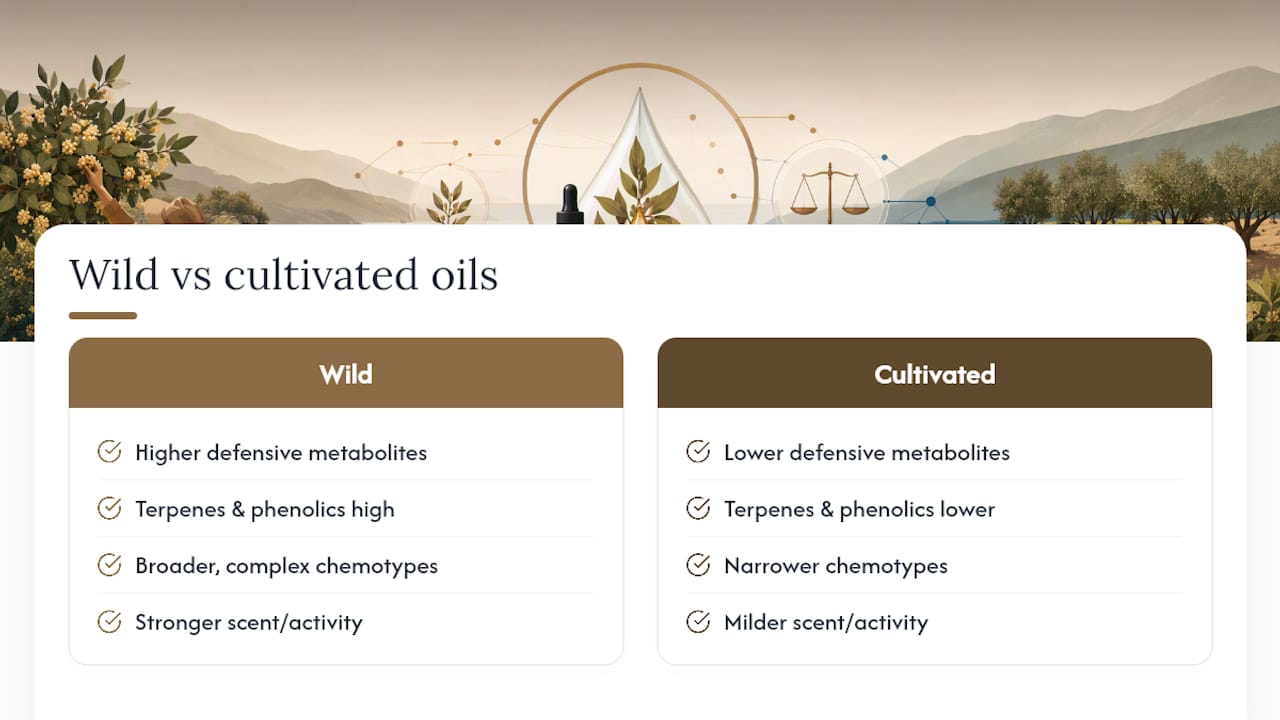
Stress makes plants chemically interesting. A wild rosemary bush fighting drought, wind, and grazing animals produces higher concentrations of defensive secondary metabolites than a greenhouse-raised cousin that never has to defend itself against anything.
Those defensive compounds, mainly terpenes and phenolics, are the same molecules responsible for an essential oil’s scent intensity and much of its biological activity. A cultivated plant grown in ideal, protected conditions has less reason to manufacture them in bulk.
Gas chromatography mass spectrometry, or GC-MS, is how labs actually confirm this. Testing wild harvests frequently reveals broader, more complex chemotype profiles than their farmed equivalents, according to comparisons run by EchoesOfAroma’s analysis of wild versus cultivated oils. The practical upshot: a wildcrafted oil can smell and act stronger, but the next bottle from a different hillside or a different year might read noticeably different on that same test. You can see the artisan side of this in how Aleppo pine needle oil is distilled from wild-harvested branches.
Is Wildcrafting Actually Sustainable?
It depends entirely on how it’s done. Wildcrafting can be lighter on the land than farming, since there’s no clearing, no monoculture, and no irrigation drawdown. Done carelessly, though, it strips wild populations faster than they can recover.
Ginseng is the textbook cautionary tale: decades of unregulated wild harvesting pushed some populations into serious decline in parts of its native range. Essential oil plants face the same risk when demand outpaces regeneration.
Ethical wildcrafters tend to show a few consistent signs:
Harvest quotas that leave a meaningful share of the population, commonly citing figures in the 10 to 20 percent range per season, according to AromatherapyUSA’s overview of wildcrafted oils
Direct economic benefit flowing to the local harvesters who know the land best
Some form of ongoing species monitoring rather than a one-time harvest-and-move-on approach
Pro Tip: Ask a supplier directly what percentage of a wild stand they harvest each season. A vague answer is more telling than a specific one, even an imperfect one.
What Should You Expect on Testing and Traceability?
Batch-to-batch variability is normal for wildcrafted oils, not a sign of a bad product. A shift in rainfall, altitude, or harvest timing changes the chemical fingerprint from one lot to the next, so two bottles of the “same” oil can legitimately smell a little different.
That variability is exactly why testing matters more here than with cultivated oils. A credible supplier can produce a Certificate of Analysis backed by GC-MS results, which shows the actual chemical breakdown of that specific batch rather than a generic average.
Look for:
A GC-MS report tied to the specific batch you’re buying, not a stock report from a different harvest
Screening for common adulterants, like synthetic fragrance compounds cut into a “pure” oil
Contaminant checks, particularly for oils harvested near roadsides or agricultural runoff zones
Selective harvesting itself, done at roughly 10 to 20 percent of a stand per the AromatherapyUSA figures already noted, is also a quiet quality signal: suppliers who bother to protect the population for next year tend to be the same ones who bother to test this year’s batch.
A Practical Checklist for Buying Wildcrafted Essential Oils
Before you check out, run through this:
Check the label for specifics. Species name, harvest region, plant part used, and harvest date should all be listed, not buried in vague marketing language.
Ask for the COA. A legitimate wildcrafted oil should have a GC-MS report available on request, even if it’s not printed on the bottle.
Confirm the harvest season matches the plant. A supplier selling “fresh wild lavender” year-round without acknowledging seasonality is worth questioning.
Research the species’ conservation status. Rare or slow-growing wild plants deserve extra scrutiny before you buy in bulk.
Compare the price to the labor involved. Hand-foraging is slow and low-yield, so wildcrafted oils typically cost more than cultivated versions; a suspiciously cheap “wildcrafted” oil is a red flag, not a deal.
Pro Tip: Because wild oils run more concentrated, start with a heavier dilution than you’d use for a cultivated version, roughly half the usual drop count, and patch-test on your forearm before applying anywhere near your face. For guidance on using potent extracts in skincare, Palinova’s anti-aging oil guide covers safe application ratios.
Palinova’s View: Sourcing Rooted in the Land, Not the Label
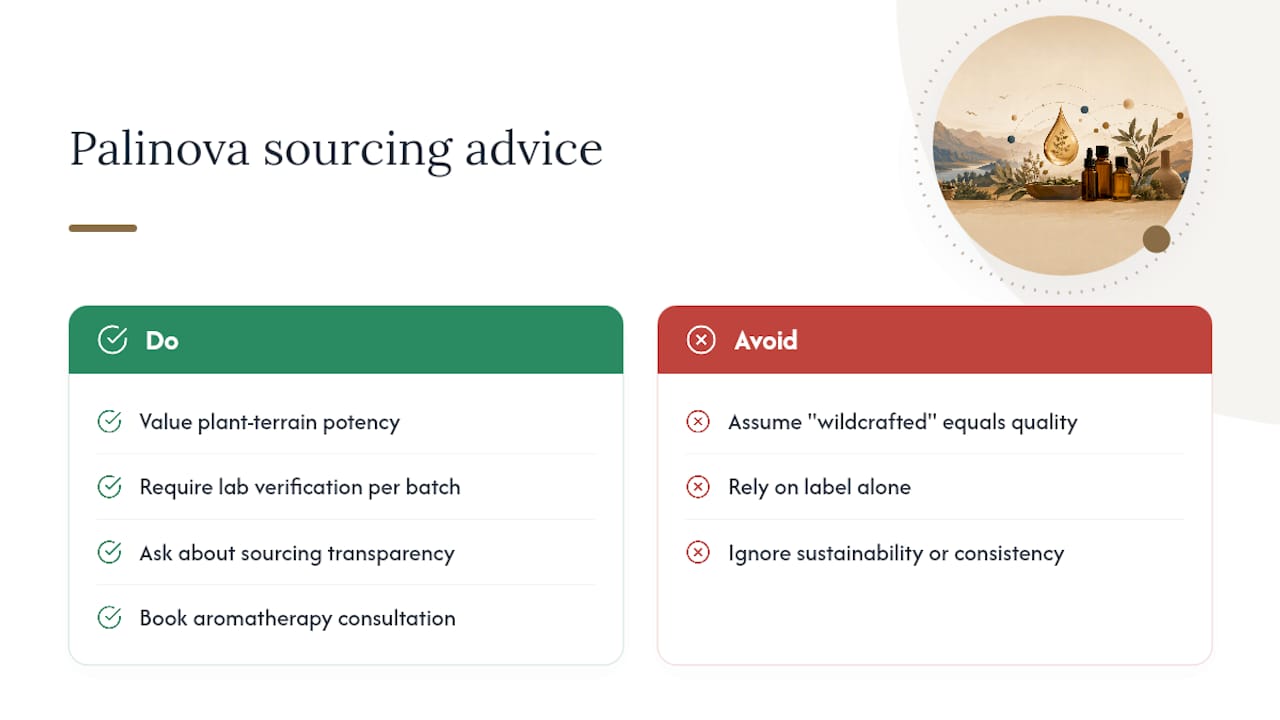
Palinova sources from Palestinian terrain that has grown these botanicals for generations, long before “wildcrafted” became a marketing term. That heritage shapes how the brand thinks about potency: strength comes from the plant’s relationship with harsh, specific ground, not from a certification sticker.
Balancing that potency against sustainability and consistency is the real work. Palinova leans on lab verification and transparent sourcing rather than assuming a wild origin alone guarantees quality, since the chemical complexity of wild-harvested botanicals still needs confirmation batch by batch. Customers unsure which oil fits their skin or wellness goals can book an aromatherapy consultation for a personalized recommendation instead of guessing from a product description.
— abdelmuhsen
Try Palinova’s Wildcrafted Oils for Yourself
Palinova sells wildcrafted oils sourced directly from Palestinian land, with harvest transparency rather than vague “natural origin” claims on a label. The Wildcrafted Cypress Essential Oil, steam distilled from wild-harvested trees, is a solid starting point if you want to feel the difference between a wild profile and a farmed one. For something rarer, the Achillea Fragrantissima Essential Oil comes from a botanical you won’t find in most cultivated oil catalogs at all.
Start small. Order a single bottle, patch-test it the way this guide recommends, and ask Palinova directly for harvest details or a COA if you want to see the batch data behind it. Browse the full new arrivals if you’re curious what else is currently in season, and use the free aromatherapy consultation if you’d rather get a recommendation matched to your skin or wellness goals than pick blind.
Sources
FAQ
How Can You Tell If an Essential Oil Is High Quality?
Ask for a GC-MS report tied to the specific batch, check that the label names the species, harvest location, and plant part, and be wary of any price that seems too low for the labor involved in wildcrafting.
What’s the Difference Between Wildcrafted and Organic Oils?
Organic certification verifies farming practices, while wildcrafted describes an oil harvested from wild, uncultivated plants; wildcrafted oils tend to have more complex chemistry but less batch consistency than certified organic ones.
Which Essential Oil Brands Should I Be Cautious About?
Be cautious of any brand that can’t provide a GC-MS report on request, lists no harvest location or date, or prices a supposedly wildcrafted oil far below what hand-foraging and limited yields would justify.
Are Wildcrafted Oils Actually Better Than Cultivated Ones?
Not universally. Wildcrafted oils often deliver richer aromatic complexity and stronger therapeutic compounds, but cultivated organic oils offer more predictable dosing, which matters more for some skincare and daily-use applications.
How Are Wildcrafted Essential Oils Made?
Harvesters hand-forage plants from their native habitat during a specific seasonal window, then distill the material, usually by steam distillation, without any cultivation, irrigation, or fertilization involved in growing it.
Recommended


Comments