
Traceable Florastina Oils: From Wild Plant to Bottle, Batch Tested
- Palinova
- 1 day ago
- 12 min read
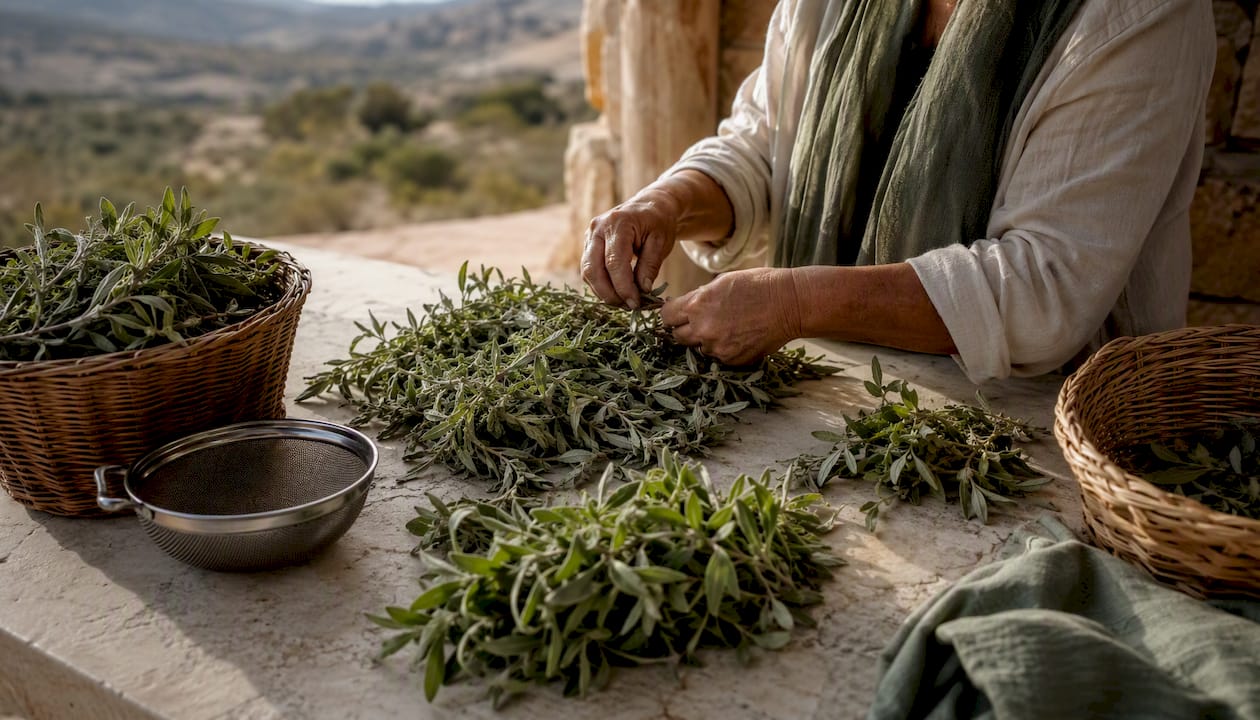
Florastina essential oils start as wild botanicals hand-harvested across Palestinian hillsides, get processed with extraction methods matched to each plant’s chemistry, then pass GC/MS batch testing before Palinova bottles them for sale. Every stage, from harvest timing to cap seal, shapes what ends up in the bottle. The sections ahead walk through harvest practices, extraction science, quality checks, and storage.
TL;DR:
Wild-harvested botanicals should be tracked through multi-year population monitoring and specific region sourcing to ensure sustainability and chemical consistency.
Extraction methods are chosen based on the plant’s chemistry, with newer techniques like CO2 extraction preserving heat-sensitive compounds, though they are more expensive.
Genuine oils list Latin plant names, origin, extraction method, and batch-specific GC/MS reports, while marketing terms like “therapeutic grade” lack regulatory validation.
Proper packaging with amber glass, minimal headspace, and safe storage away from light and heat are crucial to maintaining an oil’s quality for one to three years.
Always request the harvest region, Latin name, and batch report from wild-harvest brands to verify transparency and ethical sourcing practices.
Table of Contents
Florastina Provenance: How Place, Plant, and People Shape the Oil
Ethical Wild Harvesting: Principles, Traceability, and Community Impact
Step-by-Step Production: Collection, Handling, and Extraction Methods
Quality Checks: Labeling, GC/MS Reports, and Certification Cues
Palinova and Florastina in Practice: Sourcing Proof and Product Examples
From Field to Distillery: The Intermediate Stages Most Guides Skip
What Sets Florastina Oils Apart from Other Wild-Harvest Options
Author Perspective: Ethical Sourcing as Both Principle and Practice
Florastina Provenance: How Place, Plant, and People Shape the Oil
Provenance means knowing exactly where a plant grew, who picked it, and under what conditions. For essential oils, terroir isn’t a wine-world affectation. Soil mineral content, altitude, and rainfall change the concentration of aromatic compounds in a wild rosemary bush the same way they change grape sugar levels. A Florastina oil sourced from a specific hillside in one season can smell measurably different from the same species picked a valley over.
Palinova builds its supply chain around direct relationships with local harvesters and small cooperatives who know their terrain across multiple seasons, not one-off buyers chasing the lowest price. That continuity matters because:
Harvesters familiar with a specific patch of land can judge peak bloom by sight and smell, not just calendar dates.
Repeat relationships mean the same families return to the same regeneration cycles year after year, which protects yield long-term.
Direct sourcing cuts out middlemen who often blend batches from multiple unverified origins.
Timing and plant-part selection matter just as much as location. Flowers picked before full bloom yield thinner, greener oil profiles; leaves harvested after seed-set can carry more bitter, resinous notes. Getting that window right is half the craft.
Ethical Wild Harvesting: Principles, Traceability, and Community Impact
Wild-harvested botanicals constitute a significant portion of global essential oil trade, and that scale carries real biodiversity risk if buyers don’t ask hard questions. Reports on species like frankincense have documented how unmanaged demand can strip a region’s wild stock within a generation, which is exactly why sourcing discipline matters more for wild plants than for anything grown in rows on a farm.
The SAI Platform’s framework for sourcing wild-harvested botanicals boils ethical sourcing down to three obligations:
Maintain the wild resource at a population level that can regenerate year over year.
Protect surrounding biodiversity, not just the target species.
Avoid negative social or ecological impact on the communities and habitats involved.
Meeting those obligations in practice means correct species identification (a common name can cover several related plants with very different chemical profiles), tracked regeneration cycles, and fair pay to the people doing the actual picking. AHPA’s guidance on wild collection adds that collectors need training in identification and handling, since a misidentified plant or a contaminated batch can undo months of careful sourcing in one shipment.
Pro Tip: Ask any wild-harvest brand for the Latin name of the source plant and the region it was picked in. A vague answer, or a brand that only offers a common name like “wild sage,” is a red flag. Multi-year population monitoring, not a one-season snapshot, is what actually keeps a wild species harvestable.
Step-by-Step Production: Collection, Handling, and Extraction Methods
Fresh-cut plant material starts losing volatile compounds within hours, so handling between field and still matters as much as the harvest itself. Material gets sorted to remove damaged or off-species plants, kept out of direct sun during transport, and processed as close to harvest time as the terrain allows. Delay and heat are the two fastest ways to degrade an oil before extraction even starts.
Extraction method is chosen based on the plant’s own chemistry, not convenience:
Steam distillation works for robust herbs and woods where heat won’t damage the aromatic compounds.
Cold pressing suits citrus peels, where heat would destroy the delicate top notes.
Solvent extraction produces absolutes from delicate flowers like jasmine that yield almost no oil under steam.
CO2 extraction uses pressurized carbon dioxide at low temperatures to pull fragile molecules intact, especially from resins and fine florals.
Method | Best suited for | Heat exposure |
Steam distillation | Herbs, woods, hardy leaves | Moderate to high |
Cold pressing | Citrus peels | None |
Solvent extraction | Delicate flowers (absolutes) | Low |
CO2 extraction | Resins, fine florals | Very low |
Reviews of extraction technology note that steam distillation and solvent extraction remain the industry workhorses, but newer supercritical CO2 and ultrasound-assisted methods are gaining ground because they preserve heat-sensitive compounds that steam can scorch away. The trade-off is cost: CO2 equipment runs far more expensive than a simple copper still, which is why it’s typically reserved for higher-value botanicals. Matching temperature, pressure, and extraction time to a species’ own chemistry, as production specialists note, is what separates a vivid, true-to-plant oil from a flat, cooked-tasting one.
Quality Checks: Labeling, GC/MS Reports, and Certification Cues
A genuine essential oil label always lists the plant’s Latin binomial, not just a common name. “Lavender oil” could mean Lavandula angustifolia or a cheaper hybrid with a completely different chemical makeup, so the botanical name is the first thing worth checking on any bottle.
The second thing worth checking is whether the seller offers a GC/MS report. Gas chromatography, mass spectrometry breaks an oil down into its individual chemical components and their percentages, which is the closest thing the industry has to a fingerprint. A batch code and date on that report should tie back to a specific harvest, not a generic “quality assurance” statement.
Genuine label elements include:
Full Latin (botanical) name of the source plant
Country and region of origin
Extraction method used
Batch number matched to a GC/MS report
Harvest or production date
One figure worth knowing: the terms “therapeutic grade” and “aromatherapy grade” have no legal definition or regulatory body behind them anywhere in the essential oil trade. Neither term appears in any government standard, which means they’re marketing language, not quality proof. ISO 9235:2013 and related analytical standards exist for defining natural aromatic raw materials, but no such standard covers those grading buzzwords. A real GC/MS batch report tells you far more than either phrase ever will.
Packaging and Storage: How the Bottle Protects the Oil
Essential oils degrade when exposed to light, heat, and oxygen, in that rough order of damage. That’s why quality producers use amber or cobalt glass, never clear glass, and fill bottles close to the top to minimize the airspace where oxidation happens fastest.
Look for these signals on a well-packaged bottle:
Dark amber or cobalt glass, never clear
Low headspace between the oil and the cap
An orifice reducer or dropper cap that limits air exposure per use
Full labeling: Latin name, origin, extraction method, batch date
Stored properly, away from direct sunlight and heat sources like a stove or a sunny windowsill, most essential oils hold their profile for one to three years, with citrus oils degrading faster than woods and resins. A properly bottled Florastina oil carries all four packaging signals above plus a batch number a customer can ask about directly.
Using Florastina Oils Safely: Dilution and Mixing Cautions
Essential oils are potent enough that using them undiluted on skin is rarely a good idea. A few practical rules cover most situations:
Dilute to roughly 2 to 3% in a carrier oil (about 12 to 18 drops per ounce) for general adult skin use, and cut that in half or lower for children, pregnant women, or anyone with sensitive skin.
Avoid combining strong oxidizing oils, like citrus oils, with sensitizing oils, like cinnamon bark or clove, on the same application, since layering irritants compounds skin reactions rather than canceling them.
Never apply an undiluted oil near eyes, mucous membranes, or broken skin.
You may run across the “30/50/20 rule” in blending circles, referring to top, middle, and base note proportions in a perfume blend rather than a dilution or safety standard. It has nothing to do with how much oil is safe to put on skin. When in doubt about a specific health condition or medication interaction, a conversation with a healthcare provider or a trained aromatherapist beats guesswork every time.
Palinova and Florastina in Practice: Sourcing Proof and Product Examples
Palinova’s partnership with Florastina centers on direct-sourced Palestinian botanicals, harvested by known cooperatives rather than anonymous brokers. That relationship shows up in specific products readers can check for themselves, including Wildcrafted Cypress Essential Oil and Achillea fragrantissima, a desert botanical native to the region. Readers curious about the full sourcing story can read more about how these oils move from earth to bottle.
From Field to Distillery: The Intermediate Stages Most Guides Skip
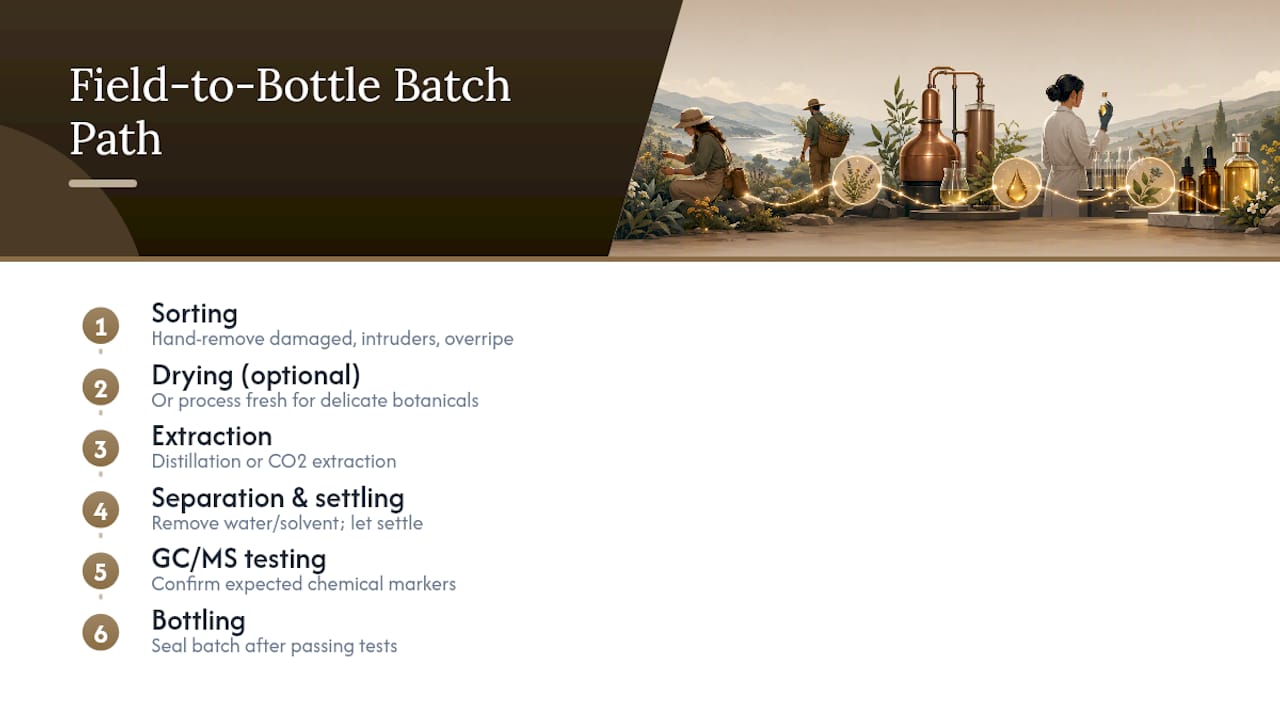
Most explanations of essential oil production jump straight from “harvest” to “distill,” skipping steps that determine final quality. After collection, plant material typically passes through sorting, where damaged leaves, off-species intruders, and overripe material get pulled by hand.
Some botanicals, particularly resins and certain leaves, go through a drying or wilting stage before extraction. Drying reduces water content, which concentrates the aromatic compounds and, for some species, actually improves yield. Other plants, like fresh citrus peel or delicate florals, need to go straight from harvest to processing because drying would destroy the exact volatile compounds worth capturing.
The raw output, whether distillate or CO2 extract, then gets separated from water or solvent residue and left to settle before it’s tested. Only after GC/MS confirms the batch matches expected chemical markers does the oil move to bottling. Skipping any one of these intermediate stages, rushing a drying period or extracting too soon after harvest, shows up later as a thinner, less accurate scent profile.
Why Wild Harvesting Plays by Different Rules Than Farming
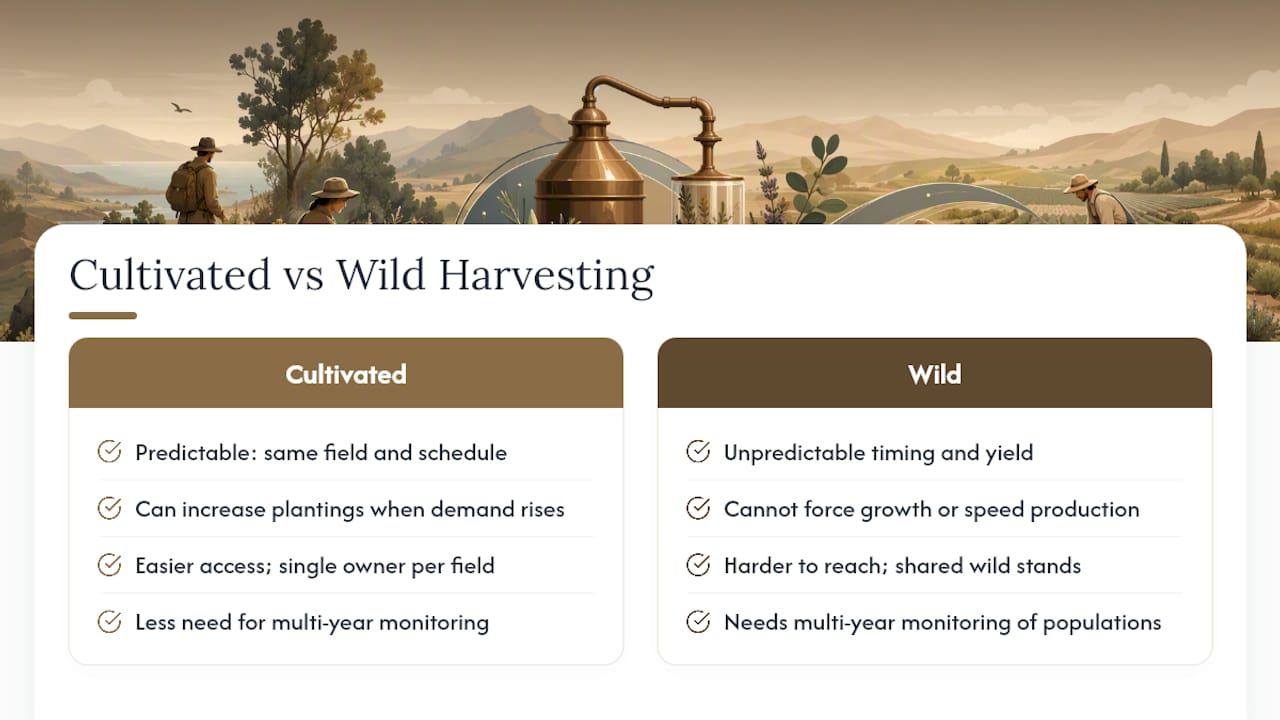
Cultivated crops offer predictability: same field, same irrigation, same harvest window every year. Wild harvesting offers none of that, which is exactly why it demands more oversight, not less.
A cultivated lavender farm can plant more when demand rises. A wild stand of a desert botanical can’t simply be told to grow faster. That’s the core tension: wild plants often produce oils with more complex, terroir-driven chemical profiles precisely because they’ve adapted to specific, unmanaged conditions, but that same unmanaged growth makes overharvesting a real risk if nobody is tracking population health across years.
Access is another difference entirely. Wild stands often grow on terrain that’s harder to reach and harder to protect, meaning harvesters need real knowledge of the landscape, not just a planting schedule. And because no single farmer owns a wild population, coordination between multiple harvesters or cooperatives becomes necessary to avoid the classic tragedy-of-the-commons problem, where everyone takes a little and the total adds up to too much.
The upside of getting it right is real. Wild plants that have survived drought, poor soil, and competition tend to concentrate more defensive compounds, the very molecules responsible for much of an essential oil’s aroma and activity. Multi-year monitoring of the same wild population, tracking bloom density, plant health, and regeneration between seasons, is the only reliable way to know if harvest levels are sustainable, and it’s a discipline cultivated farming simply doesn’t require.
How Weather and Season Change What Ends Up in the Bottle
The same species picked in two different years can produce noticeably different oil. Rainfall, temperature swings, and even the specific week of bloom all shift the ratio of chemical compounds a plant produces, which is why professional buyers ask for the harvest year, not just the species name.
A dry season often concentrates aromatic compounds because the plant produces less overall biomass relative to its oil content, while a wet season can dilute that same profile even from the identical patch of land. Altitude and sun exposure compound the effect. Two harvests of the same plant from opposite sides of a hill, one shaded and one full sun, can differ enough in scent that an experienced nose can tell them apart blind.
Yield follows the same unpredictable pattern. A bumper bloom year might triple the raw plant material available, but the extracted oil percentage per kilogram of plant matter can actually drop, since rapid growth sometimes comes at the expense of concentrated oil production. This is part of why wild-harvest oils, done right, get labeled by harvest year and region rather than sold as an interchangeable commodity. A brand willing to tell you this year’s Cypress oil is a touch more resinous than last year’s isn’t hedging. It’s being accurate about a genuinely variable natural product.
How Local Rules Shape What Reaches Your Shelf
Wild harvesting doesn’t happen in a regulatory vacuum, even when it feels remote from any government office. Land access rules determine which areas harvesters can legally collect from, and those rules vary significantly by region and by whether the land is communal, private, or protected.
In the United States, food-contact botanical handling can fall under produce safety standards like 21 CFR Part 112, and AHPA’s guidance specifically flags when wild-collected material needs to meet those same standards as cultivated produce. That matters for any oil marketed with wellness or ingestion-adjacent claims, since the bar for handling and documentation gets higher.
Beyond formal law, voluntary frameworks like GACP (Good Agricultural and Collection Practices) and GMP (Good Manufacturing Practices) set expectations that go beyond what any single government requires, covering everything from collector training to batch documentation. Certifications built on principles like those from UEBT (the Union for Ethical BioTrade) or the SAI Platform push further still, asking brands to document not just legality but fairness to the communities doing the harvesting. None of these frameworks are legally mandatory everywhere, which is exactly why the presence of one, batch tracking, collector training records, community benefit-sharing, tells you a brand chose accountability rather than being forced into it.
What Sets Florastina Oils Apart from Other Wild-Harvest Options
Plenty of essential oil brands source wild botanicals. What varies enormously is how directly they can trace that sourcing back to a specific harvester and hillside, and Florastina’s approach through Palinova leans hard into that traceability rather than treating origin as a footnote.
The practical benefit shows up in consistency of information, not just marketing language. A bottle of Achillea fragrantissima, a desert botanical with a sharp, herbaceous profile used in traditional Palestinian wellness practices, comes with a specific regional story rather than a generic “Middle Eastern” origin claim. That specificity matters for anyone trying to understand why one batch smells slightly different from the last: the answer is usually a named hillside and a named season, not a shrug.
Botanicals rooted in Palestinian agricultural heritage also offer scent and chemical profiles that simply don’t exist in oils sourced from more commonly farmed regions. Wildcrafted Cypress carries a resinous depth shaped by terrain most commercial cypress plantations never encounter. For enthusiasts who care about the difference between a mass-produced oil and one tied to a specific wild landscape, that terroir-driven variation is the entire point of buying wild-harvested over cultivated in the first place.
Author Perspective: Ethical Sourcing as Both Principle and Practice
Community-first sourcing and biodiversity protection aren’t separate goals. Fair pay keeps harvesters invested in long-term regeneration instead of short-term stripping. When you buy a wild-harvest oil, ask for the batch report and the harvest region. If a brand can’t answer, that tells you something.
— abdelmuhsen
Where to Buy Florastina Oils Through Palinova
Palinova sells the Florastina line directly, with full traceability behind every bottle rather than vague sourcing language. If you want to start with a proven wild-harvest classic, Wildcrafted Cypress Essential Oil is steam-distilled and carries the resinous depth typical of terrain-grown cypress. For something distinctly regional, the Achillea fragrantissima Essential Oil offers a sharp, herbaceous desert profile you won’t find in commercially farmed alternatives.
If skincare is the goal rather than aromatherapy, Barbary Fig Seed Oil is Palinova’s flagship anti-aging seed oil, cold-pressed from prickly pear seeds and prized for its high vitamin E and essential fatty acid content.
Not sure which oil fits your situation? Palinova offers a free aromatherapy consultation covering skin type, wellness goals, and safe dilution ratios for your specific needs. Book a consultation before your next order and get a recommendation tailored to what you’re actually trying to solve.
Sources
FAQ
What essential oils should you not mix together?
Avoid combining strong oxidizing oils like citrus with highly sensitizing oils like cinnamon bark or clove on the same skin application, since the irritation compounds rather than cancels out. When blending for scent rather than skin application, most oils can be combined safely in small test amounts first.
What is the highest quality essential oil company?
No single company holds an official “highest quality” title, since no governing body issues that ranking. The better question is whether a brand provides Latin names, harvest origin, and GC/MS batch reports. Palinova provides all three for its Florastina line.
How do you extract essential oils from a plant?
Steam distillation, cold pressing, solvent extraction, and CO2 extraction are the four primary methods, and the right choice depends on the plant’s own chemistry. Robust herbs and woods typically suit steam distillation, while delicate flowers and resins often need gentler CO2 or solvent methods.
What is the 30/50/20 rule for essential oils?
That figure refers to top, middle, and base note proportions in perfume blending, not a dilution or safety guideline. For skin safety, general dilution guidance runs closer to 2 to 3% oil in a carrier oil for adult use.
How can you tell if an essential oil is genuinely wild-harvested and pure?
Check for the plant’s Latin name, a specific country and region of origin, the extraction method used, and a batch number tied to a GC/MS report. Marketing terms like “therapeutic grade” carry no regulatory meaning and don’t substitute for that documentation.
Recommended


Comments