
Match Bottle Lot to CoA to Verify Essential Oil Purity Without a Lab

GC‑MS is the baseline test for verifying essential oil purity, and it’s what any credible Certificate of Analysis should include. When results are ambiguous or the oil is high‑value, chiral gas chromatography and isotope ratio mass spectrometry catch what GC‑MS misses. For a consumer, the real verification step isn’t running your own lab work. It’s matching a batch‑specific, third‑party CoA to the lot number on your bottle. Home tests like freezing or blotting paper can’t prove any of this.
TL;DR:
Most oils only require GC‑MS and GC‑FID testing, which detect species fraud, dilution, and synthetic adulteration at a moderate cost and turnaround time.
Chiral GC and IRMS are necessary mainly for high-value oils, where enantiomer ratios and isotope signatures reveal synthetic addition or geographic origin deviations.
Physical tests like refractive index, specific gravity, and optical rotation offer quick, low-cost checks but can be fooled by sophisticated adulteration.
Contaminant panels for pesticides, heavy metals, residual solvents, and microbes are essential for safety, especially when oils are used on skin or ingested.
Verifying a batch CoA matches the lot number on your bottle is the most critical step for confidence in oil purity, as many issues stem from documentation mismatches.
Table of Contents
What Are the Four Levels of Essential Oil Purity Testing?
Purity testing isn’t one test. It’s a ladder, and where you land on it depends on how much certainty you need and how much you’re willing to pay for it.
Tier one is quick screening. Think refractive index, specific gravity, or a fast ATR‑FTIR scan. These run cheap, often under an hour, and they catch obvious problems: an oil bulked out with vegetable oil, or one that’s clearly the wrong species. They can’t catch a skilled adulteration job.
Tier two is routine lab profiling, the GC‑MS and GC‑FID work that forms the backbone of most commercial CoAs. This is where a lab identifies the actual chemical makeup of the oil, compound by compound, and checks it against known reference ranges. Turnaround is usually days, not hours, and cost scales with how many compounds get reported.
Tier three is advanced forensic testing: chiral GC for enantiomeric ratios and IRMS for isotope signatures. These get called in when GC‑MS results look fine but something still feels off, or when the oil in question (rose, sandalwood, bergamot) is valuable enough that fraud is worth the effort for a bad actor. Expect higher cost and longer wait times, and not every lab offers them.
Tier four runs alongside any of the above: contaminant panels. Purity isn’t only about what’s supposed to be in the bottle. It’s also about what shouldn’t be there.
Pesticide multi‑residue screening for oils sourced from conventionally farmed crops
Heavy metal testing (ICP‑MS) for lead, arsenic, cadmium, and mercury
Residual solvent testing (GC) for oils extracted with hexane or similar solvents
Microbial testing for oils intended for topical use on compromised skin
A buyer’s first question is usually “how much does this cost and what does it actually prove?” Tier one answers that in an afternoon for the price of a coffee. Tier three can run into hundreds of dollars per sample and take weeks, which is exactly why it’s reserved for oils where the financial or safety stakes justify it.
How Does GC‑MS Prove an Essential Oil Is Pure?
GC‑MS is really two instruments working in sequence, and understanding that split makes the report far less intimidating. The gas chromatography (GC) part separates the hundreds of aromatic compounds in an oil by how fast they travel through a column, essentially sorting a crowd by how quickly each person walks. The mass spectrometry (MS) part then identifies what each separated compound actually is, by breaking it into fragments and weighing the pieces.
On a report, three columns matter most: the compound name, the percentage area (how much of the total sample that compound represents), and the retention time (when it eluted from the column). A lavender oil report showing linalool at 25 to 38 percent and linalyl acetate at 25 to 45 percent sits inside the range most labs treat as normal for Lavandula angustifolia. Peppermint oil should show menthol as the dominant compound, typically in the 30 to 55 percent range, with menthone and menthyl acetate following behind. If a “peppermint” sample comes back heavy on synthetic-leaning fillers and light on menthol, something’s wrong with the bottle, not the test.
Pro Tip: Ask the seller for both the GC‑FID and GC‑MS sections of the report, not just a summary page. GC‑FID gives more reliable quantification (the percentages), while GC‑MS gives identification. Together they cross-check each other; alone, either one leaves a gap.
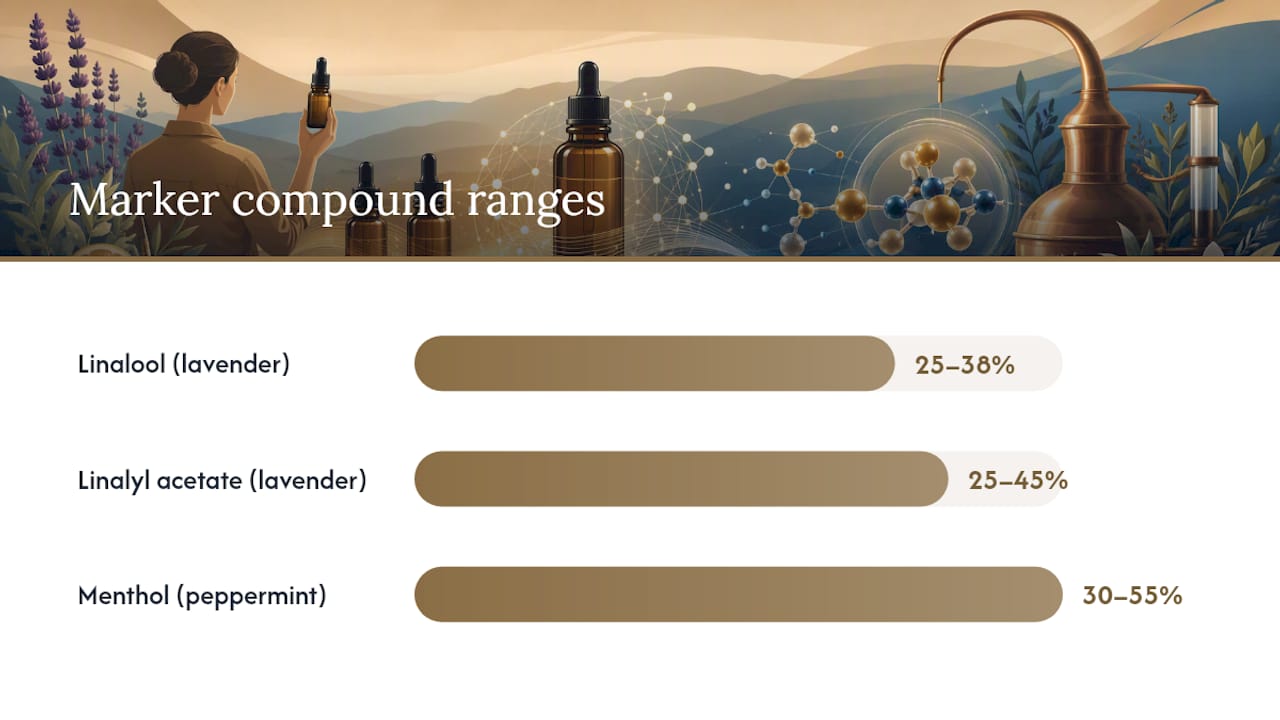
Reference ranges for these marker compounds come from ISO monographs and pharmacopeia standards, which is why ISO’s essential oil committee publishes chromatographic profile methods labs lean on for comparison. GC‑MS is widely treated as the primary authentication tool for routine screening, and for good reason: it catches wrong species, gross dilution, and most obvious synthetic additions.
Here’s the blind spot nobody likes to talk about: a molecule made in a lab and a molecule made by a plant can be chemically identical. GC‑MS reads a molecule’s identity and quantity, not its origin. A synthetic linalool added to bulk up a lavender oil will show up in the linalool column looking exactly like the real thing, sitting inside the “normal” range, while quietly displacing the oil’s authentic minor constituents. That’s the gap the next tier of testing exists to close.
Compound identity and percentage, read together, catch dilution and species fraud
Retention time confirms the lab is reporting the right peak, not a lookalike
Reference ranges come from ISO and pharmacopeia standards, not each lab’s guess
Synthetic and natural versions of the same molecule are functionally invisible to GC‑MS
When Do You Need Chiral GC or IRMS Testing?
Most molecules in essential oils exist as one of two mirror-image forms, called enantiomers, and plants almost never make them in equal amounts. A real lavender oil might contain linalool that’s 99 percent one enantiomer and 1 percent the other, a ratio dictated by the plant’s own enzymes. A synthetic version manufactured in a chemical plant tends to land closer to a 50/50 mix, or at least a ratio nowhere near what nature produces. Standard GC‑MS can’t tell the two forms apart because they weigh the same and behave identically on a normal column. Chiral GC solves that by using a specialized stationary phase, often built from cyclodextrin, that interacts differently with each mirror-image form and physically separates them.
This matters most for a specific list of oils where synthetic fraud is common and profitable:
Lavender, where synthetic linalool and linalyl acetate are cheap to source and easy to blend in
Peppermint, where synthetic menthol shows up in bulk industrial supply chains
Bergamot, prized (and priced) for its natural linalyl acetate content
Rose, where the raw material cost makes adulteration especially tempting
An abnormal enantiomeric ratio is one of the most reliable markers of synthetic addition, and it holds true even when the overall GC‑MS composition percentages fall comfortably within the expected range. That’s what makes chiral GC a forensic tool rather than a routine one: it catches fraud specifically engineered to pass the standard test.
Isotope ratio mass spectrometry (IRMS) works on a different axis entirely. Instead of separating mirror-image molecules, it measures the ratio of stable isotopes, mainly carbon‑13 to carbon‑12, and sometimes hydrogen isotopes. Those ratios shift based on how a plant photosynthesizes and where it grew, which means IRMS can reveal geographic origin and flag synthetic molecules built from fossil-derived carbon, which typically carries a depleted carbon‑13 signature compared to plant material. A “Bulgarian rose oil” that shows an isotope signature inconsistent with Bulgarian growing conditions is a red flag worth chasing down, even if every other number on the report looks clean.
Neither test is cheap or fast, and not every lab runs them. Save chiral GC and IRMS for oils where the price tag justifies the extra step, where origin claims are part of the sales pitch, or where a GC‑MS report comes back looking suspiciously perfect on an oil known for heavy adulteration. For everyday lavender or tea tree at a modest price point, a solid GC‑MS and GC‑FID report is usually enough.
What Do FTIR and Physical Tests Actually Catch?
ATR‑FTIR spectroscopy shines infrared light through a sample and records which wavelengths get absorbed, producing a spectral “fingerprint” unique to that oil’s chemical makeup. Paired with chemometric software (pattern recognition techniques like principal component analysis), it can cluster a batch of samples and flag the ones that don’t match the expected group. Research on FTIR combined with pattern recognition shows it can classify oils and detect gross adulteration at a fraction of the cost and turnaround of full GC‑MS work, which is why it’s gaining traction as a routine screening layer rather than a replacement for chromatography.
For buyers who want a quick gut check before committing to a full lab panel, three physical measurements are worth requesting:
Refractive index, which measures how much light bends passing through the oil and should sit within a published range for that species
Specific gravity (density), a quick check against known values that flags dilution with a heavier or lighter carrier oil
Optical rotation, which measures how the oil rotates polarized light, useful because many natural aromatic compounds are optically active in a specific direction
Compare all three against the numeric ranges on the supplier’s CoA, not against a generic online chart, since acceptable ranges shift slightly by species and extraction method.
Pro Tip: FTIR and physical tests are excellent at catching gross dilution (a lavender oil cut 30 percent with fractionated coconut oil) but weak against sophisticated, low-level synthetic blending. Treat a clean FTIR result as reassuring, not conclusive.
Why Contaminant Testing Belongs in Every Purity Check
An oil can pass every chromatography test with flying colors and still be unsafe if it’s carrying pesticide residue, heavy metals, or leftover extraction solvent. Purity, properly defined, covers both what should be there and what absolutely shouldn’t.
Contaminant testing is a standard component of a complete purity and safety assessment, and the methods differ by contaminant type:
Heavy metals get measured with ICP‑MS (inductively coupled plasma mass spectrometry), sensitive enough to detect trace lead, arsenic, cadmium, and mercury
Pesticide residues get screened with multi‑residue panels that check for dozens of common agricultural chemicals in a single pass
Residual solvents get measured by GC, relevant mainly for oils or extracts processed with hexane or similar solvents rather than pure steam distillation
For an oil going into a diffuser, contaminant thresholds matter less. For an oil going on broken skin, in a bath, or anywhere near food flavoring, they matter a great deal, and the acceptable limits tighten accordingly. If you’re buying for a skincare formulation, ask the supplier directly whether heavy metal and pesticide testing was run on that specific lot, not just “at some point” on the product line. A CoA that only covers chromatography and skips contaminants is telling you half the story.
How Do You Verify a Batch CoA Matches Your Bottle?
A Certificate of Analysis is only as good as its match to the bottle in your hand. A generic CoA, or one from a different production run, certifies nothing about what you actually bought. Here’s the sequence to run every time.
Match the lot or batch number. The number on the CoA needs to match the number printed on your bottle, exactly. This is the single most common gap in supplier documentation, and it’s the first thing to check before reading anything else on the report.
Confirm the analysis date is recent and logical. A CoA dated years before your purchase, or with no date at all, raises questions about whether it reflects the oil currently in the bottle.
Check the full Latin binomial, not just the common name. “Lavender oil” could mean Lavandula angustifolia, Lavandula latifolia, or a hybrid, and each species carries a distinct chemical profile that changes what “normal” looks like on a GC‑MS report.
Verify plant part, extraction method, and country of origin. Steam-distilled peppermint leaf behaves differently than a CO2 extract, and origin affects both chemotype and IRMS expectations if you ever go that far.
Look for a named, external lab and an analyst signature. A CoA generated in-house with no third-party lab name attached carries far less weight than one signed by an independent, accredited facility.
Confirm both GC‑FID and GC‑MS sections are present. Reports with only a summary paragraph and no compound-by-compound data give you nothing to actually verify.
Cross-check marker compounds against published reference ranges. Compare the percentages against ISO or pharmacopeia ranges, or at minimum a reputable published range for that species, and flag anything outside the expected band.
If a number falls outside range, don’t assume fraud automatically. Natural variation from harvest year, climate, and growing region shifts these numbers slightly from batch to batch, which is part of why essential oils vary between brands even when both are genuinely pure. What you want is a supplier willing to explain the deviation, not one who deflects the question.
A lot number match is non‑negotiable; everything else is secondary to this one check
An unnamed lab or missing analyst signature is a legitimate reason to ask more questions
A supplier who can’t produce a lot‑matched CoA on request is a signal worth taking seriously
Can Home Tests Prove an Essential Oil Is Pure?
They can’t, not against modern adulteration, and it’s worth being blunt about that. The three most common DIY checks, the paper blotter test, the freezer test, and the smell test, were designed to catch crude dilution with vegetable or mineral oil. Sophisticated adulteration today is often engineered specifically to pass those basic checks, which means an oil can leave a “clean” blotter mark or smell convincingly authentic while still containing synthetic fillers a lab would catch in minutes.
That doesn’t mean home checks are worthless. They’re just a different category of check.
Read the label carefully for the full Latin binomial name, not a vague common name
Check the bottle material since genuine essential oils oxidize in clear glass and reputable brands package them in amber or cobalt glass
Look up the lot number on the seller’s website before buying, if that option exists
Compare the price against typical market rates for that species; sandalwood or rose priced like lavender is a red flag before you even open the bottle
Once you’ve run those quick checks and something still feels inconsistent, that’s the moment to stop guessing and send a sample to a lab, or simply request the batch CoA directly from the seller. Home tests are a filter for obvious problems, not proof of purity.
How Does Palinova Document Its Essential Oil Quality?
Transparent sellers make batch documentation easy to find, not something you have to fight for. That means lot‑searchable CoAs, a named third‑party lab on the report, and clear origin metadata (plant part, extraction method, growing region) attached to each product listing rather than buried in a generic brand-wide PDF.
Palinova publishes buyer-facing guidance on exactly what to check before purchasing, including a GC/MS-first checklist for verifying oil quality and a list of questions to ask any supplier about GC/MS, SDS, and origin documentation. Those same questions work regardless of who you’re buying from.
A practical template to send any seller: “Can you provide the batch CoA matching lot number [X], including GC‑FID and GC‑MS data, the analyzing lab’s name, and the country of origin for this specific run?” A seller who answers quickly and specifically is telling you something. One who deflects or sends a generic document is telling you something too.
Matching Test Rigor to Real Buyer Risk
The instinct to demand chiral GC and IRMS on every bottle is understandable, but it’s not how risk actually works in this market. A $12 lavender oil for a diffuser and a $180 rose otto for a skincare formulation carry wildly different fraud incentives, and the testing effort should scale accordingly.
For most everyday purchases, documentary verification does more work than people give it credit for. A lot‑matched CoA from a named lab, checked against published reference ranges, filters out the overwhelming majority of bad actors without you spending a dollar on your own testing. Save chiral GC and IRMS for the oils where origin claims drive the price, or where a GC‑MS report looks a little too clean for a species known for heavy adulteration.
This week’s realistic move: pick one oil currently in your cabinet, find its lot number, and email the seller asking for the matching CoA. What comes back, or doesn’t, tells you more than any home test ever will.
— abdelmuhsen
A Transparent Alternative for Sourcing Essential Oils
If you’ve read this far, you already know the real fix isn’t running your own GC‑MS panel. It’s buying from sellers who make batch verification easy in the first place. Palinova takes that approach with its Palestinian-sourced essential oil line, publishing origin and extraction details on product pages rather than leaving buyers to guess.
Palinova isn’t a testing lab, and it doesn’t claim to be one. What it offers instead is sourcing transparency rooted in Palestinian agricultural heritage, direct support for the growers behind each bottle, and product listings, like the Achillea Fragrantissima Essential Oil or the Origanum Syriacum (Za’atar) Essential Oil, that include the botanical and origin detail this article recommends checking before you buy. Some sellers offer aromatherapy consultations to help match oils to specific health or skincare needs. Browse the full essential oils and skincare collection and reach out to the team to request batch documentation on any product before you order.
Sources
For readers who want to go deeper into the lab methods and standards covered here, a few sources stand out. Contract Laboratory’s guide to essential oil testing covers GC‑MS, chiral GC, IRMS, and contaminant panels in detail. The MDPI study on FTIR spectroscopy documents how chemometric pattern recognition performs as a rapid screening method. ISO’s technical committee page lists the standards labs reference for chromatographic profiles and physical property ranges. For the regulatory picture in the United States, Taking Charge of Your Wellbeing and the FDA both explain why “pure” carries no legal definition on a bottle label.
Essential Oil Testing: A Guide to Quality, Purity, Methods, and Regulations — Contract Laboratory
FAQ
How can you tell if an essential oil is 100% pure?
No single home check proves purity with certainty, since the term “pure” carries no legal definition in the United States. The reliable path is a batch‑specific CoA showing GC‑MS and GC‑FID data from a named third‑party lab, matched to the lot number on your bottle.
Which brands of essential oils are 100% pure?
No brand can legitimately claim absolute purity as a regulated fact, since the FDA doesn’t pre‑approve or define that label term for essential oils. What matters more is whether a brand publishes lot‑matched CoAs and origin details; Palinova, for example, publishes GC/MS-focused buyer guidance alongside its Palestinian-sourced product line.
How can you tell if essential oils are good quality?
Quality shows up in the details on the CoA: marker compounds sitting within published reference ranges, a full Latin binomial rather than a vague common name, and named extraction method and origin. A quality oil also passes contaminant screening for pesticides, heavy metals, and residual solvents where relevant to its use.
How do you test if oil is pure?
Start with the CoA the seller provides, confirming the lot number matches your bottle and that GC‑MS and GC‑FID sections are included. For deeper verification on high‑value oils, chiral GC checks enantiomeric ratios and IRMS checks isotope signatures, both of which catch synthetic tampering that basic chromatography can miss.
Recommended

Comments