
Steam Distillation Explained: From Plant Material to Oil
- Palinova

- 1 day ago
- 17 min read
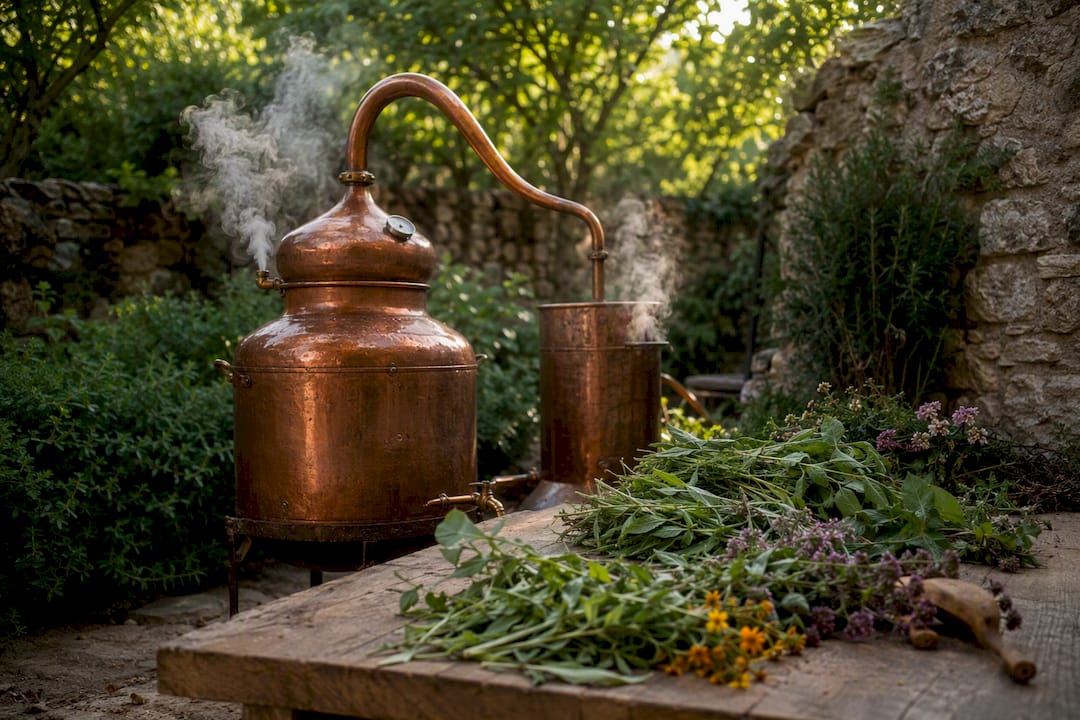
Steam distillation turns plant material into essential oil by using hot vapor to pull volatile aromatic compounds out of plant cells, then cooling that vapor back into liquid so the oil separates from the water. It’s the oldest industrial extraction method still in wide use, and it remains the standard for most of the essential oils on shelves today.
Steam passes through or over plant material, rupturing the tiny glands and sacs where aromatic compounds sit, and carries those compounds along as vapor to a condenser.
Once condensed, the liquid separates into two layers: essential oil, which is largely immiscible with water, and hydrosol, the fragrant water left behind.
Steam distillation is favored precisely because it protects heat-sensitive aromatics that would degrade under direct high heat, according to the American College of Healthcare Sciences. That’s the whole mechanism in a sentence. The rest of this explainer covers how to actually run the process, why the physics works the way it does, and how plant choice and equipment change the result.
Key Takeaways
Steam distillation converts plant material into essential oil by using vapor to release volatile compounds, which then condense and separate from water because oil and water don’t mix.
Point | Details |
Core mechanism | Steam ruptures plant glands, carries volatile compounds to a condenser, then oil separates from hydrosol by density. |
Loading density matters | Pack the still too tight or too loose and steam channels unevenly, cutting yield without warning. |
Physics behind it | Partial vapor pressures combine, letting aromatic compounds vaporize below their individual boiling points. |
Plant part dictates prep | Roots like vetiver need soaking, leaves need light crushing, and delicate flowers need minimal handling. |
Cloudy distillate isn’t failure | Some botanicals form stable emulsions that need solvent extraction or a chilling step to fully recover oil. |
Palinova’s approach | Sources Palestinian botanicals directly and uses artisan steam distillation calibrated to each plant, as seen in its cypress and Aleppo pine needle oils. |
Table of Contents
How the Steam Distillation Process Works Step by Step
Every steam-distilled oil, whether it comes off a copper alembic in a Provençal lavender field or a stainless still in a commercial facility, follows the same basic sequence. What changes between operations is scale, precision, and how much control the distiller has over each stage.
Prepare the plant material. Fresh material generally yields a brighter, more “true to source” aroma, but some botanicals (vetiver roots, orris rhizomes) actually distill better after drying or aging, because that changes how tightly the aromatic compounds are bound in the plant tissue. Chop or bruise tougher material like bark, roots, or seeds to expose more surface area to steam. Leave delicate flowers like jasmine or rose whole, since over-processing can bruise petals and release plant waxes that muddy the final oil.
Load the still with the right density. Pack the plant chamber too tightly and steam channels through gaps instead of moving evenly through the material, a problem distillers call channeling. Pack it too loosely and you waste chamber volume and steam. The goal is even, fluffy loading that lets vapor contact every part of the plant material roughly the same amount.
Generate and introduce steam. There are two common approaches here, and they produce meaningfully different results. Direct steam injection uses an external boiler to generate steam, which then gets piped into the plant chamber, giving the operator precise control over pressure and flow. Hydrodistillation, by contrast, boils water directly beneath or around the plant material inside the same vessel, which is simpler to set up but harder to control and more prone to scorching delicate botanicals near the bottom.
Watch the vapor travel through the system. As steam moves through the plant bed, it picks up volatile oil molecules and carries them up and over into the condenser, following the same basic path outlined in standard lab distillation procedures/05%3A_Distillation/5.05%3A_Steam_Distillation). The condenser, usually a coiled or jacketed tube cooled by circulating water, drops the vapor’s temperature fast enough to turn it back into liquid before it escapes.
Collect and observe the distillate. The liquid drips into a separator, often a Florentine flask or a simple funnel-shaped vessel, where it settles by density. Oil that’s lighter than water floats to the top; oil that’s heavier (a few botanicals, like clove, produce this) sinks and gets drawn off from the bottom. A clear distillate usually signals a clean run. A milky or cloudy distillate often means the water is carrying suspended oil droplets that haven’t coalesced, which is common with high-wax or resin-heavy plants.
Decide when to stop. Most of the oil comes off in the first portion of a run, with yield dropping sharply after that. Distillers typically monitor the rate of oil collecting in the separator and end the run once it slows to a trickle, since running longer mostly wastes fuel and can pull in unwanted heavier compounds along with trace amounts of plant material.
Pro Tip: If your distillate runs cloudy and won’t clear after settling, don’t assume the batch is ruined. Some plants, including juniper berry and certain conifer needles, can release compounds that form a stable emulsion. A slow chill in the refrigerator or a small amount of added salt can sometimes break the emulsion and free the oil.
Commercial operations tend to lean on external boilers rather than boiling water inside the still itself, because it gives far more repeatable steam pressure from batch to batch, an operational detail worth knowing if you ever compare a home setup to a professional one.
Why Steam Distillation Works: The Physics Behind It
The reason steam distillation exists at all comes down to one principle: when two immiscible liquids are heated together, their vapor pressures add up independently, and the mixture boils once that combined pressure equals atmospheric pressure. This is the practical application of Dalton’s law, and it’s why steam distillation can pull oil out of a plant at a much lower temperature than it would take to boil that oil on its own.
Water boils at 212°F (100°C) at sea level. Many essential oil constituents have boiling points well above that, sometimes 300°F or higher if isolated alone. But because water vapor and the oil’s volatile compounds share the same vapor space, their partial pressures combine, and the mixture reaches the boiling threshold at a temperature below either substance’s individual boiling point. According to background on the mechanics of steam distillation, this partial-pressure effect is exactly why co-distilling with steam lets heat-sensitive aromatics escape the plant without scorching.
Here’s the part that trips people up: volatility and solubility aren’t the same thing, and the difference explains why you get two distinct products out of one run.
Volatility determines whether a compound evaporates readily at distillation temperatures. Most essential oil constituents (terpenes, esters, some phenols) are highly volatile and jump into the vapor phase easily.
Solubility determines whether a compound dissolves in water once condensed. Essential oils are mostly non-polar and barely soluble in water, which is why they separate out as a distinct oil layer rather than staying mixed in.
Hydrosols form because a small fraction of the plant’s volatile compounds are water-soluble enough to stay dissolved in the condensed water rather than pooling as oil. That’s not waste; it’s a separate product with its own aroma and mild therapeutic use.
A few concrete examples make this less abstract. Limonene, the dominant compound in citrus peel oils, is highly volatile and almost entirely water-insoluble, so citrus oils separate cleanly and quickly. Linalool, common in lavender and coriander, behaves similarly but partitions slightly more into the water phase, which is part of why lavender hydrosol has real aromatic character of its own. Eugenol, the backbone of clove oil, is denser than water, which is why clove oil sinks in the separator instead of floating, a detail that surprises a lot of first-time distillers who assume all essential oils float.
None of this requires a chemistry degree to use practically. If you understand that steam lowers the effective boiling point of aromatic compounds and that oil and water separate because they don’t mix, you understand why the entire process works the way it does, and you can reason through most troubleshooting from there.
Equipment and Operating Parameters That Shape the Oil
The still you use and the pressure you run it at aren’t just logistics. They directly shape the aroma, yield, and chemical makeup of the finished oil, and getting them wrong is the single most common reason home distillers end up disappointed with their first batches.
Three main still designs dominate the field. Pot stills, sometimes called hydrodistillation setups, boil water directly with the plant material inside one chamber, and they’re the simplest and cheapest option but offer the least control over scorching. Direct steam stills separate the boiler from the plant chamber, piping steam in through a perforated plate or grid, which gives much better temperature uniformity and is standard in most commercial operations. Clevenger-type apparatus, common in labs and small research batches, uses a self-contained reflux system that returns excess water to the boiling flask automatically, useful for repeatable small-scale extraction where you need consistent, measurable results rather than volume.
Steam pressure and temperature ranges vary by design and scale, but the underlying tradeoff is consistent across all of them: higher pressure and temperature speed up the run and increase raw yield, while lower and gentler settings preserve more of the delicate top-note compounds that give an oil its brightest character. Distillers working with tough material like roots, bark, or seeds generally push higher pressure since those compounds are more heat-stable. Distillers working with flowers or citrus peel tend to run cooler and slower to protect fragile aromatic fractions.
Condenser design matters more than most beginners expect. A condenser that’s undersized for the steam volume passing through it won’t cool vapor fast enough, and you lose oil straight out the exhaust. Adequate, steady cooling water flow (not just cool water, but enough volume moving through the jacket) is what keeps the condenser working at capacity through a full run.
Two problems show up again and again in real operation:
Foaming, where plant material with high mucilage or protein content creates froth that gets carried into the condenser and clogs the line, usually solved by reducing steam pressure or loading less tightly.
Channeling, where steam finds a path of least resistance through unevenly packed material and bypasses large sections of the plant bed, cutting yield without any obvious sign until you notice the run finishing faster than expected with less oil to show for it.
Pro Tip: Keep a simple log for every run: plant weight, pressure, run time, and oil yield. After four or five batches of the same botanical, you’ll start to see your own optimal window rather than relying on generic published ranges that were likely measured on different equipment.
Monitoring checkpoints worth building into any run include distillate clarity at 15-minute intervals, condenser outlet temperature (it should stay cool to the touch throughout), and separator flow rate, since a sudden drop usually means it’s time to end the batch. Patent and literature reviews on industrial steam distillation technology point to steam flow control and condenser efficiency as the two variables most linked to both productivity gains and sustainability improvements at commercial scale.
Which Plant Parts and Harvest Choices Affect Oil Yield
Essential oils don’t sit evenly distributed through a plant. They concentrate in specific structures, glandular trichomes on leaves, oil sacs in citrus peel, resin ducts in bark, and that concentration point dictates how you should process the material before it ever reaches the still.

Flowers like lavender store their oil in small glands right at the surface of the petals, which is why lavender distills relatively quickly and why rough handling before distillation (excess bruising, prolonged storage) can knock off some of that surface oil before it ever reaches the still. Leaves, eucalyptus being the classic case, hold oil in glands embedded slightly deeper in the leaf tissue, so a bit of chopping or crushing helps expose those glands to steam. Roots, vetiver above all, store oil in dense fibrous tissue that resists steam penetration entirely unless the root has been dried and often soaked beforehand, which is part of why vetiver oil is one of the slowest and most labor-intensive oils to produce. Citrus peels hold oil in visible sacs just under the rind’s surface, dense enough that many citrus oils are actually cold-pressed rather than steam distilled, since pressing avoids heat exposure entirely for a fruit-forward profile some producers prefer.
Fresh versus dried material is a real tradeoff, not a simple rule of “fresher is always better.” A few pre-treatment patterns show up consistently across producers:
Fresh processing suits most flowers and leaves, where volatile top notes degrade with storage time.
Drying or wilting helps woody material, seeds, and some roots by reducing water content that would otherwise dilute steam efficiency and slow the run.
Soaking is a specific step used for certain roots like vetiver, softening tissue enough that steam can actually penetrate it within a reasonable timeframe, a practice documented in industry process summaries on commercial-scale distillation.
Fermentation, used occasionally for specific botanicals, changes the chemical profile entirely by allowing enzymatic reactions to generate new aromatic compounds before distillation even begins.
Harvest timing carries its own weight. Plants distilled at peak bloom or peak oil concentration, which varies by species and even by time of day for some flowers, produce noticeably different chemical profiles than the same plant harvested a few weeks earlier or later. Plant stress from drought or poor soil can shift oil composition too, sometimes concentrating certain compounds at the expense of others. Storage after harvest matters just as much: material left sitting too long before distillation loses volatile top notes to simple evaporation, which is one reason sourcing and origin show up so often in serious discussions of essential oil quality.
What Yield to Expect and How Oil-Water Separation Works
Realistic yield expectations save a lot of frustration for anyone distilling at home for the first time. Essential oils are extraordinarily concentrated, and that concentration is exactly why yields look small compared to the raw plant weight going into the still.
Different botanicals require wildly different amounts of raw material to produce a usable amount of finished oil, which is part of why some oils cost far more than others at retail. Rose and melissa sit among the lowest-yielding, heavy-blossom botanicals in the trade, which is a large part of why rose otto commands a premium price. Lavender and peppermint yield considerably more per pound of plant material, landing them at a more accessible price point. This yield difference alone explains most of the price spread you see across an essential oil shelf, more than brand, packaging, or marketing ever does.
The hydrosol collected alongside the oil isn’t a byproduct to discard. It carries a different, gentler concentration of water-soluble aromatic compounds and gets used on its own in skincare, cooking, and light aromatherapy applications, since its dilution is naturally much lower and safer for direct skin contact than the essential oil itself.
A milky or cloudy distillate signals that some oil is suspended in the water as fine droplets rather than separating cleanly. According to standard lab distillation procedures, some botanicals produce distillates that won’t fully clear on their own and require solvent extraction followed by rotary evaporation to recover the trapped oil completely, a practical reason some commercial producers choose solvent or CO2 extraction for particular high-wax or resin-heavy plants instead of pushing steam distillation to its limits.
Finishing the oil after collection matters just as much as running the still correctly:
Drying with an anhydrous salt like sodium sulfate removes residual water that can cause an oil to go cloudy or accelerate oxidation in storage.
Filtration through fine paper or cloth clears out any remaining plant particulate before bottling.
Basic quality checks, smell, color, and clarity against a known reference sample, catch obvious problems before an oil ever reaches a customer.
How Distillation Choices Shape Final Oil Quality
Every parameter you control during a run trades speed against fidelity to the plant’s original aroma. Push temperature and pressure higher and you finish faster with more raw yield, but you risk cooking off the most delicate top-note molecules or generating breakdown artifacts that weren’t present in the living plant. Run cooler and slower and you protect those fragile compounds, but the process takes longer and sometimes yields slightly less.
Overheating shows up in the finished oil as a flat, sometimes slightly burnt or “cooked” character, distinct from the bright, layered scent the same plant would produce under gentler conditions. Long runs carry a related risk: after the bulk of volatile oil comes off early, continuing to push steam through the plant bed mostly pulls in heavier, less desirable compounds and can concentrate trace bitter or waxy notes that dilute the overall quality.
Steam distillation isn’t the right tool for every botanical, and knowing when to reach for an alternative is part of doing this well. As the Tisserand Institute points out, extraction is as much a craft as a science, and the final quality of any oil depends heavily on the raw material and the skill of the person running the process, not the method alone. Delicate florals like jasmine and tuberose, where heat destroys too much of the character, are typically solvent-extracted into an absolute instead. Resins and some spices sometimes go through CO2 extraction, which avoids heat and water entirely and often produces a fuller aromatic profile. Citrus peels, as noted earlier, are frequently cold-pressed rather than steam distilled, preserving a fresher top note than steam would allow.
Quality control doesn’t require a laboratory to start. Sensory evaluation, smell and visual clarity against a trusted reference, catches most obvious problems immediately. Specific gravity and refractive index measurements, simple enough for a small producer to run with basic equipment, give a numeric fingerprint that can be compared batch to batch. For anything sold commercially or used in sensitive applications, gas chromatography analysis from a third-party lab is the only way to confirm the actual chemical composition rather than relying on smell alone, and buyers researching brand-to-brand variation will often find this is exactly where quality gaps show up.
Pro Tip: If an oil smells noticeably different from batch to batch even though you sourced the same plant, check your run time and temperature logs before blaming the plant material. Process drift is a far more common culprit than most people assume.
How Palinova Applies These Principles in Production
Everything covered so far, the loading density, the steam parameters, the plant-specific pre-treatments, plays out in real production runs, not just in theory. Palinova sources botanicals directly from Palestinian agricultural land and distills them using artisan methods that stay close to traditional practice rather than defaulting to the fastest, highest-yield settings a still can run.
Take the brand’s Aleppo Pine Needles process as a working example. Conifer needles are dense, resinous material that channels easily if packed wrong and can scorch if pushed too hot, so getting a clean, bright pine oil instead of a flat, resinous one depends on exactly the loading and temperature discipline outlined earlier in this article. The same logic applies to the brand’s cypress essential oil, a woody botanical where run time and steam control determine whether the finished oil reads as sharp and green or heavy and dull.
Ethical sourcing and traditional distillation aren’t separate from oil quality. They’re the reason a given batch smells like the plant it came from rather than a generic, over-processed version of it.
Readers evaluating any producer’s oils, not only Palinova’s, should look for a few specific checkpoints on a product page before buying:
Plant origin, stated specifically rather than vaguely, since terroir genuinely changes chemical composition.
Distillation method, disclosed rather than assumed, since steam distillation, cold pressing, and solvent extraction produce meaningfully different products even from the same plant.
Batch or lot information, which signals a producer tracking consistency run to run rather than blending indiscriminately.
[
Where Steam-Distilled Oils Are Used and How to Handle Them Safely
Aromatherapy, perfumery, cosmetics, and food flavoring all lean on steam-distilled oils specifically because the method produces a cleaner, more complete aromatic profile than most alternatives, without solvent residues to worry about. That purity is part of why steam distillation remains preferred for efficiency and high output quality across most commercial extraction operations rather than being treated as an old-fashioned holdover.
Using these oils safely comes down to a short list of practices that matter regardless of which oil you’re handling:
Dilute before skin contact. Essential oils are concentrated enough that undiluted application routinely causes irritation, and a carrier oil at a modest percentage is standard practice.
Watch for photosensitivity with citrus oils in particular, since some citrus constituents increase sun sensitivity for hours after skin application.
Store oils in dark glass away from heat and light, since exposure accelerates oxidation and shortens shelf life.
Avoid ingestion unless you’re following specific, regulated medical or culinary guidance, since internal use carries risks that topical or aromatic use doesn’t.
If you’re considering commercial sale or any distillation beyond small personal batches, check your local and state regulations first. Rules around labeling, production volume, and sale vary, and it’s worth confirming your specific situation rather than assuming a home hobby scales legally without any paperwork.
Home distillation is genuinely fun to experiment with, but it rarely matches commercial results, mostly because consumer-grade stills can’t hold steam pressure and temperature as precisely as industrial equipment, and small batch sizes make quality control harder to nail down consistently. The bigger issue is safety: pressurized steam systems built without proper relief valves or pressure ratings can fail dangerously. If you’re distilling for inhalation-based applications like steam therapy rather than oil extraction, safe steam inhalation practices are worth reviewing before you experiment on your own equipment.
Useful Sources for Further Reading
For readers who want to go deeper into the technical side, a few sources stand out for their practical detail rather than surface-level summaries.
The American College of Healthcare Sciences breaks down distillation quality factors in plain language aimed at aromatherapy students. Chemistry LibreTexts offers the clearest lab-level procedural walkthrough available online, useful if you’re setting up a small still yourself. The MDPI review of steam distillation patents is the strongest source for anyone curious about industrial-scale technology and sustainability improvements. The Tisserand Institute’s extraction guide gives useful context on when steam distillation loses out to solvent or CO2 methods.
A Straight Take on What Actually Matters Here
Most explainers on this topic get so caught up in the romance of copper stills and ancient technique that they skip the part that actually determines oil quality: process discipline. The chemistry is genuinely elegant, but Dalton’s law doesn’t care whether your still is beautiful. It cares whether your steam pressure, loading density, and run time are dialed in consistently.
The conventional advice to just “distill low and slow for the best quality” oversimplifies things. Some botanicals, dense roots and bark especially, need more aggressive parameters to yield anything worthwhile at all. The real skill is matching conditions to the specific plant in front of you, not applying one universal rule.
If you take one thing from this, prioritize understanding your raw material before you touch the temperature dial. A perfect still setup can’t fix plant material that was harvested at the wrong time or stored too long before distillation. That’s where quality is actually won or lost, long before the steam ever touches the plant.
— abdelmuhsen
Sources
Reading about steam distillation is one thing. Having oils on hand that were actually made this way, with attention to loading density, run time, and plant-specific handling, is another. Palinova distills its collection using artisan methods rooted in Palestinian agricultural tradition, sourcing botanicals directly rather than through anonymous bulk suppliers, so the process choices covered in this article aren’t theoretical for the brand’s own production.
The wildcrafted cypress essential oil is a clear example of a plant that punishes careless distillation and rewards careful steam control, exactly the kind of woody botanical where run time and temperature discipline show up directly in the final aroma. If a warm, resinous evergreen note interests you, it’s worth a look. Beyond that single product, the full Mediterranean botanical essential oil collection gives a wider sense of how these production choices play out across different plant families. Every purchase also comes with access to a free aromatherapy consultation, so if you’re unsure which oil fits your needs, that’s the next step to take before you buy.
FAQ
How does steam distillation extract essential oils?
Steam passes through plant material, rupturing the glands that hold aromatic compounds, and carries those compounds as vapor into a condenser. Once cooled back into liquid, the oil separates from the water because it’s largely immiscible with it.
What is the 20/30/50 rule for essential oils?
This isn’t a standard, established distillation or safety framework, and definitions of it vary widely depending on the source, so it’s best not treated as an authoritative rule for extraction or dilution decisions.
Can I make essential oils at home using steam distillation?
Yes, with a basic still setup you can extract oil from botanicals like lavender or citrus peel at home, but consumer equipment rarely matches the pressure control and consistency of commercial stills, so yields and quality tend to vary more than store-bought oils.
Is it legal to distill essential oils?
Distilling essential oils for personal use is generally allowed, but selling oils commercially or running larger-volume operations can trigger labeling, safety, or production regulations that vary by state, so checking your local rules before scaling up matters.
Recommended

Comments